Evaluate shade cloth by identifying the crop and exposure problem, checking the material’s actual shade rating and planning how it will fit the garden. A darker cover is not automatically a better solution, because it changes the light reaching the plants as well as their heat exposure.
Begin with a specific growing area rather than a whole-yard purchase. You need to understand which plants you intend to cover, when direct sun reaches them and what you will observe afterward.
Keep the evaluation separate from a promise to rescue an unidentified plant problem. Shade cloth is one management option, not a diagnosis of every wilted leaf or a replacement for an appropriate watering decision.
Describe the actual exposure problem
Write down the crop, its stage and the time and conditions when you notice the concern. A young transplant adapting outdoors raises a different question from an established fruiting crop in a prolonged hot period.
Maryland Extension discusses shade cloth as a way to reduce excessive sunlight and heat stress. Its examples include warm-season crops and cool-season plantings, with the growing context retained rather than one rule for every vegetable.
Observe the site before assuming that the visible symptom has one cause. Keep notes about soil moisture, recent weather, physical damage and any change in care, and obtain help when the cause remains unclear.
If you are hardening off starts, follow a crop-appropriate outdoor transition plan. Placing a cloth above a tray does not establish that the plants have completed that separate process.
Identify what the covering is designed to do
Read whether the actual product is shade cloth, insect netting, a row cover or a weather barrier. Similar-looking rolls can be sold for different purposes, so keep the full material description and instructions.
Maryland’s guide discusses row covers, insect barriers and shade cloth as distinct tools. Do not infer an insect-exclusion claim or frost-protection rating from a shade percentage printed on another type of cover.
Look for the manufacturer’s intended application and any relevant mounting requirements. A decorative shade sail intended for people is not automatically specified as a vegetable-growing material simply because it reduces sun below it.
Save the exact product identity while comparing listings. A seller that groups several percentages, colors and sizes on one page requires you to check the selected variant, not just the largest number in the heading.

Read the shade percentage as a light-related specification
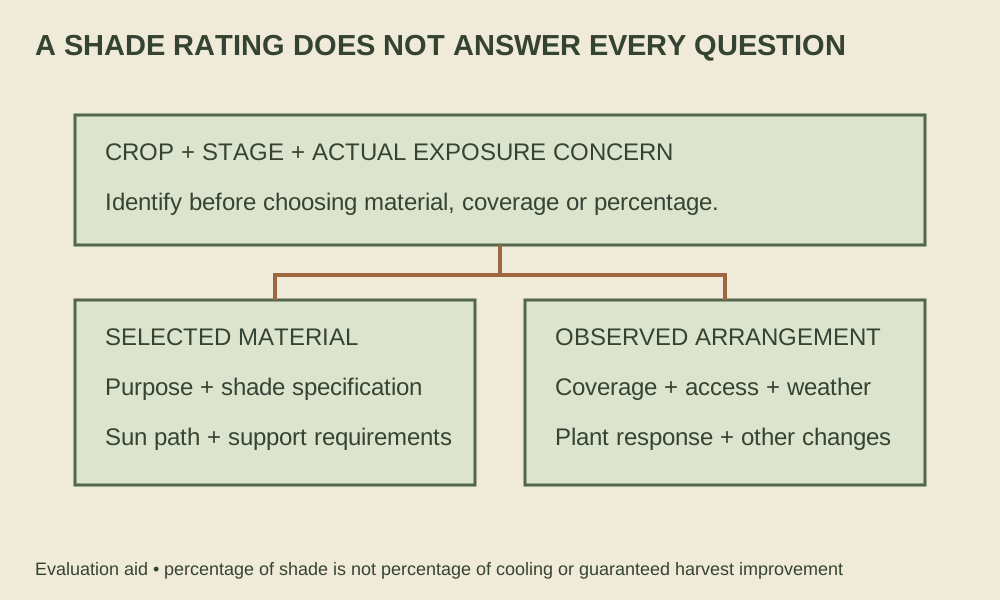
A shade percentage describes the material’s reduction of light under its stated specification. It is not a percentage reduction in air temperature, a predicted yield improvement or a guarantee about the conditions in your garden.
Maryland describes thirty-percent black shade cloth as a research-supported option for reducing heat stress while retaining light in its discussed setting. Read that as an example to investigate for your crop, not a national requirement to buy one percentage.
Delaware Extension also discusses the tradeoff between cooling and blocking light. Its vegetable research found no advantage from the tested colored cloths over black in those experiments, so color alone is not evidence of better results in your yard.
Ask local Extension staff what rating and arrangement fit the crop and conditions you are trying to address. Bring the product description and your site observations so that the advice concerns an identified material.
Map the sun and the proposed coverage
Sketch the planted area and the direction of the sun during the period that concerns you. A flat overhead rectangle on paper does not show whether low-angle sun will still reach the plants from the side.
Mark nearby structures and plants that already cast shade. You may find that only one portion of a bed needs investigation rather than assume the entire planting receives identical exposure all day.
Keep the intended coverage and the support footprint separate. A piece of cloth can be large enough to cover a bed while its planned supports or fasteners still lack an appropriate place to go.
Use instructions suited to the actual material and support system for installation. This planning guide does not supply wind loads, anchoring details or permission to fasten an improvised structure to a fence, building or railing.
Keep access and airflow in the comparison
Plan how you will water, inspect, harvest and reach controls after the cloth is in place. A cover that must be completely dismantled for every visit can turn an otherwise manageable crop into a complicated routine.
Read the actual growing guidance and product instructions about the arrangement around the plants. Do not assume that enclosing the sides more tightly is beneficial simply because the overhead cloth appears to help with one exposure concern.
Keep the material off an unintended heat source or unsuitable support, following its actual limitations. A garden application should not become a reason to ignore how the product is designed to be mounted and maintained.
Consider what you will do when the material is not needed or weather changes. Include removal and storage access before buying a piece whose full size is difficult to handle in your available space.
Evaluate a limited change with useful observations
Write down the arrangement and the conditions before you make a change. If you later notice an improvement or decline, you will have a specific starting point rather than only a memory that the garden looked hot.
Keep other changes visible in the same record. Adding shade, changing irrigation and moving plants at once may be a reasonable practical response, but it prevents you from confidently assigning the result to the cloth alone.
Do not describe a casual backyard comparison as a controlled experiment. You can use observations to adjust your care without claiming that one small trial proves a material’s performance for other crops or locations.
For example, note whether the intended area remains covered at the relevant time and whether routine access still works. Those are direct checks of your arrangement, distinct from a conclusion about future fruit production.
Write a reason for the selected variant
Before checkout, complete a sentence that connects your crop, the exposure period you are addressing and the material you selected. If the explanation is only that the darker panel costs less, return to the crop guidance and light tradeoff before making the purchase.
Keep a rejected option beside the chosen one with the specific reason it did not fit. For example, a panel might have the intended dimensions but the wrong documented purpose, or the appropriate material might require a support arrangement you cannot provide.
This comparison can save you from treating a retailer’s substitute as an automatic upgrade. An item with a larger shade percentage changes the evaluation and should be checked against the crop’s needs rather than accepted because its number is higher.
Compare the complete material and setup
Compare the selected size, shade rating, edge finish and supplied attachment items for the exact product. A lower price for a loose piece is not the same purchase as a finished panel with specified fittings.
Include compatible supports and any items the installation instructions require in your cost note. Do not assume you can borrow an existing plant support for another purpose without checking whether that use is appropriate.
If a retailer substitutes a different percentage or material, revisit the decision rather than treat equal dimensions as equivalence. The feature you are evaluating may have changed even when the panel still covers the same rectangle.
Your finished choice should connect an identified crop concern to a documented material, a suitable arrangement and observations you can actually make. That gives you a practical way to evaluate shade while leaving unsupported temperature and harvest promises out of the decision.