Use first and last frost dates as historical planning references, then combine them with crop requirements, your site and the current forecast. They describe patterns of risk; they do not announce the exact morning a future garden will freeze.
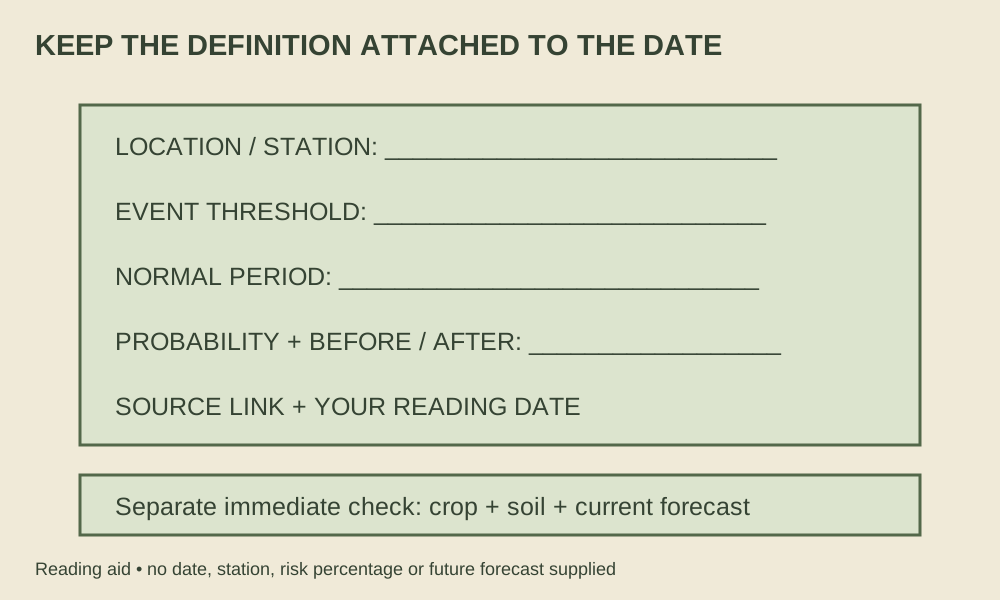
Before copying a date into your notebook, check the location, temperature threshold, data period and probability behind it. Two legitimate sources can show different dates because they are answering different questions.
Keep the reference intact as you plan. A date with its explanation is useful, while a bare number labeled safe can make you more confident than the underlying information supports.
Read what the date actually measures
Look for whether the source describes frost, a temperature at or below freezing, or a colder threshold. Do not assume every chart uses the same definition simply because its title includes the word frost.
The National Weather Service’s Medford page separates frost-potential and freeze thresholds. Its frost-potential examples use temperatures at or below 36 degrees Fahrenheit, while its freeze chart uses 32 degrees or below.
Those are definitions within that resource, not a rule that every garden chart follows. Write down the threshold used in your selected source so that you can compare it with another table without silently changing the event being measured.
Likewise, distinguish an average or median reference from the actual first or last event in a particular year. A historical summary and this week’s forecast provide different information and belong in different places in your plan.
Keep the observation location attached
Find the station, county or area represented by the date. A tool that accepts your ZIP code may still return a nearby station’s record rather than a measurement taken at your back fence.
Maryland Extension notes that frost likelihood varies even within a neighborhood, with wind, elevation, nearby structures and water among the influences. Treat a nearby reference as context while you learn how your own site behaves.
Record the station or area name beside the date, along with the source link. If two tools disagree, compare those details before deciding that one of them must be wrong.
Do not replace a missing local record with the nearest attractive number you find online. Ask your local Extension service or weather office which available information best represents your area and what its limitations are.
Notice the climate-normal period
NOAA’s national last-spring-freeze discussion uses 1991–2020 climate normals, which summarize a thirty-year period. It also explains that actual conditions in any calendar year can vary considerably from that historical pattern.
A resource based on a different period can still be informative, but you should not compare its date with a newer table as though all the inputs were identical. Keep the period visible whenever the source provides it.
For example, the Medford probability page identifies its data as 1981–2010 normals. If you use it to learn how a probability chart works, retain that scope instead of describing its dates as a current prediction for all of Oregon.
Do not average two dates yourself and call the result more accurate. A meaningful comparison starts with their definitions, locations and methods, not just arithmetic performed on the calendar.

Read the direction of the probability
A spring table may describe the chance of another threshold event after a date, while a fall table may describe the chance of an event by a date. Read the heading and explanation before interpreting a percentage.
The Medford spring example shows the remaining chance of another frost-potential event decreasing as the date moves later. A lower listed probability represents less risk under that historical calculation, not a guarantee that the event cannot occur.
Write a short plain-English interpretation next to any percentage you use. If you cannot explain what event, place and time direction it describes, return to the source rather than building a planting schedule around the number.
Also avoid combining the spring and fall percentages into an invented probability of a completely frost-free growing season. Those entries describe particular seasonal events and do not automatically supply that different calculation.
Attach the crop decision to the reference
List the actual crop and whether you are sowing seed, moving a transplant or planning a final harvest. Each action raises a different question, so avoid assigning the whole garden one universal safe day.
Keep soil conditions and crop-specific guidance in the decision. The absence of a predicted freeze does not establish that soil is suitable for a warm-season transplant or that a particular seed will establish well.
For an indoor seed-starting plan, use a locally suitable outdoor target and the exact crop’s instructions to work backward. Do not begin with an early sowing date and assume that a historical frost reference will eventually make the oversized plants convenient to move.
For a fall crop, distinguish time to maturity from time you want available for picking. Consult local crop guidance so that the first-frost reference does not become an unsupported promise of a completed harvest.
Use the forecast for the immediate decision
As planting approaches, read the local forecast and relevant weather alerts. NOAA explicitly directs readers to compare the forecast with climate normals, keeping historical context separate from the weather expected now.
If the forecast conflicts with your intended planting, revise the task rather than arguing with the date in your notebook. You can postpone moving suitable transplants or adjust another planned job while you obtain guidance for the actual crop and conditions.
Do not assume a generic covering erases every cold risk. If protection is part of your plan, learn the limits and appropriate use of that particular method instead of treating its presence as a substitute for checking conditions.
Keep monitoring after you plant, especially early in the season. Maryland emphasizes watching weather reports for unexpected frost even when you have used a historical date to organize the initial schedule.
Compare conflicting dates without picking a favorite
Suppose one tool gives you an earlier spring date than another. Put both entries on a short comparison card and copy their station names, event thresholds and probability descriptions before you look at the dates again.
You may find that one entry summarizes the last freeze while the other represents a different cold threshold or remaining chance of an event. If you cannot establish the definitions, keep the discrepancy unresolved and ask the provider rather than selecting the earlier date because it suits your planned weekend.
Then make the actual crop decision on a separate line, noting the local crop guidance and current forecast you used. This preserves the difference between understanding the historical information and deciding whether to plant; a careful comparison of tables is useful even when you ultimately postpone the task.
Save the explanation with a screenshot or copied link if you expect to revisit it later. A cropped image showing only the date can lose the very heading that tells you which probability and threshold you were using.
Build a useful local record over time
Record what you observed, where you observed it and the date, while keeping your measurements separate from the official station record. A note that one low corner had visible frost is valuable without becoming a complete backyard climate study.
Save the original reference alongside the actual planting date and any change you made. Next year, you can review the reason for the decision instead of remembering only that you planted on a certain weekend.
Your final plan should preserve the historical source and leave room for current conditions. That lets frost dates do their proper job: help you organize a season while you continue making crop-specific decisions in the garden you actually have.