Before buying garden-hose parts, identify the connection at each end, the actual hose size and the component you are replacing. Several measurements can appear in one listing, and a matching fraction does not establish that two parts connect.
Make a short connection record with photographs and model information before you shop. That is more useful than carrying a memory of a brass fitting that looked about the right size.
Keep the task within the garden equipment you can identify. A household plumbing alteration, a backflow requirement or an unfamiliar pressurized system calls for appropriate local advice instead of an improvised adapter stack.
Name the connection you are trying to make
Draw the two components as separate boxes and label what joins them. For example, a hose-to-watering-wand connection is a different job from replacing a cut hose end or connecting equipment that has a pipe-thread port.
Write down whether you need to connect two intact fittings, repair a damaged end or replace a proprietary part. Each task leads to a different product category, even if the finished assembly appears to perform the same watering job.
Keep the actual model numbers on the drawing when available. A manufacturer’s replacement-part list can settle a question more reliably than trying several visually similar pieces at the hardware store.
If the problem is a leak, identify where it occurs before deciding what to buy. A photograph taken while everything is wet may show the symptom without establishing which joint or component is responsible.
Separate hose diameter from thread size
ELEY’s watering-tool FAQ distinguishes hose inside diameter from its end connections. It explains that common North American garden hoses with different inside diameters can use the same nominal three-quarter-inch garden hose thread.
That means a hose described as five-eighths inch can connect to a compatible tool labeled with three-quarter-inch garden hose thread. The numbers describe different features, so do not reject or accept the combination by comparing the fractions alone.
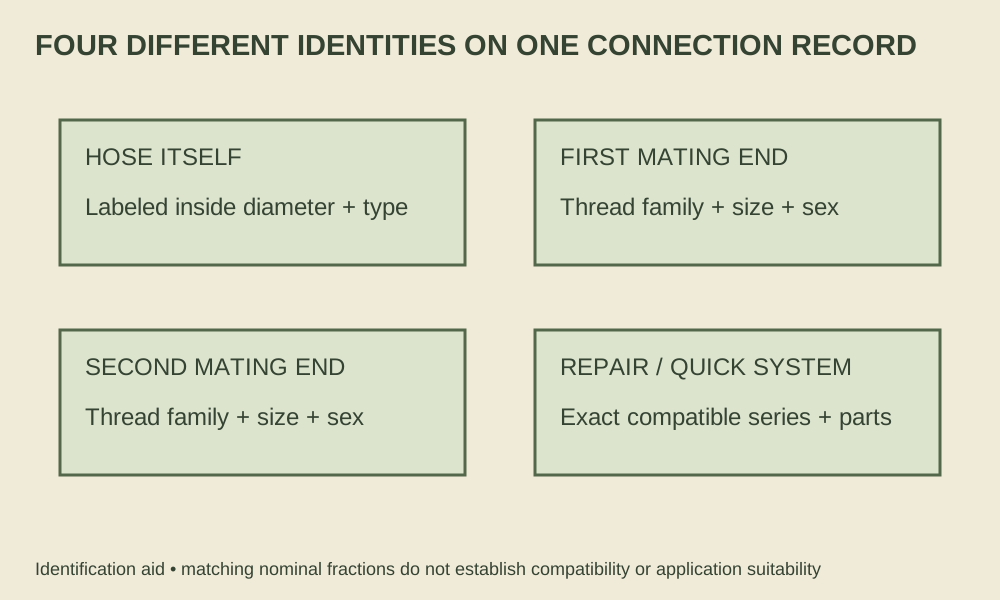
Record the hose’s labeled inside diameter separately from the end fitting’s thread description. If you cannot identify the hose, ask the repair-part manufacturer how it wants the hose measured rather than assuming an outside measurement supplies the missing information.
A hose wall has thickness, and some repair products also depend on the hose construction. Keep a tape or caliper reading labeled with what you actually measured so that an outside diameter does not get reported as an inside diameter.
Identify the thread family
ELEY explicitly cautions that garden hose thread and National Pipe Thread are different, even when both are labeled three-quarter inch. Read the full connection description instead of treating the nominal size as the complete specification.
Record GHT or another identified thread designation exactly as the product documentation states it. Do not assume a fitting has garden hose thread just because it is sold in a garden category or has brass-colored surfaces.
Photograph the fitting from the side and straight toward the opening, with any markings visible. Those views help a supplier understand the part without asking you to estimate a thread from one distant photograph.
Do not force parts that fail to engage normally or treat thread sealant as a way to make unrelated thread families compatible. Stop and establish the correct connection before damaging both components.


Describe both mating ends
Write down which side has external threads and which has internal threads, using the manufacturer’s male and female descriptions when those are available. An adapter listing often describes two ends, so read both before adding it to your cart.
Also note whether a nut swivels, whether a quick connector is involved and whether a valve or another component is integrated. These details can change what must move when you attach or remove the hose.
Dixon’s garden-hose fitting range lists distinct adapters, swivels, quick-connect parts and replacement seals. That variety is a reason to identify the actual assembly rather than assume all small hose fittings are interchangeable.
If a quick-connect system is involved, keep its series and part identity together. Two products described as quick connect have not established that their mating profiles belong to the same system.
Check the hose side of a repair part
A repair coupling connects to the hose itself as well as to whatever fits its finished end. Verify both sides, including the hose type and dimensions the actual repair product requires.
Dixon’s 5751212K example separately lists hose inside diameter and GHT thread size and restricts its push-on fitting to the specified Lok-On hose style. It illustrates why a familiar thread does not make the hose-gripping end suitable for every garden hose.
This is a compatibility example, not a recommendation to use that industrial fitting on your household hose. Follow the exact repair system’s instructions and suitability information rather than borrowing its installation method for another product.
Photograph the damaged end and the hose markings while they are still available. Do not cut away the only identifying information before you know what replacement method you intend to use.
Retain the operating conditions
Read the intended application, working-pressure and temperature information for each selected component. A material description or a high advertised number does not replace the limits and conditions in the actual instructions.
Keep garden watering separate from drinking-water, hot-water or other specialized uses. Do not infer a suitability claim for the complete assembly from the color of its metal or a claim attached to one unrelated component.
Likewise, record any manufacturer instructions for freezing weather and storage. A part that fits today has not thereby been established as safe to leave full of water through winter.
If the assembly connects to a public water supply, confirm local backflow-protection requirements with the relevant provider or qualified installer. Buying an adapter does not answer that separate installation question.
Check an adapter description in two directions
Suppose your existing tool has a documented male GHT connection and your proposed new component has a different documented thread. Write the required mating connection beside each component before searching, then compare every adapter candidate with both requirements.
A listing that matches the first end but says nothing about the second has not completed the check. Similarly, a listing that contains the right two thread names can still describe the wrong male or female arrangement, so read the complete specification rather than relying on search-result wording.
Keep a separate line for any seal, mating half or other required item the manufacturer identifies. If you cannot determine what is supplied, resolve that before ordering rather than assuming that a small missing piece will be easy to substitute.
This example is a reading method, not permission to connect unrelated equipment. The application and operating requirements still need to be compatible after both ends have been identified.
Send a supplier a complete question
Put the two-end drawing, the hose information and the relevant photographs in one place. Ask whether the exact proposed part is compatible with that arrangement, including the conditions you recorded.
For example, a useful question names the hose’s labeled inside diameter and both documented thread descriptions. A question that says which adapter fits my normal hose leaves the supplier to guess the facts that matter most.
Compare the complete purchase, including any specified seal or mating half, before deciding that a cheaper standalone piece supplies the same solution. Keep the part numbers on your receipt or in your garden notebook.
Your finished record should explain the hose side, both mating connections and the product-specific requirements. That gives you a repeatable way to buy a replacement instead of collecting almost-matching fittings that create a new question every season.