Choose bagged soil for a raised bed by matching the growing system, the product’s intended use, and the volume you actually need. The word soil on the front of a bag is not enough to make that match.
Start with your bed, not with the sale display. An open-bottom bed connected to the ground and an elevated planter with an enclosed bottom create different conditions, even when both are advertised as raised beds.
Once you know the system, you can compare labels and calculate a useful shopping list. Keep those decisions separate from questions about fertilizer, crop selection, or a soil problem that a new bag may not address.
Identify what you are filling
Write down whether the bed is open to the ground, lined in a way that changes its function, or built as a self-contained planter. Add the manufacturer’s filling and drainage requirements if you are using a purchased structure.
Do not assume an elevated box can use the same fill as a ground-connected bed simply because both have wooden sides. The important comparison is the environment holding the roots, not the appearance of the frame.
Minnesota Extension distinguishes container media from bagged garden soil and topsoil, noting that heavy soils can restrict air and water movement in pots and elevated boxes. Use that distinction when you read the intended application on a bag.
If you are still deciding between formats, read our raised-bed and container comparison before ordering fill. A change in the structure can change the material decision and the quantity you need to carry home.
Read the application before the ingredient list
Look for the complete intended-use statement, directions, ingredient description, and labeled volume. A front label may emphasize a crop photograph or a broad gardening phrase, while the instructions explain whether the material is a fill, an amendment, or a container medium.
Write down the exact product name and version while you compare. Two bags from the same brand may serve different applications, so a shared logo should not substitute for reading the directions for each actual product.
If a material is described as something to mix into existing soil, do not silently reinterpret it as a complete standalone fill. Conversely, do not add extra ingredients to a finished mix without a reason supported by its directions and your growing plan.
Keep a photograph of both sides of the chosen bag in your notebook. That gives you a useful reference for later questions about what you used, especially if the front-facing name is similar to another product in the store.

Compare composition without inventing one universal recipe
Iowa State’s raised-bed soil guidance emphasizes a light, well-drained mixture and the quality of the topsoil and mature compost used. It also cautions about contaminated inputs and excessive salts in compost.
That is a reason to investigate the actual material, not a reason to copy an unrelated recipe onto every enclosed planter. Your product’s intended use, the bed construction, and local guidance should agree before you treat a mix as suitable.
Maryland Extension explains that container media supply air, water, nutrients, and physical support. It also notes that commercial mixes vary in composition and that dense garden soil is a poor substitute for an appropriate container medium.
Use an ingredient list to understand the product category, then read what the manufacturer expects you to do with it. A familiar ingredient can appear in different formulations, so recognizing one word does not establish that two bags are equivalent.
If the label includes a fertilizer charge, make a separate note of that information. Do not interpret the presence of added fertilizer as a complete, season-long feeding plan unless the actual product directions support that conclusion.
Measure the interior and the intended fill depth
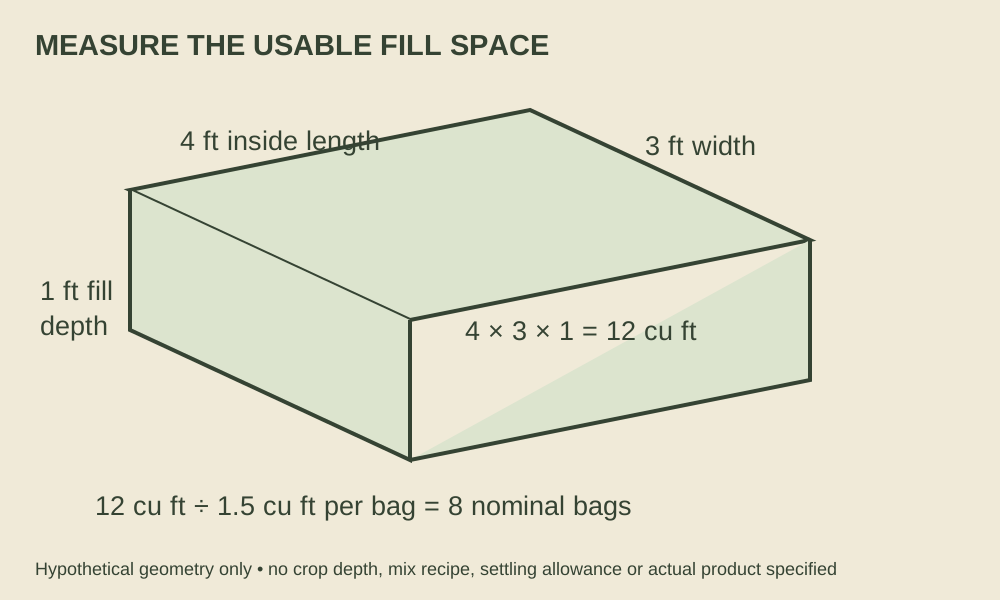
Measure the usable inside length and width, then decide the intended filled depth for your actual setup. Keep the outside dimensions, decorative trim, and any unfilled space out of the volume calculation, and label the filled depth separately from the total wall height.
For a simple rectangular space, length times width times filled depth gives a starting volume when all three dimensions use the same unit. This is geometry, not a recommendation for a crop’s root depth or the amount of settling you should expect.
For example, a hypothetical interior measuring four feet by three feet with one foot of filled depth represents twelve cubic feet. If the selected bag is labeled one and a half cubic feet, eight bags provide that nominal volume before any project-specific adjustments.
Write the assumptions beside the calculation so that the result stays useful. If your actual planter tapers or includes an internal feature, account for its real shape instead of treating the outside as a perfect rectangular box.
Do not confuse the bag’s weight with its volume. Your fill calculation describes space, and a heavier bag should not be counted as containing more usable volume unless its labeled volume actually says so.
Separate filling from topping up an existing bed
An empty structure and an established bed with a lowered surface are different starting points. For the latter, record what you already know about its fill and why you think an addition is needed before buying a large quantity of something new.
A lower surface does not, by itself, tell you which ingredient or nutrient the bed needs. If the decision concerns nutrients or pH, keep the soil-test interpretation separate from the volume estimate.
Iowa State notes that distinct soil layers can interfere with water movement and root growth. Read its advice in the context of a ground-connected bed and seek guidance that fits your setup rather than building arbitrary layers from whatever materials are cheapest.
Write down the existing material and the proposed addition as separate entries. If either is unknown, make that uncertainty part of the next decision rather than disguising it with a precise number of bags.
Compare the delivered project cost
Compare the total labeled volume you need and the total checkout cost, including delivery if relevant. A lower price per bag is not necessarily a lower price for the filled space when the bag volumes differ.
Include the practical route from the delivery point or vehicle to the bed. A good purchase plan accounts for where the bags can go and how you will handle the work, rather than leaving a large stack in the only clear path through the yard.
Suppose two suitable products have different bag sizes and different purchase totals. Compare both against the same measured volume, then consider the actual directions and handling plan instead of choosing the one with the more appealing front photograph.
If a delivery substitute is offered, compare the complete label again before accepting it. A replacement from the same brand can change the intended use or composition enough that your original decision no longer applies.
Save a fill record for the next season
Keep the bed sketch, volume calculation, product label, actual quantity used, and date in one place. Record any departure from the plan, including a different product or a fill depth that changed during the project.
Then observe how the actual planting performs without treating one symptom as proof of a single cause. Notes about drainage, watering, crop choice, and later additions will help you ask a more specific question if a problem develops.
The finished decision should explain what you filled, why the chosen material suits that system, and how you calculated the purchase. That gives you a repeatable starting point instead of an unexplained memory of several bags labeled soil.