Read a garden soil test by connecting each result to its sample, method, units, crop, and recommendation. A page of numbers becomes much more useful when you can explain what each number represents before deciding what to buy.
Your goal is not to make every bar longer or every nutrient value larger. It is to understand the report’s meaning for the planting area you sampled and to follow a recommendation that actually applies to that area.
Keep the original report open while you make a separate decision note. Copying one highlighted number into a shopping list can remove the context that makes the number useful in the first place.
Start with the identity of the sample
Check the sample name, collection date, location, and crop information you supplied. If the report says vegetable garden but the sample actually came from a separate ornamental bed, clarify that mismatch before treating its recommendations as your vegetable plan.
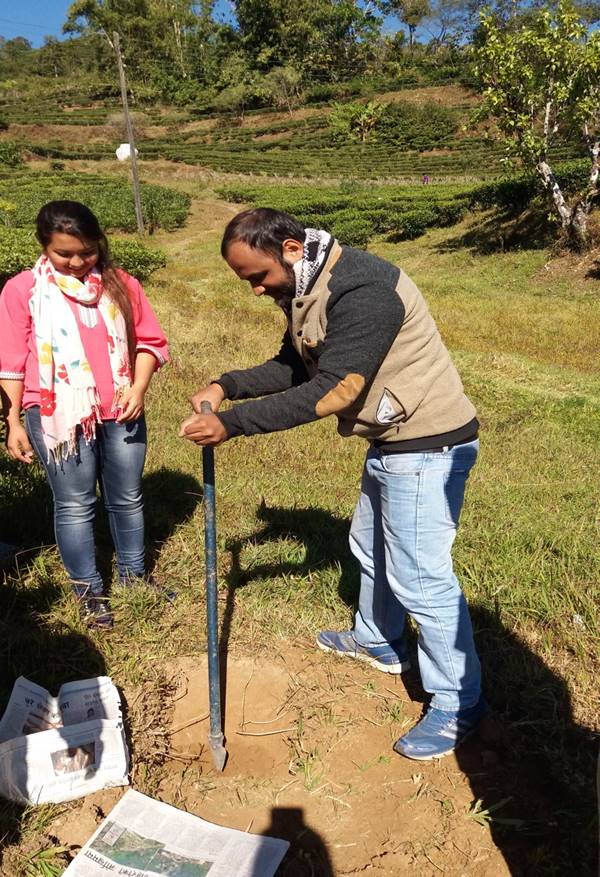
Oregon State’s garden-soil testing guidance recommends naming samples and mapping the areas they represent. That simple step helps keep a result connected to the patch of soil you intended to investigate.
On your own sketch, mark which bed or section belongs to each report. Use a stable label, such as East Bed, rather than a crop name that might describe a different location next season.
Also record what changed before sampling, including known additions and any unusual circumstances you reported to the laboratory. Do not invent missing history; leave an unknown clearly visible so that a later discussion can address it.

Separate measurements from recommendations
A measured nutrient value describes an analysis of the submitted sample. A fertilizer or lime recommendation describes a proposed action, and the two should not be copied into your notebook as though they were the same kind of number.
OSU’s interpretation guide explains that soil tests assess nutrients expected to become available to plants rather than simply measuring the total amount of every nutrient in the soil. Read its categories as a decision aid, not a contest for the highest result.
Create two columns in your note: what the report says and what action it recommends. If a result has no corresponding action, leave that action blank instead of adding a product because the nutrient appears somewhere on the page.
Keep the laboratory’s comments with the recommendation. A short footnote about the crop, application timing, or assumptions can be more important to the decision than the color of a chart bar.
Keep the method and units attached
OSU cautions that laboratory methods influence results and sufficiency ranges. A threshold from an unrelated chart should not be carried over to a result obtained by a different test method just because the nutrient name matches.
Copy the unit exactly as printed, including the area or material basis where one is given. If the report and a product label use different units or describe different quantities, resolve that difference before calculating a purchase.
For example, a result column and a recommendation column may sit close together but serve different purposes. Circle their headings on your copy so that the measurement is not accidentally read as an amount of fertilizer to spread.
If a unit, abbreviation, or method is not explained, add it to a question list for the laboratory. A precise question about one row is easier to answer than a message saying that the entire report looks confusing.
Read pH without turning it into a universal recipe
Maryland Extension explains soil pH and buffer pH as different information, with buffer measurements relevant to a lime recommendation. A pH result alone does not tell you to add an arbitrary amount of lime.
The same guidance emphasizes that plants differ in their pH preferences. Keep the actual intended crop attached to your interpretation instead of applying the target for one plant group to every bed in the yard.
If your report includes a recommendation for a pH adjustment, read its material and rate assumptions carefully. Confirm the intended product and area calculation with the laboratory or local Extension resource rather than choosing a bag by its name alone.
If no adjustment is recommended, record that decision too. A deliberate note saying no change recommended is more useful than a blank space that might later be mistaken for a forgotten task.
Use categories to ask a better question
Maryland Extension notes that an optimal or very high nutrient result does not mean adding more will improve growth. Use the category and its explanation to understand why the report may recommend leaving a nutrient alone.
When a result is low, read the corresponding recommendation instead of choosing the strongest-looking fertilizer on a shelf. Product selection still needs to fit the specified nutrient need, the label, and the area you intend to treat.
Suppose one bed has a high result for a nutrient and another report recommends an addition elsewhere. Keep the two decisions separate, even if buying one product for the whole garden would be more convenient.
Do not turn an unmeasured item into a zero, and do not treat a report as proof of tests it does not list. If your original question concerns something outside the stated testing panel, ask what analysis would address that question.
Prepare an answerable question for the laboratory
OSU recommends contacting the testing company for help interpreting results, with local Master Gardener resources as another place to ask. Send the original report and your specific question together so that the response can refer to the actual numbers.
For example, ask whether a recommendation applies to your entire mixed vegetable bed or to the crop code entered on the submission form. That is more actionable than asking which general-purpose product is best for every plant.
If you have selected a candidate material, share its complete label rather than only a brand name. Ask how the report’s recommendation relates to that particular material, including any assumptions you do not understand.
Keep the reply with the report and write down the part of the plan it resolves. If the answer reveals a mistake in the submitted crop or sample identity, correct that foundation before moving on to product quantities.
Imagine reopening two reports a year apart and finding different sample names. Before concluding that a nutrient changed, compare the maps and submission notes to establish whether both reports represent the same bed.
If they do, keep that match visible in your summary. If they do not, preserve both reports but label the comparison as unresolved rather than drawing a trend line between two numbers that may describe different places.
Use the same discipline for your action record: proposed, clarified, and completed are different statuses. A fertilizer recommendation that you considered but never applied should not appear in next year’s history as a known addition to the soil.
Build a record you can compare later
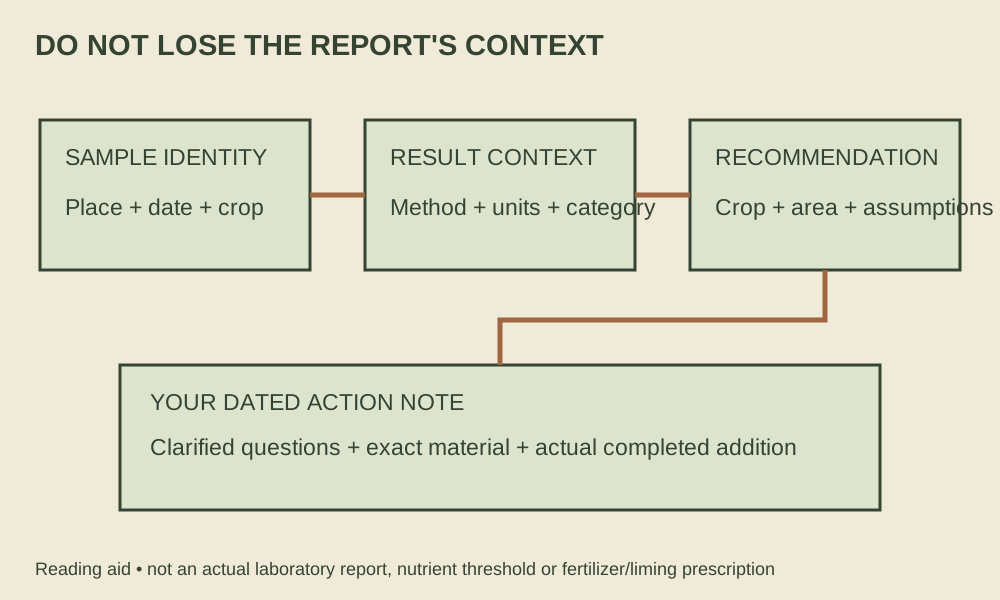
Save the report, sample map, laboratory explanation, and any actual additions as one dated record. Include the treated area and selected material, so a future note can distinguish a planned action from something you completed.
OSU’s interpretation guide recommends consistent sampling and keeping records for meaningful comparisons over time. If the laboratory, method, season, or represented area changes, make that change visible beside the new result.
Then summarize the decision in plain language: which recommendation applies, what remains unclear, and what you will do next. You should be able to reopen the note later and understand the choice without reconstructing it from a collection of loose numbers.