A sunny forecast is a reason to check your vegetable garden, not an automatic instruction to run the hose. The useful decision starts with the soil, the crop, and what has happened since the last effective watering.
You can build a simple routine without pretending one timer setting fits every bed. Keep a few observations together, respond to what they show, and revise the routine as the plants and weather change.
Separate seedlings from established plants
A newly sown row and an established tomato plant are not the same watering problem. Their roots occupy different parts of the growing space, so one broad impression of the bed can miss what each needs.
Oregon State Extension distinguishes keeping germinating seeds and seedlings uniformly moist from watering developing plants more deeply. Use that distinction to divide your observations rather than applying a single rule across every stage.
Write the sowing or transplant date beside the crop in your notebook. That small detail helps you remember why a new row needs a different kind of attention from an older planting nearby.
Check crop-specific local guidance when you are unsure about the stage. A general garden routine should help you ask the right question, not erase the differences between crops.
Look below the surface before deciding
Dry-looking soil at the top does not establish the condition where the roots are growing. Oregon State warns that a drip-irrigated surface can look dry while moisture remains below it.
Use a consistent, careful inspection point away from the plant’s main stem and avoid damaging roots. Compare the surface with a suitable deeper sample or observation according to local guidance for your bed and crop.
Record whether the soil feels dry, moist, or saturated at the observed location. These are practical notes about your garden, not a calibrated measurement or a reason to use a universal moisture percentage.
If you use a meter, follow its instructions and recognize what it can and cannot tell you. A display should add evidence to a soil-and-plant check rather than replace your understanding of the site.
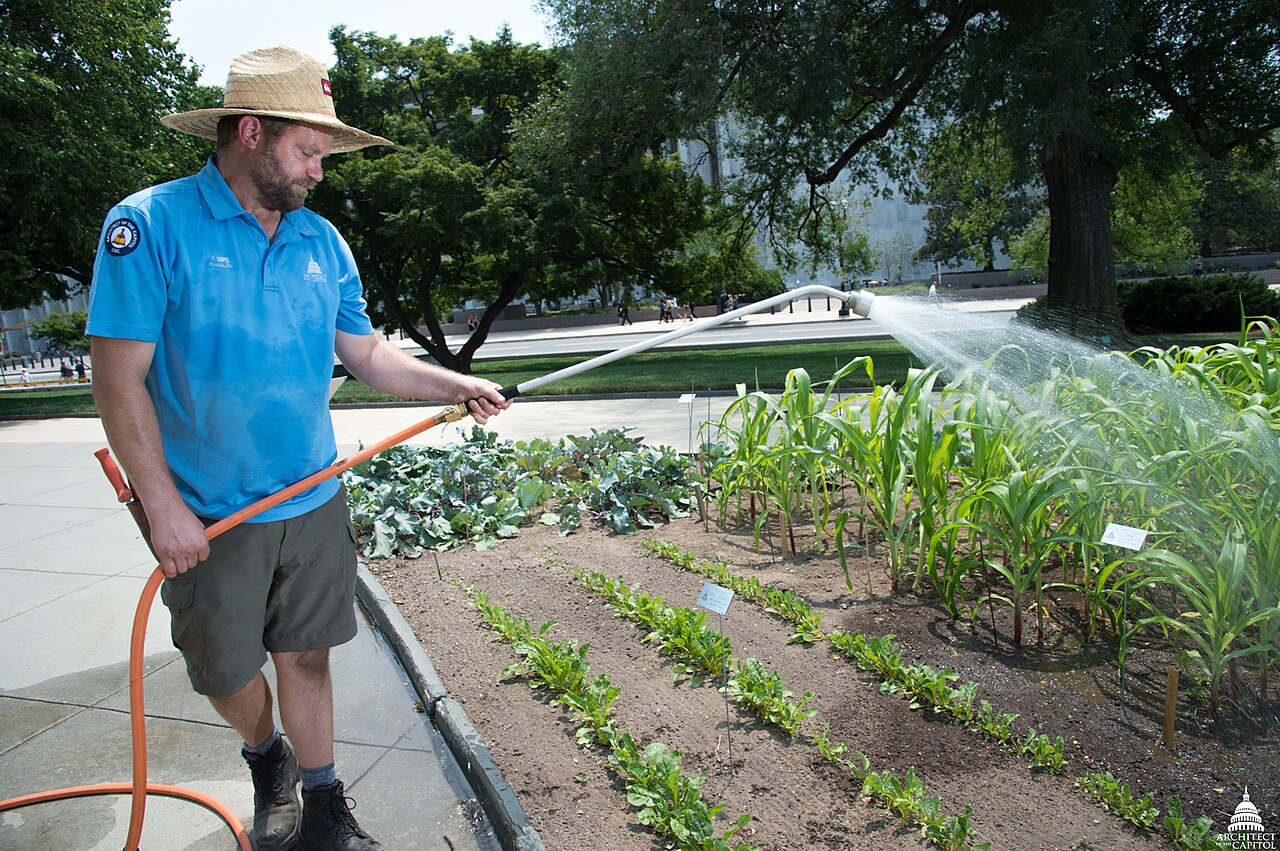

Keep rainfall and irrigation in the same record
Write down rain as well as water you apply. A rain gauge can give you a better local record than assuming a weather-app shower reached your particular backyard.
Iowa State Extension uses roughly an inch of combined weekly rainfall and irrigation as a general reference for many vegetable gardens. That is context, not a command to add an inch regardless of soil, crop, rain distribution, or current conditions.
A brief shower and a soaking rain can leave different results where you inspect the bed. Check the soil after the event rather than deciding that any rain cancels the next observation.
Keep the note simple enough to maintain: date, crop area, recent rain, last irrigation, and soil condition. You can add detail later if a recurring problem gives you a reason.
Read the plant alongside the soil
Look for changes in the plant, but do not diagnose every drooping leaf as a request for more water. An unfamiliar symptom deserves more attention than turning on irrigation automatically.
Compare the affected plant with others of the same crop and stage. Note when the change appears, whether it persists, and what the soil check shows at the same time.
If the ground remains wet while the plant declines, extra water may move you farther from the answer. Ask your local Extension office for help with persistent or unexplained symptoms and include the observations you have already gathered.
Photographs can help document a change if you use the same angle and include the surrounding planting. They are most useful when paired with dates and conditions rather than sent without context.
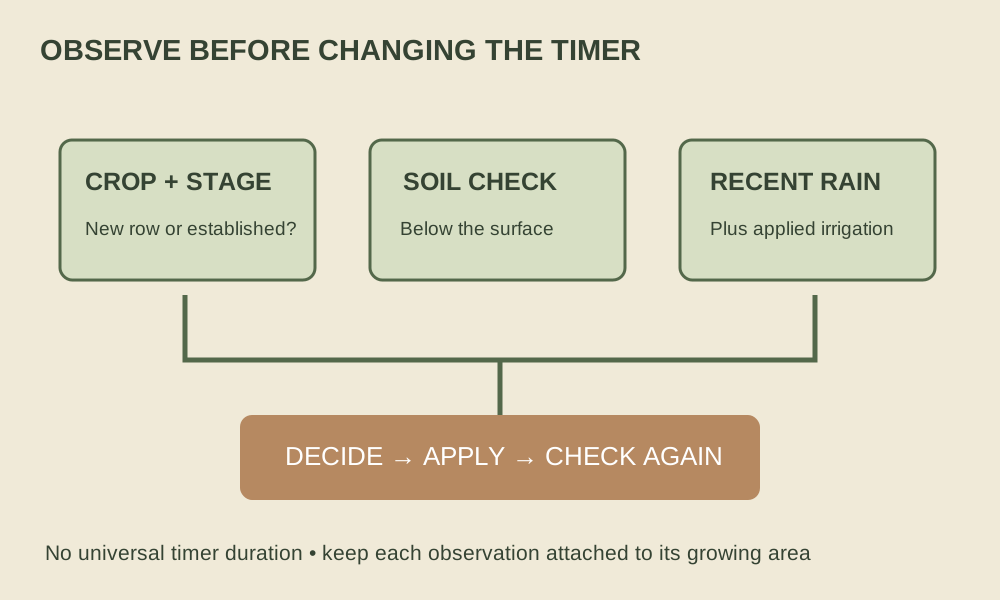
When water is needed, check what reaches the soil
Watch the application instead of walking away immediately. Water running into a path is a clue that the rate or placement needs attention, not proof that the rooting area has received enough.
Iowa State emphasizes slower application and checking wetting depth. Use those principles to assess your own method without borrowing an exact running time from a different soil or irrigation layout.
For a hose or can, keep the delivery controlled enough to avoid washing soil away from seedlings. For drip equipment, confirm the intended outlets are working and observe areas that may be missed.
Check again after a suitable interval for the method and soil. The point is to learn how an application changes the bed, then use that evidence when deciding what to adjust next time.
Treat different growing spaces as different zones
A container beside a paved patio may need a different routine from an in-ground bed nearby. Record it separately rather than assuming that watering the garden means every growing space was covered.
You can divide a small garden without installing a complicated system. Give the seed row, established crop area, and containers simple names in the notebook so your observations remain attached to a location.
Notice whether the same corner repeatedly dries first or stays wet longer. That pattern can prompt a closer look at shade, soil, application coverage, or drainage instead of repeatedly changing the whole garden’s watering.
Do not add fertilizer as a substitute for understanding a water-related concern. A pale or struggling plant needs a reasoned diagnosis, and extra inputs can make an unclear situation more complicated.
Use weather changes to revisit the routine
Hot, windy conditions can change the rate at which a garden loses water. A cool, cloudy stretch can make last week’s routine a poor guide to today’s conditions.
Use a forecast to decide when to inspect more closely and whether your normal plan needs a check. Do not treat the predicted temperature as a direct conversion into a fixed number of hose minutes.
When you change the routine, change one understandable element and record the result. That makes it easier to tell whether a different duration, placement, or inspection interval improved coverage.
Follow any current local watering restrictions and use an appropriate water source for food crops. Ask local authorities or Extension for guidance where the source or restrictions are unclear.
Leave a useful note for the next gardener
Imagine that your garden contains an older pepper bed and a newly sown row beside it. A note that both areas received water yesterday does not tell you whether the new row remains appropriately moist or whether the established rooting area was adequately wetted.
Record the observation for each area before deciding the next action. You may discover that the same method is reaching one part well and leaving another part unevenly covered.
Use that finding to refine the layout or application, not simply to increase water everywhere. A small sketch showing where an emitter or hose stream actually reaches can make an irrigation adjustment easier to understand.
Check the result on the next inspection and keep the part of the note that explains the difference. Over time, these short comparisons tell you more about your own garden than a collection of universal schedules saved from unrelated growing conditions.
If the observation remains confusing, preserve it as a question for local help. You can say what was planted, what changed, and what you found in the soil without guessing the cause in advance.
If someone will care for the garden while you are away, show them the actual inspection points. A note saying “check the new row separately” is more useful when they know exactly which row you mean.
Leave the current crop map, recent rain and watering notes, and the local contact you would use for an unexplained problem. Avoid reducing the whole handoff to a timer setting that ignores a changed forecast.
At the end of the week, keep the observations that taught you something. You do not need a perfect log; you need enough continuity to stop treating every watering decision as a fresh guess.
If everyday access makes these checks difficult, revisit the raised-bed location plan before expanding. A garden that is easy to observe gives you a better chance to respond at the right time.