Discover top-performing grow lights designed for indoor plants. This guide highlights five reliable options, covering full spectrum LEDs, adjustable heights, timers, and energy-efficient performance. Whether you’re growing greens, herbs, or flowering plants, these lights provide the brightness and spectrum needed for year-round growth. Compare features, installation ease, and user controls to choose the right light for your space and plant needs.
| Product | Brand | Key Feature | Light Type |
|---|---|---|---|
| GooingTop LED Grow Light | GooingTop | Full spectrum with 6000K white light; 5-level dimming; timer | Clip-on, USB/AC |
| Briignite LED Grow Light Bulb | Briignite | Full spectrum A19 bulb; 11W per bulb; 100W equivalent | LED Bulb |
| yadoker LED Growing Light | yadoker | Full spectrum 380-800nm; height adjustable; 10-level dimmable | Standalone lamp |
| LEOTER Grow Light | LEOTER | 80 LEDs; full spectrum + red/blue; 10 dimmable modes; 3 spectral modes | Desk/clip |
| Aokrean Plant Grow Light | Aokrean | 3 spectrum options; auto timer; 10 brightness levels | Halo light stand |
GooingTop LED Grow Light — Full Spectrum Clip
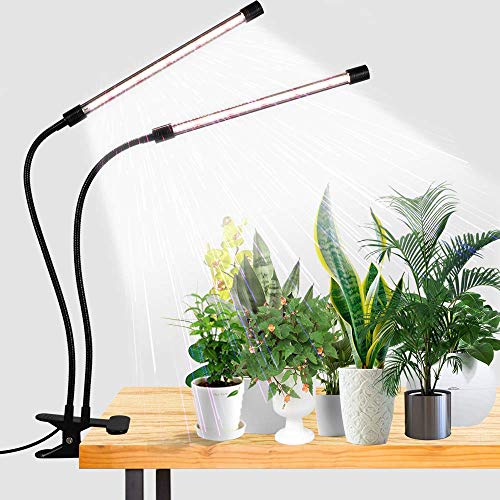
The GooingTop LED Grow Light provides a 6000K white light blended with red LEDs to closely mimic noon sunlight. Its high color rendering index of 95 ensures accurate color perception for plant leaves and health indicators. A flexible gooseneck and strong clamp enable precise positioning to cover target foliage. The design supports USB or AC power, making it suitable for desks, shelves, or plant stands. It offers timer options of 4, 8, or 12 hours within a 24-hour cycle, simplifying routine care for busy gardeners.
Briignite LED Grow Light Bulb A19 — Full Spectrum

The Briignite A19 grow light bulbs offer full spectrum output with a natural white appearance, while emitting red and blue wavelengths essential for photosynthesis. Each bulb delivers about 1000 lumens while consuming just 11 watts, offering substantial energy savings. The bulbs are designed to provide balanced lighting for all growth stages, helping tomatoes, cucumbers, peppers, greens, and herbs thrive indoors. With high efficiency and broad coverage, these bulbs are ideal for standard light sockets and retrofit into existing fixtures.
yadoker LED Growing Light — Full Spectrum

yadoker’s grow light delivers a full spectrum range from 380nm to 800nm, combining white, warm white, and red LEDs to support all growth stages. A height-adjustable stand extends up to 61 inches, allowing coverage for larger plants or groupings. Ten dimming levels let you tailor brightness from 10% to 100%, and the light includes an automatic timer fixture for 3, 9, or 12 hours. Its tall design helps light larger canopies and spaces with multiple plants in proximity.
LEOTER Grow Light — 80 LEDs
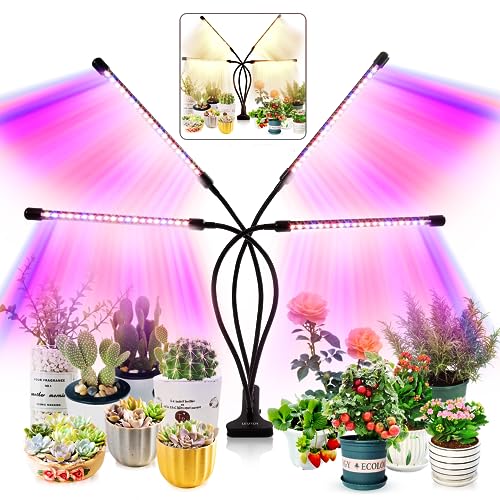
LEOTER’s upgraded LED cluster uses 80 efficient diodes across red, blue, and full-spectrum bands to support photosynthesis at every stage. It includes a memory timer that cycles through 3, 9, or 12 hours with automatic on/off, simplifying care for workdays or travel. Ten dimmable levels provide flexibility across plant types and growth phases. The unit emphasizes a balance of spectrum for root development, flowering, and foliage, making it suitable for a variety of indoor plants, from herbs to flowering specimens.
Aokrean Plant Grow Light — 3 Pack Halo

Aokrean offers a compact halo-style grow light with three spectrum options and a user-friendly stand base. The 3-pack setup accommodates multiple plants or a longer coverage area. Three timer cycles (3, 9, 12 hours) allow daily automation, while 10 brightness levels let gardeners fine-tune light intensity. Installation is straightforward, and the design supports a range of indoor plant configurations from seedlings to small shrubs.
Buying Guide
- Spectrum needs: Full spectrum (white, red, blue) supports all growth stages; some models add specific red/blue emphasis for flowering or leafy growth.
- Brightness and dimming: Look for adjustable brightness levels (at least 5–10 steps) to adapt to plant type and growth stage.
- Height and coverage: Adjustable stands or flexible goosenecks help target light; larger plant groups may require higher mounting or longer arms.
- Timer and automation: Built-in timers reduce daily maintenance; verify cycle options (3/6/12 hours are common).
- Power options: USB-powered units are portable and inexpensive; AC-powered units provide consistent performance and longer run times.
- Energy efficiency: LED options typically offer the best efficiency and lower heat output, important for indoor setups and delicate seedlings.
- Installation: Consider weight, mounting method, and whether the unit can be used with existing fixtures or needs a dedicated stand.
- Durability and warranty: Check build quality and warranty length for longer-term use with plants of varying needs.
- Multi-plant setups: For larger gardens, prioritize models with taller stands, wider coverage, and independent light control per head when available.