Discover the right fertilizer pump system for planters and containers. This guide helps buyers pick reliable dosing tools, from manual spreaders to water-powered injectors. It’s ideal for homeowners, small-scale urban gardeners, and greenhouse enthusiasts who want consistent nutrient delivery without guesswork. Below, five top options are evaluated for suitability, ease of use, and potential limitations. A quick buying table and a concise guide follow to support an informed decision.
| Product | Best For | Main Advantage | Limitations |
|---|---|---|---|
| Dr. Earth Pump & Grow | Indoor houseplants and safe, nutrient-rich feeds | All-natural, pet-safe formula | Limited dosing visibility |
| Miracle-Gro Liquid Food | General indoor plants needing simple feeding | Brand familiarity and convenience | Generic instructions; may require frequent applications |
| NEWTRY 0.4%-4% Doser | Irrigation systems, greenhouses, hydroponics | No electricity; adjustable range | Assembly and setup can be technical |
| NEWTRY 1%-10% Doser | Commercial and home drip irrigation | High accuracy and versatility | Higher concentration requires careful handling |
| Dioche Fertilizer Spreader | Manual fertilizing for larger planters | Adjustable strap and large capacity | Not a dosing pump; helper for spread timing |
Dr. Earth Organic & Natural Pump & Grow House Liquid Plant Food 16 oz

Best for: Indoor houseplants and homes seeking a natural fertilizer option. This product emphasizes organic, human-grade whole-food-based ingredients derived from seafoods, fruits, vegetables, and grains. The formula is designed to feed plants without synthetic chemicals, making it suitable for households with pets and children. Its nutrient profile supports steady growth with a simple two-pump dosing that covers two weeks for many houseplants.
Why chosen: The blend aligns with organic gardening goals and minimizes risk from artificial additives. It appeals to buyers who prioritize safety and natural sourcing while avoiding GMO-based contamination. The dosing is straightforward, reducing the guesswork for routine houseplant feeding.
Caution: Because the product relies on natural ingredients, results can vary with environmental conditions. Monitor plant response and adjust as needed to prevent over- or under-feeding.
Miracle-GRO Liquid Plant Food 8 oz.

Best for: General indoor plants needing a convenient feeding regime. Miracle-Gro is widely recognized for straightforward liquid plant feeds, which can simplify routine maintenance for busy households or apartment gardeners. This 8 oz bottle is a compact choice for small to moderate plant collections.
Why chosen: Brand familiarity can translate to predictable results and broad compatibility across common houseplants. The liquid format allows flexible application through watering cans or dosing injectors where supported by the system.
Caution: The listing provides limited details on concentration or feeding frequency. Use with care to avoid nutrient buildup in soils sensitive to salt accumulation, particularly in potted plants with restricted drainage.
NEWTRY 0.4%-4% Fertilizer Injector

Best for: Gardeners using drip irrigation in greenhouses or field plots who want electricity-free dosing. The adjustable dosing range (0.4%-4%) and a universal 3/4″ NPT connection suit diverse irrigation setups. It accommodates a flow range suitable for moderate to high irrigation systems.
Why chosen: The water-powered design avoids electrical needs, appealing to users seeking simple, low-maintenance nutrient delivery. Reciprocating dynamic sealing helps maintain a stable mixture even when pressure varies, supporting even fertilization across runs.
Caution: It requires correct installation within the irrigation line and careful calibration to prevent under- or over-fertilization. Performance can depend on water pressure and flow consistency.
NEWTRY 1%-10% Fertilizer Injector
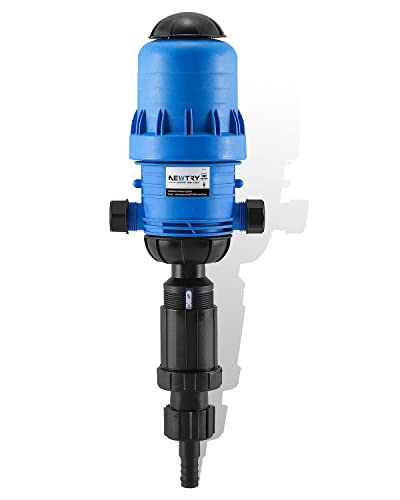
Best for: More advanced drip irrigation users and homeowners with varied crop needs who require higher fertilization control. This model covers a broader percentage range (1%-10%) with a 3/4″ NPT connection and a similar pressure tolerance (2.9 to 87 PSI).
Why chosen: The wider ratio and precise dosing promise versatile mixing across different fertilizers and plant types. It emphasizes accuracy via a dedicated cylinder and piston motion design to promote uniform distribution even as flow and pressure change.
Caution: Higher concentration doses demand careful handling to prevent tissue burn in delicate plants. Verify compatibility with your fertilizer type before use.
Dioche Fertilizer Spreader With Bag

Best for: Manual fertilizing tasks in vegetable gardens and larger planter setups. This hand spreader features an adjustable strap for comfort and a large capacity, making it a practical helper for extended planting sessions.
Why chosen: Although not a dosing pump, it complements liquid or solid amendments by enabling even distribution across beds and containers. It’s a solid choice for those who prefer hands-on control and a larger application area per session.
Caution: It requires manual operation and regular refilling. Uneven ground or wind can affect accuracy during spreading; use steady arms and consistent passes for best results.
PlantVantage Root & Bloom Liquid Fertilizer

Best for: Plants requiring stronger root development and flowering, including trees, flowers, and vegetables. This concentrated plant fertilizer supports root growth and vibrant blooms across indoor and outdoor applications.
Why chosen: The product emphasizes boosting blooms and overall garden performance through improved nutrient uptake. It suits growers looking for tangible improvements in flowering and fruiting without complex dosage equipment.
Caution: Concentrated formulas require careful dilution according to plant type and pot size to avoid overfeeding. Monitor plant response and adjust schedules accordingly.
Soft Soil by GS Plant Foods – Liquid Aerator

Best for: Lawns with compacted soils or poor drainage. This liquid aerator loosens soil to improve air, water, and nutrient penetration to the root zone without mechanical tools.
Why chosen: The product offers a non-mechanical approach to improving lawn health, making it accessible for homeowners who want a simpler solution to improve turf condition and nutrient uptake.
Caution: Results depend on initial soil conditions and timing. It is most effective when used as part of a broader lawn care plan including regular watering and mowing practices.
Saluaqui Fertilizer Injector Automatic Dosing Device

Best for: Gardeners and small industrial settings needing consistent dosing across liquid fertilizers. The unit is positioned as a reliable dosing tool for greenhouse, flower beds, and hydroponic systems.
Why chosen: It emphasizes continuous, precise dosing in diverse environments with straightforward maintenance, enabling users to focus more on plant growth and less on equipment upkeep.
Caution: The description highlights general reliability rather than detailed specifications. Ensure compatibility with your existing irrigation and fertilizer types before installation.
Buying Guide: Key Considerations For Fertilizer Pumps And Injectors
What should you consider when choosing a fertilizer pump or injector for planters?
- System Type: Decide between manual spreaders, liquid feeders, and water-powered injectors depending on your setup and preferred workflow.
- Feed Type and Concentration: Check whether your fertilizer is liquid, granular, or concentrated and ensure the dosing device supports the correct concentration range.
- Compatibility: Match fittings, such as 3/4″ NPT connections, with your irrigation lines or hoses to prevent leaks and ensure proper flow.
- Power Source: If avoiding electricity is important, prioritize water-powered injectors; for precise, adjustable dosing, choose products with clear ratio controls.
- Control and Uniformity: Look for features that promote even distribution, such as reciprocating seals and accurate piston motion, to minimize uneven feeding.
- Safety and Handling: Consider pet- and child-safety, especially with organic or high-concentration formulas. Follow dilution guidelines carefully to prevent plant damage.
Frequently Asked Questions
- What’s the difference between a fertilizer injector and a fertilizer spreader?
– Injectors dose liquid fertilizer into irrigation water for roots, while spreaders distribute granules or liquids across soil or mulch manually or mechanically. - Can I use any fertilizer with a dosing pump?
– Most dosing pumps are designed for specific concentration ranges. Always verify compatibility with your fertilizer type and follow manufacturer guidelines. - Do I need electricity for a fertilizer injector?
– No. Water-powered injectors operate without electricity, using water pressure to drive dosing. - How do I prevent over-fertilization with injectors?
– Start with the lower concentration, calibrate to match plant needs, and monitor for signs of nutrient burn or deficiency. - Is a liquid aerator the same as a fertilizer injector?
– No. A liquid aerator improves soil air and water penetration; injectors deliver fertilizers. They can complement each other in a lawn care plan. - Which option is best for beginners?
– A simple, ready-to-use liquid fertilizer like Miracle-Gro paired with a basic manual spreader or a basic injector is often easiest for beginners.