Controlling unwanted vines and brush around your property helps protect foundations, preserve landscaping, and keep outdoor spaces tidy. The following selections focus on quick-acting formulas that target woody plants, vines, and tough brush while offering various application methods. Each option is evaluated for effectiveness, safety profile, and ease of use in residential settings.
| Product | Brand | Type | Best For |
|---|---|---|---|
| Stump-Out Stump & Vine Killer | Bonide | Concentrate | Stumps, vines, broadleaf weeds |
| BioAdvanced Brush Killer Plus (Ready-to-Use) | BioAdvanced | Ready-to-use spray | Poison ivy, poison oak, tough brush |
| Neudorff Weed and Grass Killer | Neudorff | Ready-to-use spray | Weeds and vines, fast results |
| Ortho GroundClear Poison Ivy & Tough Brush Killer | Ortho | Ready-to-use spray | Poison ivy, kudzu, blackberry |
| BioAdvanced Brush Killer Plus (Concentrate) | BioAdvanced | Concentrate | Brush, roots, poison ivy |
Note: The selections below are presented with practical application considerations, including whether they’re best used as a spray for foliage control, as a stump killer, or for treating root systems. Always follow label directions and use protective gear when handling any herbicide.
Stump-Out Stump & Vine Killer
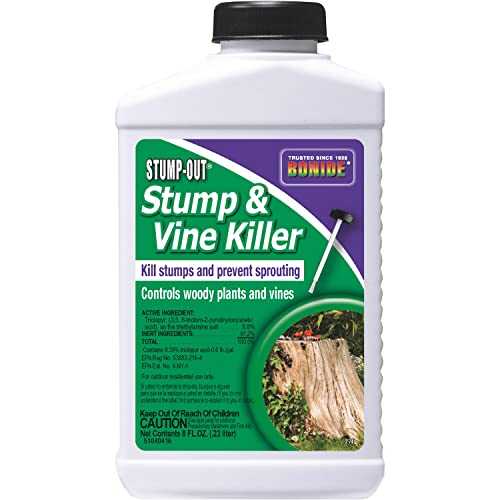
Stump-Out is an 8-ounce concentrate designed to address woody vines and broadleaf weeds. It can be used as a foliar spray via hose-end or tank sprayer and also as an undiluted stump killer to prevent sprouting after cutting. This flexibility makes it suitable for clearing fence lines, trellises, and unwanted brush where vines tend to resprout from roots. When applied correctly, it provides rapid foliage knockdown and helps prevent regrowth from stumps. Applicators should ensure thorough coverage of green tissue for optimal results.
BioAdvanced Brush Killer Plus (Ready-to-Use)

This 1-gallon ready-to-use spray targets poison ivy, poison oak, blackberry, and more than 75 other weeds. It’s designed to kill listed roots and tough vine weeds with a systemic action, leveraging triclopyr to move through plant tissues. Users often see results within 1-6 weeks, making it suitable for larger vines and brush areas around foundations, fences, and garden perimeters. The Ready-to-Use format minimizes mixing steps, enabling straightforward application with a sprayer wand or spray bottle.
Neudorff Weed and Grass Killer

Neudorff Weed and Grass Killer is a fast-acting spray designed to eliminate tough weeds and vines with a non-staining formula. It claims visible results within about an hour and provides up to six weeks of control, helping prevent regrowth on treated vines and brush. The product’s formulation is described as environmentally mindful, with application in cultivated areas prior to reseeding or replanting. It supports flexible use on perimeters, walkways, and untreated garden beds where vine control is needed without extensive soil impact.
Ortho GroundClear Poison Ivy & Tough Brush Killer3

Ortho GroundClear is a ready-to-use weed killer designed to control more than 60 tough weeds and brush, including poison ivy and poison oak. It uses a fast-acting formulation that starts showing visible results within an hour and works systemically to kill weeds down to the root. The Comfort Wand application helps target vines along fence lines, posts, and undergrowth with directional precision. This option is well-suited for immediate, broad-area control around residential landscapes where vines threaten foundations or low-lying structures.
BioAdvanced Brush Killer Plus (Concentrate)

This concentrate option targets poison ivy, poison oak, blackberry, and a wide range of brush and vine weeds when mixed per label instructions. It relies on a penetrating formula to reach listed roots and perform effective control of tough vines. Concentrates like this are often favored by those who treat larger sites or require specific dilution ratios for variable vine densities. Users should apply when foliage is actively growing and conditions favor absorption.
Buying Guide: Key Considerations For Vine and Brush Control
Choosing the right weed killer for vines depends on several factors. The following considerations help compare options and align them with your yard’s needs:
- <bApplication method: Ready-to-use sprays are convenient for quick treatment along fences and trellises. Concentrates offer cost savings for large areas or repeat use but require mixing and careful measurement.
- <bTarget spectrum: If poison ivy or oak is a concern, ensure the product is labeled to kill those species. Some formulas focus on brush versus general broadleaf weeds.
- <bRoot vs. foliage action: Systemic products move through the plant to kill roots, reducing regrowth. Stump-specific formulas prevent sprouting after cutting.
- <bSpeed of results: Some products show visual results in as little as an hour, while others may take several weeks. Consider urgency based on safety and proximity to structures.
- <bEnvironmental and surface considerations: Non-staining formulas and formulations suitable for lawns or cultivated beds reduce potential collateral damage. Pre-spray testing on a small area can prevent unintended damage.
- <bSafety and protective measures: Always wear gloves and eye protection. Follow label directions for rain-fast timing, re-entry intervals, and drift control to protect pets and children.
- <bReapplication and follow-up: Some vines resprout from roots, requiring a second application. Consider treating roots in conjunction with above-ground foliar control for comprehensive management.
- <bCost and coverage: Compare the cost per gallon or per treated area. Concentrates may lower long-term costs but demand more handling and equipment compatibility.
When evaluating options, consider the size of the area to treat, whether you’re targeting climbing vines on a fence line or brush near the home’s foundation, and how quickly you need results. For stubborn vines with deep root systems, a systemic product or a two-step approach—foliar application followed by stump treatment—tends to yield the most durable suppression.