Direct answer: If you want reliable, automatic irrigation for your lawn, a programmable water timer is the best choice, with mechanical timers offering battery-free reliability and digital timers offering precise scheduling. This guide compares five top Amazon options to help common buyers choose what fits best: busy homeowners who want set-and-forget systems, gardeners who need zone control, and those who demand weather-aware features like rain delays. Below is a quick product snapshot and a deeper dive into each option’s strengths and limits.
| Product | Main Advantage | |
|---|---|---|
| Orbit Mechanical Water Timer – 62034 | Battery-free, easy dial control | Hands-free basic irrigation for simple lawns and gardens |
| Orbit Programmable Digital Hose Timer – 62061 | LCD programming, rain delay, precise scheduling | Users wanting digital control on a single outlet |
| RAINPOINT Sprinkler Timer – 1 Outlet | Rain delay plus 1-minute to several hours scheduling | Flexible daily and weekly plans for varied plantings |
| RAINPOINT Water Timer for Garden Hose – 2 Zone | Two programmable zones for separate areas | Two-zone irrigation with centralized control |
| Insoma Outdoor Water Timer – 1 Outlet | Brass inlet, weather-resilient, multiple modes | Durable, long-term outdoor use with robust build |
Orbit Mechanical Water Timer – 62034

The Orbit Mechanical Water Timer delivers battery-free operation with a clockwork shutoff mechanism. It uses a large, easy-grip dial for quick adjustments, even with wet hands, and a manual bypass option for quick changes. This timer is best for buyers who want a reliable, low-maintenance solution that doesn’t rely on batteries or electronics. Choose this if you desire simple, durable irrigation control for basic lawn and garden watering without digital screens or programmable schedules. A potential limitation is the lack of advanced scheduling features like variable runtimes or rain delays.
Orbit Programmable Digital Hose Timer – 1 Outlet
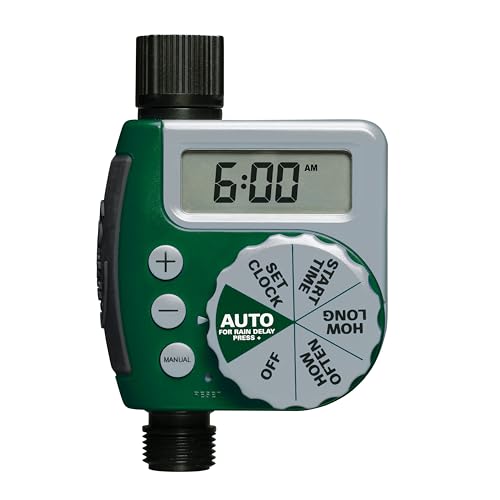
This timer converts a faucet into an automatic watering system with a single outlet and an LCD display. It offers adjustable watering duration and a rain delay feature to conserve water. It is best for homeowners seeking precise digital control for daily lawn and garden irrigation, with the ability to program schedules and durations. It’s less ideal for users who require multi-zone control or battery-free operation. Consider that it operates on batteries and requires occasional replacement to maintain schedules.
RAINPOINT Sprinkler Timer, 1 Outlet

RAINPOINT’s 1-outlet timer emphasizes easy programming with a big LCD screen and a robust feature set, including rain delay and a broad watering window (1 minute to 3 hours 59 minutes). It’s better for quicker setup and straightforward scheduling, especially when you want a single device that handles daily or weekly watering with a pause option during rain. A limitation is that it supports only one zone, which may not suit larger landscapes with varied plantings.
RAINPOINT Water Timer for Garden Hose – 2 Zone

This model enables two separate programmable zones, allowing different start times and durations for distinct areas. It also features rain delay and manual modes to conserve water and adapt to weather. It’s ideal for households needing zone-specific irrigation such as lawn zones and garden beds. The main consideration is that two zones require more setup and may involve a larger footprint or slightly higher cost than single-outlet timers.
Ortis Hose Faucet Timer with Rain Delay

The Ortis timer emphasizes an IP67-rated, leak-resistant design with a nylon-fiber composite main valve and stainless steel internal components. It supports auto, manual, and rain-delay modes, allowing quick adaptation to weather and travel. It is best for buyers who prioritize durability and weather sealing in a rugged outdoor environment. A possible limitation is that some users may find the setup slightly more involved due to its multi-mode options.
Sprinkler Timer 2 Zone & Digital Timer

The 2-zone model from RVWSX provides independent control for two areas with minute-precise duration and frequency settings. It includes rain delay and manual modes, plus an IP66-rated waterproof construction and a built-in metal filter for debris control. It’s best for larger lawns or gardens that require simultaneous yet distinct irrigation schedules. A limitation is that it may be more complex to program compared to single-zone timers, and the physical size might be larger for compact setups.
Buying Guide: Key Considerations for Water Timers
- Zones and coverage: Do you need a single-outlet timer or multiple zones? Two-zone models suit larger or varied landscapes, while single-outlet units are simpler and often cost-effective.
- Power and reliability: Battery-free timers avoid replacement hassles but often lack advanced features. Digital timers provide precise scheduling but require batteries or power sources.
- Weather and durability: Look for IP or NEMA ratings if the timer sits outdoors in sun, cold, or rain. Brass inlets and metal components can improve longevity under pressure.
- Water-saving features: Rain delays, smart weather adaptation, and detailed scheduling help conserve water and reduce overwatering.
- Ease of use: Large displays, intuitive dials, and clear language can reduce setup time and mistakes, especially when hands are wet or gloved.
- Compatibility and fittings: Check inlet/outlet thread sizes (standard garden hose fittings are common) and the overall footprint to fit your faucet setup.
Frequently Asked Questions
- What is the main difference between mechanical and digital water timers?
The mechanical timer operates without batteries and uses a clockwork mechanism for shutoff, while digital timers rely on electronics and batteries for programmable schedules and features like rain delay. - How many zones should I consider for a typical lawn?
A single-zone timer is enough for a small lawn or a single planting bed. If you have a larger yard with different plantings, a two-zone timer offers more flexibility without buying two separate devices. - Can these timers handle heavy water pressure?
Most models are rated for standard household pressure. For high-pressure setups, choose timers with stronger valves and higher PSI ratings, such as 150 PSI or more where noted. - What happens if it rains after I’ve set a rain delay?
Rain delay pauses the schedule for a set duration and resumes automatically when the delay ends, helping to conserve water during wet periods. - Are digital timers worth the extra cost?
Digital timers offer precise control, programmable schedules, and readouts that help optimize watering. If you value exact timing and water efficiency, they are typically worth the investment. - Do these timers require maintenance?
Basic maintenance includes checking seals, clearing debris from filters, and replacing batteries on digital models as needed. Mechanical timers require little ongoing care beyond periodic checks.