Protect wooden structures from termite damage with proven sprays and treatments designed for interior, exterior, and foundation use. This guide highlights five effective products chosen for their reach, long-lasting protection, and user-friendly application. Each option targets wood-destroying insects, including termites, carpenter ants, and wood-boring beetles, helping homeowners safeguard decks, framing, and other timber elements.
| Product | Brand | Ideal Use |
|---|---|---|
| Spectracide Terminate Termite And Carpenter Ant Killer | Spectracide | Indoor and foundation treatment; contact kill |
| Bora-Care Termiticide Insecticide And Fungicide | Nisus | Deep-wood treatment; long-lasting protection |
| TERRO Ready To Use Indoor/Outdoor Killer | Terro | Carpenter ants, termites, carpenter bees; spray-on ease |
| PenaShield Penetrating Wood Preservative | Nisus | Ready-to-use; penetrates deeply for long-term protection |
| BASF Termidor Foam | BASF | Foam termiticide; spot treatments and void access |
Note: The selections focus on products that perform well across common wood-infestation scenarios, balancing ease of use, coverage, and effectiveness. Always follow label directions and consider combining treatments for new construction or severe infestations.
Spectracide Terminate Termite And Carpenter Ant Killer

Features include broad indoor and outdoor effectiveness, delivering control for termites, carpenter ants, and carpenter bees. The spray provides up to nine months of indoor protection and targets wood-destroying insects on contact, making it a versatile choice for baseline protection around foundations and in crawlspaces. The AccuShot sprayer facilitates precise application in hard-to-reach areas while minimizing overspray. Users should apply evenly along baseboards, entry points, and active galleries to maximize residual control.
Bora-Care Termiticide Insecticide and Fungicide

Wood treatment that penetrates deeply into fibers to combat termites, carpenter ants, wood-boring beetles, and decay fungi, designed for the life of the wood. The product is applied directly to wood surfaces with a 2-foot band treatment, simplifying application and reducing the need for soil-based treatments. One gallon concentrates covers roughly 800 square feet, and the formula is suitable for both new construction and existing homes, ideal during the dried-in phase for comprehensive protection against drywood and subterranean termites.
Bora-Care Termiticide Insecticide and Fungicide (Second Listing)

Identical in purpose to the other Bora-Care listing, this gallon concentrate provides maximum wood protection by penetrating deep into fibers. It supports whole-house protection when used during construction or remediation for drywood and subterranean termite prevention, with a similar application scope to the first Bora-Care entry. The combination of deep wood penetration and easy application makes it a staple for long-term structural defense.
TERRO Ready To Use Indoor/Outdoor Killer Aerosol
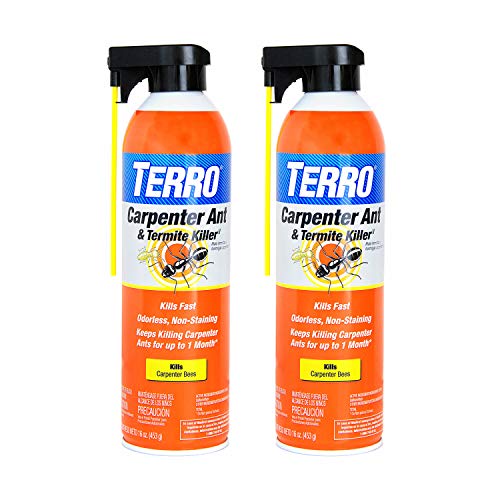
Terro’s ready-to-use aerosol provides rapid knockdown of carpenter ants, termites, and carpenter bees with on-contact killing and moderate residual control lasting up to a month. The two-way nozzle enables broad spraying or precision treatment in cracks and crevices. This format is convenient for spot treatments around outlets, window frames, and other problem areas where pests congregate.
PenaShield Penetrating Wood Preservative

Ready-to-use borate-based wood preservative designed to penetrate deeply for long-lasting protection against termites, carpenter ants, wood-boring beetles, and wood decay fungi. It is suitable for decks, attics, and woodworking projects. Treated wood remains visually natural with no discoloration or stains after drying, allowing painting, sealing, or staining if desired. The formula supports both preventive and remedial treatment in wood-rich environments and is appropriate for indoor use in protected areas.
BASF Termidor Foam

Termidor Foam is a non-repellent, ready-to-use foam termiticide/insecticide that expands up to 30:1 to reach deep into voids, galleries, and nests for targeted treatment. The thicker foam and robust cell walls persist longer, enabling effective spot treatments in walls, decks, fencing, utility poles, and other wooden elements. This option is ideal for localized infestations where traditional soil treatments aren’t feasible.
Buying Guide
Key purchase considerations when choosing a termite spray or wood preservative include:
- Target insects: Identify termites, carpenter ants, or beetles to select a product with proven efficacy against those species.
- Application method: Consider sprays, foams, liquids, or dusts. Foams are effective for voids; liquids work well for direct wood saturation; ready-to-use sprays are convenient for spot treatments.
- Wood type and location: For decks or exterior framing, choose products formulated for exterior exposure and UV resistance; for indoor framing, select indoor-safe formulations with low odor.
- Protection duration: Some products offer long-term protection inside structures, while others provide rapid knockdown with shorter residual control.
- Treatment scope: Deep-penetrating wood preservatives are preferable for new construction or extensive wood exposure; soil-applied treatments may be better for foundation-focused protection.
- Safety and compatibility: Check for family- and pet-friendly labels where applicable, and ensure compatibility with paints, stains, or sealants if refinishing is planned after treatment.
- DIY vs professional application: Some products are designed for homeowner use, while others are best applied by licensed professionals, especially in large infestations or structural remediation scenarios.
Selecting the right solution often involves balancing long-term wood protection with practical application needs. For new construction, combining a deep-penetrating Bora-Care-type treatment with a foam or liquid treatment for exposed areas can offer robust, comprehensive protection. For existing structures, targeted spot treatments with a ready-to-use spray or foam can address active galleries and voids while a follow-up wood preservative helps deter future infestations.