Maintaining stable temperature and humidity is essential for healthy plant growth in a greenhouse. The right temperature sensor helps you track conditions, trigger alerts, and even log history to optimize venting, humidification, and shading decisions. Below is a curated guide featuring five dependable sensors that are well-suited for greenhouse environments. Each product offers real-time monitoring, data logging, and remote alerts to help you act quickly when conditions shift.
Summary of selected products:
| Product | Brand | Connectivity | Range / Coverage | Data & Alerts |
|---|---|---|---|---|
| ThermoPro TP350 Hygrometer Thermometer | ThermoPro | Bluetooth | Up to 260 ft | 2-year data export |
| ThermoPro TP350 2-Pack | ThermoPro | Bluetooth | Up to 260 ft | 2-year data export |
| ThermoPro TP351 Bluetooth Thermometer Hygrometer | ThermoPro | Bluetooth | Up to 260 ft | 2-year data logging export |
| Govee WiFi Temperature Sensor H5179 | Govee | WiFi | Remote via app | 2 years data storage/export |
| SensorPush HT.w Smart Sensor | SensorPush | Bluetooth (gateway option) | Local Bluetooth range; gateway for remote | 24/7 monitoring with data logging |
ThermoPro TP350 Hygrometer Thermometer

The ThermoPro TP350 provides precise temperature and humidity readings with a compact, user-friendly design—ideal for greenhouse benches or corners where space is at a premium. It communicates via Bluetooth, enabling you to monitor conditions within a generous 260-foot range, depending on layout and obstructions. The unit’s high-accuracy sensors deliver readings within about +/-0.9°F and +/-2% RH, which is sufficient for tracking day-to-day shifts during seasonal transitions. A backlit display ensures readability in low-light conditions common in early morning or late evening greenhouse checks.
Key advantages for greenhouse use include simple pairing with a ThermoPro app, which stores and exports data for trend analysis over extended periods. The 10-second refresh rate provides near real-time feedback when heaters, fans, or humidifiers kick in, helping you verify that adjustments yield immediate results. Data export supports long-term planning, such as scheduled ventilation or irrigation changes aligned with forecasted weather. The TP350 is a dependable entry point for gardeners who want straightforward, trackable environmental data without complex setup.
ThermoPro TP350 2-Pack

Doubling up on sensors in a greenhouse offers redundancy and broader coverage across different zones, such as seeding benches, germination beds, and mature plant rows. The 2-pack maintains all the capabilities of a single TP350, including Bluetooth connectivity up to 260 feet, backlit displays for dim lighting, and 2-year data storage/export. With two units, you can compare microclimates within the same greenhouse to determine if microclimates are forming near vents, doors, or heat mats. This setup supports more granular control of environmental adjustments and can improve overall crop uniformity.
Users appreciate the ability to export historical data for longer-term comparisons, which is especially useful when tracking seasonal performance. The dual-monitor approach also aids in testing the effectiveness of climate-control strategies across multiple zones. If you operate a mid-sized greenhouse, having two TP350 sensors can provide the visibility you need to fine-tune humidity and temperature and prevent localized stress in plants.
ThermoPro TP351 Bluetooth Thermometer Hygrometer

The ThermoPro TP351 extends the feature set with an updated series of readings and a focus on ease of use for active greenhouse environments. The device maintains a 260-foot Bluetooth range and delivers readings with high precision, including +/-0.5°F for temperature and +/-2% RH for humidity. The quick 10-second refresh ensures timely feedback after adjusting climate-control equipment such as heaters, vents, or humidifiers. This model is particularly suitable for growers who prefer a Bluetooth-only setup without the need for a separate hub or gateway.
Advanced Bluetooth pairing allows simple, fast setup and reliable updates to your smartphone as you work in the greenhouse. The TP351 is well-suited for growers who want a lightweight, portable sensor that travels with you across different sections of the structure. Combined with its data export capability, it provides a practical balance between real-time monitoring and historical insight for crop planning and risk management.
Govee WiFi Temperature Sensor H5179

The Govee H5179 expands greenhouse monitoring with reliable WiFi connectivity and a robust Swiss-made sensor for precise readings. Temperature accuracy reaches approximately +/-0.54°F, while humidity is around +/-3% RH, and updates occur every 2 seconds. The WiFi connection enables remote monitoring from anywhere, which is valuable for growers who need to check conditions while away from the greenhouse or during off-hours. The device supports data storage and export for analyzing trends over weeks or months, aiding in decision-making about climate-control schedules and crop management.
A notable feature is app-based alerting: you can set threshold ranges and receive immediate notifications when conditions drift outside acceptable levels. This enables quicker interventions, such as adjusting ventilation, heaters, or humidification, to maintain stable microclimates for sensitive crops like tomatoes or peppers. The H5179 is a strong option for growers seeking continuous, remote visibility with an integrated alert system.
SensorPush HT.w Smart Temperature Sensor
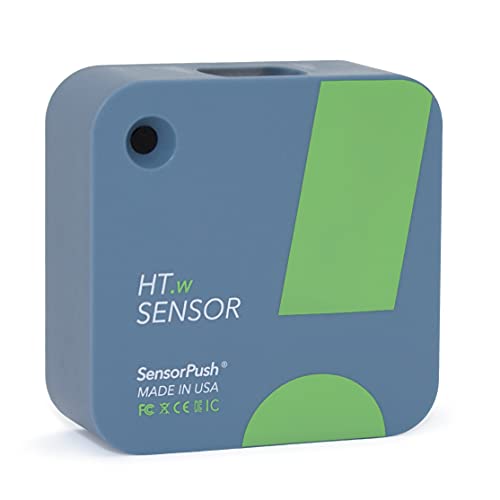
SensorPush offers a lightweight, straightforward approach to continuous environmental monitoring. It emphasizes a simple setup process that minimizes the friction often associated with sensor installation, which can be advantageous for greenhouse operators who want a quick start. The SensorPush device delivers reliable Bluetooth data, with 1–2 year battery life in typical use and a responsive app that updates when within range. For remote access, a G1 WiFi Gateway can extend monitoring to cloud-based viewing, expanding the ability to review historical data and export logs for long-term analysis.
The platform records temperature, humidity, heat index, dew point, and vapor pressure deficit, providing a comprehensive picture of the climate in your greenhouse. This makes it suitable for growers who value robust data analytics, including the ability to zoom through historical records or export data to other software. Combined with gateway options, SensorPush can be scaled from a single-room setup to a multi-zone greenhouse network as needs evolve.
Buying Guide: Key Considerations For Greenhouse Temperature Sensors
- Connectivity: Choose Bluetooth for simple, device-only monitoring or WiFi for remote access. Some systems also offer LoRa for long-range, non-WiFi setups, which can be useful in large or remote operations.
- Range and Coverage: Assess the sensor’s effective range and whether you need multiple units to cover different greenhouse zones, such as seed beds, propagation areas, and mature plant rows.
- Accuracy and Refresh Rate: Look for sensors with temperature accuracy within about ±0.5–1.0°F and humidity accuracy around ±2–3% RH. A faster refresh (every 10 seconds) helps you respond quickly to conditions.
- Data Logging and Export: Long-term data storage and easy export are valuable for analyzing seasonal trends, planning spring schedules, and validating climate-control strategies.
- Alerts and Notifications: Threshold-based alerts reduce response times to critical changes. Verify whether alerts are delivered via app, email, or SMS depending on the system.
- Power and Battery Life: Battery-powered sensors reduce wiring complexity. Check battery life ratings to minimize maintenance, especially in hard-to-reach greenhouse corners.
- Scalability: If your operation grows, a system that supports multiple sensors, grouping, and gateway options will simplify expansion and data centralization.
- Ease of Use: A quick setup, intuitive app, and clear data visualization help keep greenhouse managers efficient, especially during peak growing seasons.
- Durability: Look for devices built to handle greenhouse humidity and temperature fluctuations. Water resistance or enclosure protection can extend sensor life in humid environments.
- Privacy and Security: For Bluetooth-only systems, ensure data remains locally stored if preferred. For cloud-connected devices, review data privacy and encryption options.