Carpenter ants can cause structural damage if left unchecked, so choosing an effective spray is essential for containment and prevention. This guide reviews five top-rated insecticides designed to target carpenter ants and other wood-destroying pests, with interior and exterior applications. Each product section includes practical application guidance and key features to help you decide which spray fits your needs and living space.
Summary of selected products:
| Product | Brand | Form | Indoor/Outdoor | Key Benefit |
|---|---|---|---|---|
| Spectracide Terminate | Spectracide | Liquid with AccuShot | Both | Long-lasting control indoors; kills carpenter ants on contact |
| TERRO Ready-to-Use Aerosol | Terro | Aerosol | Indoor/Outdoor | Fast-acting with precision nozzle |
| BioAdvanced Ready-to-Use | BioAdvanced | Spray (1 Gal) | Outdoor/Indoor | Kills 75+ pests; versatile for exteriors |
| BioAdvanced Concentrate | BioAdvanced | Concentrate | Outdoor | Broad pest spectrum; effective in landscapes |
| Revenge Termite & Carpenter Ant Killer | Bonide | Concentrate | Outdoor | Long-lasting exterior barrier |
Spectracide Terminate Termite And Carpenter Ant Killer

Spectracide Terminate provides indoor and outdoor control, including carpenter ants, termites, and carpenter bees. The product offers up to nine months of indoor protection and emphasizes immediate contact kill with residual activity. The AccuShot sprayer facilitates targeted application in cracks and crevices around baseboards, foundations, and infested wood structures. It is designed for homeowners seeking a broad-spectrum solution that reduces repeated treatments while addressing multiple wood-destroying pests.
TERRO Ready to Use Indoor And Outdoor Aerosol
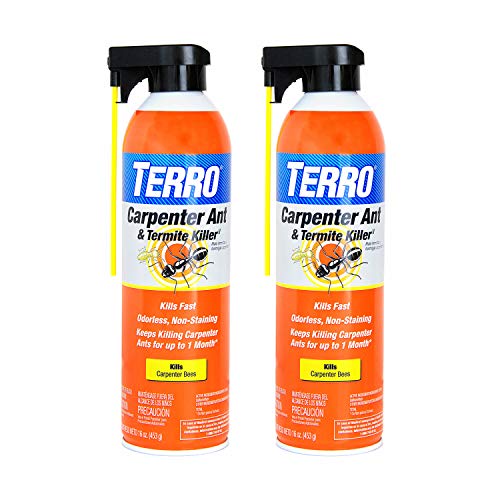
Terro’s ready-to-use aerosol targets carpenter ants, termites, and carpenter bees with a fast-acting formula and long-lasting residual control. The two-way nozzle enables broad applications or precision treatment in cracks and crevices, making it suitable for wall voids, entry points, and baseboard lines. This product is ideal for homeowners who want a straightforward spray for quick responses to visible ant activity and for periodic preventive spraying.
BioAdvanced Carpenter Ant & Termite Killer Plus, Ready-to-Use

BioAdvanced Ready-to-Use offers broad-spectrum control for over 75 pests, including carpenter ants, termites, fleas, ticks, and more. The included pump-style sprayer with an adjustable nozzle allows precise indoor and outdoor application, making it versatile for spraying baseboards, wood piles, lawns, and around home structures. Homeowners seeking a single-product solution with wide pest coverage may find this option convenient for year-round protection against wood-destroying insects.
BioAdvanced Carpenter Ant & Termite Killer Plus, Concentrate

BioAdvanced Concentrate is designed for outdoor use with a broad pest target, including termites, carpenter ants, spiders, and many others. When mixed as directed, it provides a flexible outdoor treatment option for lawns, decks, and around home structures, creating a protective barrier against wood-destroying insects and other pests. This concentrate is suitable for homeowners who prefer a scalable solution for larger outdoor areas and long-term outdoor protection.
Revenge Termite & Carpenter Ant Killer

Bonide’s Revenge Termite & Carpenter Ant Killer is a 32-ounce concentrate designed for outdoor perimeter treatments. It targets subterranean termites, carpenter ants, carpenter bees, and other pests, forming a longer-lasting barrier to protect lawns and the exterior of structures. The formulation supports trenching or soil-application strategies to deter termite colonies from approaching wood structures, making it suitable for preventive exterior protection and serious infestations alike.
Buying Guide: Key Considerations For Choosing The Right Carpenter Ant Spray
- Target pests and spectrum: If you’re dealing with multiple wood-destroying insects, choose a product labeled for termites, carpenter ants, and carpenter bees to simplify treatment plans.
- Indoor vs outdoor use: Some sprays are optimized for interior application (baseboards, walls, cracks) while others are designed for exterior barriers (perimeter, soil trenches, wood piles). Consider your infestation location and preferred treatment zones.
- Residual protection: Look for products that advertise residual control, as this reduces the frequency of reapplication and helps deter reinfestation between treatments.
- Application method: Sprays with adjustable nozzles, AccuShot triggers, or dual-nozzle designs offer greater precision in hard-to-reach spots like cracks, voids, and foundation gaps.
- Safety and usage: Natural or plant-based options (like peppermint oil sprays) can be safer for households with pets and children, but ensure proper labeling and follow-up cleaning as needed for surface safety.
- Application density and coverage: Large outdoor areas or multi-room indoor infestations may require concentrates or bigger-volume containers to ensure thorough coverage and barrier effectiveness.
- Environmental impact: Consider the impact on beneficial insects and run-off potential; choose products with clear label directions for lawn and garden use if you plan outdoor applications.
- Cost vs. value: While concentrates may require mixing, they can deliver broader coverage and longer-term protection, potentially reducing total costs over time.
Table of contents highlights: product range spans ready-to-use aerosols for quick spot treatments, ready-to-use indoor/outdoor sprays for broad coverage, and concentrates for large outdoor perimeter defenses. Users can tailor their approach based on infestation severity, location, and maintenance preferences, balancing immediate kill with longer-term prevention.