For homeowners navigating steep, uneven terrain, the right robotic lawn mower can save time and protect turf. This guide explores models designed to handle significant slopes, offering stability, smart navigation, and efficient cutting. Below, you’ll find five top picks that combine powerful traction, adaptive cutting, and remote control or app-based features to keep hills and banks looking manicured without manual effort.
Summary of chosen products
| Product | Brand | Key Slope Handling | Cutting Width | Navigation Type | Approx. Coverage |
|---|---|---|---|---|---|
| Segway Navimow i210 AWD | NAVIMOW | 45% (24°) Slopes | 7.1 in | AI Mapping + AWD | ~0.25 acre |
| ACFARM Robotic Lawn Mower | ACFARM | 25° Slopes | 7 in | App Control | 1/2 acre |
Note: The table highlights slopes and capabilities from the models reviewed. Each mower varies in runtime, battery capacity, and boundary setup needs. Review installation requirements to ensure optimal performance on your property.
Segway Navimow i210 AWD: All-Wheel Drive For 45% Slopes

The Navimow i210 AWD features all-wheel drive and automotive-grade stability control designed to conquer 45% slopes (24°). Its 7.1-inch cutting deck can be set from 2 to 3.6 inches, delivering a consistent finish on uneven ground. The AWD system helps maintain traction on banks and rough patches, reducing turf tearing and wheel slip. An on-demand drive mode elevates torque when needed, extending a battery life capable of covering about 2,690 square feet per charge. Ideal for steep lawns where traditional mowers struggle, this model combines smart mapping with efficient energy use.
Key benefits related to slopes include controlled turning that minimizes turf damage and a larger deck that helps ensure even clipping across varied terrain. The included vision-based navigation and mapping work to plan efficient cutting paths, reducing the need for manual adjustments. Battery capacity and software features contribute to reliable operation across your sloped landscape.
ACFARM Robotic Lawn Mower: 47% Slope Tolerance

The ACFARM mower is designed for steeper lawns with a climbing capacity up to around 25 degrees (47% slope in some listings). It uses a three-blade disc-cutting mechanism with a 7-inch width and adjustable cutting height from 0.8 to 2.4 inches. The mower supports up to half an acre of mowing and includes safety sensors to respond to rain or tilt, protecting both the unit and your landscape. It’s controlled via a smartphone app, enabling scheduling and adjustments without bending over the unit.
For steep terrains, the robust motors and efficient energy usage help sustain longer runtimes. The randomized cutting pattern helps prevent heavy wear in one area while eventually delivering an even finish across sloped zones. Noise remains within typical expectations for cordless robotic mowers, making it a practical option for multi-level yards with gradients.
Redkey MGC1000: Precise Positioning On Slopes

The Redkey MGC1000 emphasizes precise positioning with C-TOF technology, delivering stable signal transmission for real-time route planning on sloped lawns. This model supports a boundary-free approach to mapping, relying on intelligent sensors rather than wires. It also features adjustable cutting height and a robust automatic recharge system, ensuring the mower returns to its dock when the battery runs low. The emphasis on precise location tracking helps maintain consistent mowing on uneven terrains where boundary setup can be challenging.
The MGC1000’s obstacle detection and breakpoint detection support efficient mowing around trees and slopes, maintaining coverage even when factors like tall grass or uneven ground could otherwise interrupt a clean cut. For properties with varied elevations, this model offers a balance of autonomy and control for reliable lawn maintenance.
YARDCARE M800Plus: GPS + Vision Navigation
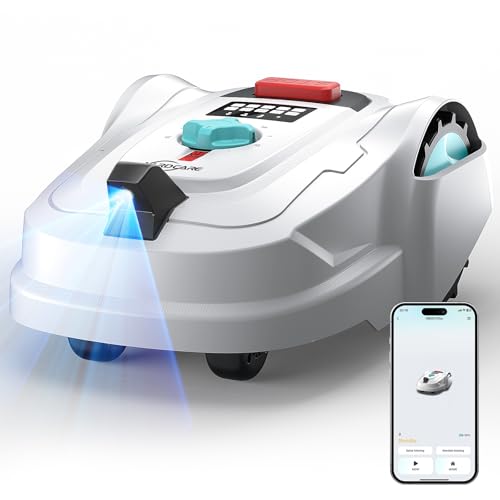
The YARDCARE M800Plus combines GPS and 3D vision navigation to map lawns without boundary wires. It tackles slopes up to about 35% (20°) and uses a mix of partial orderly mowing and longer random passes to fill in gaps. The camera-based system helps distinguish grass from non-grass areas, improving edge adherence and coverage on irregularly shaped lawns. It is suitable for yards around 8,611 square feet and includes obstacle detection to reduce collisions with outdoor objects.
For steep or irregular properties, the absence of physical boundary wires reduces setup complexity while maintaining reliable mowing patterns. The system’s AI-driven path planning seeks to optimize routes for efficient coverage on slopes, though taller grass may require manual pre-trimming to ensure optimal cutting results in one pass.
ECOVACS Goat O1000 RTK: Boundary-Free Mapping

The ECOVACS Goat O1000 RTK model eliminates perimeter wires by using advanced mapping and RTK navigation. It offers 3D obstacle avoidance and zero-edge cutting, ensuring edge-to-edge coverage with minimal manual trimming. The RTK cloud-based accuracy supports large, irregular properties and steep slopes, delivering precise mowing patterns across varied terrain. This model emphasizes complete yard mapping from day one, minimizing gaps and missed patches on sloped lawns.
With robust obstacle avoidance and a focus on safe operation near pets and outdoor objects, the Goat O1000 provides a cloud-driven approach to lawn management. It is particularly appealing for users seeking wire-free setup and reliable coverage on challenging slopes and irregular borders.
Worx Landroid Vision Cloud 4WD: 84% Slope Handling

The Worx Landroid Vision Cloud 4WD uses RTK cloud navigation and advanced 4WD traction to tackle slopes up to 84% (about 40°). Its auto-mapping feature helps understand lawn shapes and boundaries, improving edge following and coverage across steep grades. The model supports app control and obstacle avoidance, offering a comprehensive solution for complex landscapes. With front-wheel steering and a focus on maintaining turf health, this mower aims to minimize turf damage on transitions and zones where slopes meet level ground.
As a high-capability option, the Vision Cloud model appeals to users needing strong traction and precise navigation on challenging terrains. The trade-offs may include more complex initial setup and reliance on cloud services for mapping, but the potential for thorough coverage on very steep lawns is notable.
Buying Guide: Key Considerations For Steep Slopes
- Slope rating and traction: Look for all-wheel drive or four-wheel drive models rated to handle significant slope percentages. Traction control and chassis design matter on loose or uneven ground.
- Navigation and mapping: Hardware options include boundary wires, GPS+vision, RTK cloud mapping, and AI obstacle avoidance. Boundary-free models reduce setup friction but may rely on cameras and cloud services.
- Cutting height and deck size: Wider decks and adjustable cutting heights help achieve even results on slopes and uneven surfaces. Consider how height settings affect turf health on banks.
- Battery life and runtime: Slope mowing consumes more power. Choose models with ample battery capacity and efficient drive modes to maximize per-charge coverage on hilly properties.
- Obstacle detection and safety: Cameras and sensors that detect obstacles, pets, and children reduce collision risks on complex landscapes.
- Smart features and app control: Scheduling, remote operation, and automation can improve convenience, especially for properties with varied mowing needs across elevation changes.
- Installation considerations: Wire-free systems require stable Wi-Fi or GPS access, while boundary wires need careful placement around slopes and banks to prevent missed areas.
- Maintenance and durability: Sloped lawns can introduce more wear on wheels and blades. Check blade replacement intervals and service availability in your area.
When selecting a mower for steep terrain, align the model’s capabilities with your yard’s specific slopes, boundary shape, and mowing frequency. A hybrid approach—combining robust traction with intelligent mapping—often yields the most consistent results across multiple sections of a sloped property.