Finding the right rain barrel irrigation pump starts with knowing your water source, garden size, and power preferences. This guide highlights five well-suited options for American gardeners using rain barrels, harvesting more from every drop while keeping setup simple. Best for small to medium gardens, portable rigs, and off-grid setups, these pumps cover AC, DC, solar, and cordless categories. Each pick is explained with who it’s best for, why it stands out, and a practical limitation to consider.
ECO-WORTHY 33-Series Industrial Water Pressure Pump
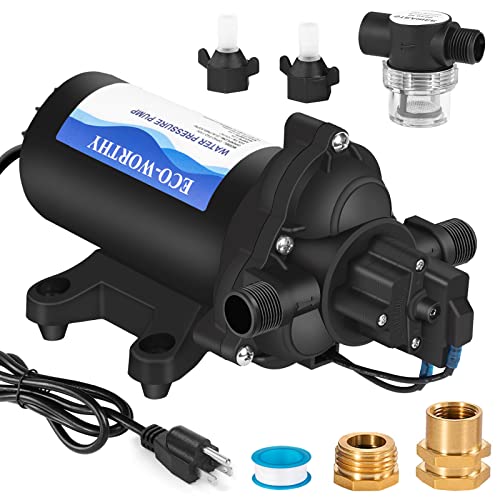
The ECO-WORTHY 33-Series is a 110V AC diaphragm pump designed for off-tank irrigation use. It delivers about 4.0 GPM at 50 PSI and includes a smart pressure switch that starts and stops with faucet use. This model is ideal for homeowners who want a reliable, plug-in option that doesn’t require a battery or solar setup. It can self-prime up to 9.8 feet and lift to 131 feet, making it suitable for a single rain barrel feeding multiple zones. A built-in thermal protector guards the motor against overheating, adding a layer of safety during longer watering sessions.
Best for: Small to medium rain-barrel systems that stay near a power outlet and need consistent flow control. This pump is a strong choice if you prefer a straightforward, non-battery solution with automatic on/off based on faucet demand. Limitation: It relies on AC power availability, which may require extension cords or a nearby outlet in some setups.
RAINPOINT Compact Programmable Solar Automatic Plant Waterer Kit
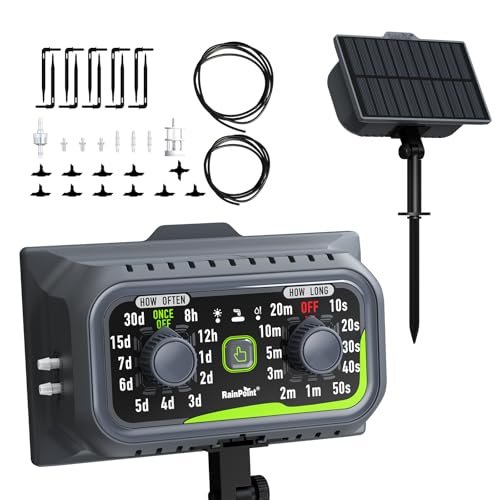
This compact solar irrigation kit is designed for indoor or outdoor use without mains power. It is programmable to water 10–20 plants through a drip system, making it well-suited for rain barrel users who want self-contained solar operation. The dial-based programming lets you set daily watering intervals, which simplifies keeping a diverse plant collection hydrated while away. It delivers a modest lift suitable for small to medium installations and reduces water waste through timed dosing.
Best for: Gardeners who prefer a solar-powered, low-maintenance solution for moderate plant loads and busy schedules. Limitation: It is marketed for 10 plants per kit and may require expansion components if you grow more; expansion kits are sold separately.
Algreen 500GPH Rain Barrel Pump Kit

The Algreen 500GPH Rain Barrel Pump Kit provides a direct watering solution from rain barrels with an integrated pump, garden hose fittings, and clamps. It’s designed for direct watering from up to two barrels and includes a submersible pump with flow control. This kit is a practical, all-in-one choice for homeowners who want to set up a simple rain-barrel watering system without piecing together multiple components. It emphasizes immediate usability and compatibility with standard garden hoses.
Best for: Users who want an all-in-one rain barrel watering system ready to install from the start. Limitation: The kit focuses on up to two rain barrels and basic flow control, which may be limiting for larger setups needing higher flow or more barrels.
VEVOR 12V DC 1.2 GPM Diaphragm Pump

The VEVOR 12V DC pump delivers 1.2 GPM at up to 80 PSI. It’s a compact, 12V solution suited for rain-barrel setups with a small water demand, such as drip irrigation lines or a single garden bed. The two-chamber diaphragm design helps minimize water pulsation, while a copper motor provides durability. It includes protective features like overheating and overload protection to extend service life. The low-noise operation is helpful for quiet residential use, especially in urban or allotment garden spaces.
Best for: Off-grid or portable rain-barrel projects requiring a compact, battery-powered option. Limitation: It demands a 12V power source and may be less ideal for high-flow needs or larger irrigation zones.
RISINGUP Solar Drip Irrigation System

This solar-powered drip system is designed to draw water from rain barrels or other containers. With a 900 ml/min pump, it targets up to 30 pots and provides adjustable watering durations and frequencies. A memory function preserves settings after power loss, and there’s an audible low-water or clog alarm. It’s particularly effective for larger patio gardens or greenhouses where mains power is less convenient, and solar energy helps reduce utility usage over time.
Best for: Gardeners who want a programmable, solar-powered drip solution capable of irrigating multiple pots with minimal daily attention. Limitation: Setup guidance notes emphasize careful plug insertion; improper sealing can impact performance in less-than-ideal weather.
Summary Table of Chosen Products
- ECO-WORTHY 33-Series Industrial Water Pressure Pump — 110V AC, 4.0 GPM, 50 PSI — Best for near-outlet, plug-in simplicity.
- RAINPOINT Compact Programmable Solar Automatic Plant Waterer Kit — Solar-powered, programmable — Best for off-grid, busy schedules.
- Algreen 500GPH Rain Barrel Pump Kit — All-in-one kit for direct watering from two rain barrels — Best for quick-start setups.
- VEVOR 12V DC 1.2 GPM — Battery-powered, compact — Best for portable or off-grid use with a 12V source.
- RISINGUP Solar Drip Irrigation System — Solar, adjustable, supports many pots — Best for multi-pot installations with solar autonomy.
Buying Guide
What size pump do I need for my rain barrels?
Rate your garden’s water demand first. If you’re watering a few raised beds or 6–12 pots, a pump in the 1–4 GPM range is typically sufficient. For larger gardens or two-barrel setups, look for higher GPM and PSI to ensure even distribution without stalling.
Should I choose AC, DC, or solar pumps?
AC pumps are simple and powerful but require a nearby outlet. DC pumps (12V or 24V) offer portability and battery compatibility, ideal for off-grid setups. Solar pumps minimize running costs and are best when sun exposure is reliable and pumps are used during daylight hours.
How important is self-priming and lift height?
Self-priming helps when the pump starts from a rain barrel that’s not fully full. Lift height matters if your garden beds are located above the barrel or if the water must travel uphill. Choose a model with a priming capability and a lift height that matches your layout.
What safety features should I look for?
Thermal overload protection helps prevent motor burnout. Overheat protection, water-resistant casings, and built-in pressure switches that shut off when fixtures aren’t in use add reliability and safety for long watering sessions.
What accessories matter for installation?
Common needs include garden hose fittings, clamps, adapters, and tubing. All-in-one kits reduce guesswork, while separate components give flexibility to customize connections and add more barrels or zones as needed.
How do I maintain a rain barrel irrigation pump?
Regularly inspect hoses and fittings for leaks, clean debris from strainers, and ensure the water source remains free of sediment. For solar and battery-powered units, follow the manufacturer’s guidance on battery health and sun exposure to maximize life and efficiency.
Installation considerations for a rain-barrel system
Place the rain barrel pump on a stable surface with outlet access or a mount. Ensure the discharge path directs water away from foundations and into the irrigation lines. If you’re using multiple barrels, consider a distributing manifold to balance flow and prevent backflow.
Quick decision checklist
- Power availability: AC, DC, or solar?
- Required flow: 1–4 GPM for typical home gardens
- Elevation: can the lift height meet your needs?
- Number of barrels: single vs. dual or more
- Automation: need programmable schedules?
FAQ
- Do rain barrel pumps require a battery?
- Can I use a rain barrel pump for lawn irrigation?
- Is self-priming necessary?
- What maintenance is typical for these pumps?
- Can I expand a rain-barrel system later?
Not always. Some models run on AC power or solar energy; others are DC-based and can use a small battery or a solar panel as the power source.
Yes, if the pump provides enough flow and pressure for the lawn zone. For large lawns, high-GPM models with adequate PSI work best.
Self-priming is helpful when the barrel isn’t fully filled or piping runs uphill. It reduces the hassle of manual priming before watering.
Check fittings for leaks, clean filters or strainers, and ensure electrical components stay dry and dry-rated. Solar and battery systems may require occasional battery checks or solar panel cleaning.
Yes. Many systems support additional barrels or longer irrigation runs with adapters, manifolds, or extra tubing. Start with a scalable solution if you anticipate growth.