Finding a reliable solar lighting solution for a chicken coop helps support hen welfare, consistent egg production, and energy cost savings. This guide reviews five programmable solar lights designed for poultry coops, barns, and off-grid settings. Each option offers color options, dimming levels, timers, and weatherproof design to stand up to outdoor use.
| Product | Brand | Key Feature |
|---|---|---|
| Solar Chicken Coop Light with Timer | Three-Color Dimmable LED | Unbranded | Three-color modes, four brightness levels, remote timer |
| Solar Chicken Coop Light with Timer | 3-Color Dimmable LED, IP66 | TSJKPAYL Store | Three-color modes, 4 brightness levels, IP66 weatherproof |
| Solar Chicken Coop Light with Remote, IP66 Pendant | Unbranded | Remote control, 3 modes, 4 brightness levels, 24H timer |
| Automatic LED Daylight Extender for Chicken Coop | Neitra Store | Extends daylight hours, simulates natural daylight |
| Solar Light Bulbs for Indoor Home and Chicken Coop | Lampelc Store | Solar powered bulb for sheds and coops, 100 sq ft coverage |
The products below are organized to help compare how each option supports poultry environments, with emphasis on schedule control, color temperature, battery capacity, and weatherproofing. All five selections are suitable for coops, barns, and other off-grid spaces where dependable, programmable lighting matters.
Three-Color Dimmable Solar Coop Light With Timer

This solar coop light offers white, warm white, and a combined setting to provide a calm, poultry-friendly environment. Four brightness levels allow subtle illumination or stronger lighting for coop work. The system uses a 5W solar panel and a 4500mAh battery, delivering up to 48 hours of light after six hours of sun (at low brightness). A USB charging option helps when weather blocks sun, maintaining dependable operation during extended overcast periods. The remote timer supports 2, 4, or 8 hours, and a light sensor turns the light on at dusk automatically.
Three-Color Dimmable Solar Coop Light With IP66 Cord
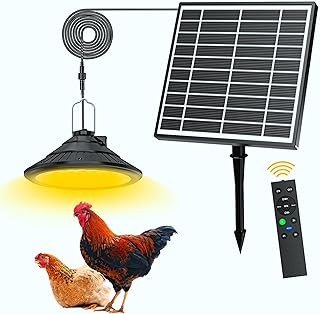
This model emphasizes durability with an IP66 rating and a 16.4-foot waterproof cord for flexible installation in remote coops. It provides three color modes and four brightness levels similar to the first option, aiming to match poultry circadian rhythms. The solar panel and battery deliver long-lasting performance with a 48-hour illumination window after a full sun day, and the kit includes a 5-meter waterproof cord to simplify outdoor routing and protect connections from rain and dust. The weatherproof design helps maintain consistent performance through temperature swings.
Solar Coop Light With Remote And Auto Sensor
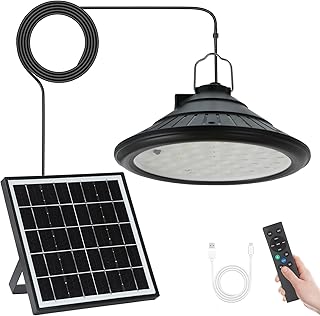
This pendant-style light provides remote control, three lighting modes, four brightness levels, and a 24-hour timer. It supports both solar and USB-C charging, enhancing reliability during variable weather. The light sensor automatically turns the unit on at dusk and off at dawn, preserving energy, while the 4500mAh battery supports up to 48 hours of light at 10% brightness after six hours of sun. A 16.4-foot cord adds flexibility for placement in larger coops or sheds.
Automatic Daylight Extender For Chicken Coops

The daylight extender focuses on egg-production optimization by simulating longer daylight hours. It uses dual 3000K warm LEDs to achieve a dawn-to-dusk transition that aligns with natural daylight patterns. Programmable timing and brightness control let users tailor the extender to seasonal needs, supporting hens’ welfare and consistent egg output during shorter days. This option emphasizes consistent light duration over color variety, making it a useful supplement to other ambient coop lighting.
Solar Light Bulbs For Indoor Home And Chicken Coop

These solar bulbs provide a flexible lighting option for sheds, coops, and garages. The system is designed for indoor-outdoor versatility with a long cord length and solar charging capability for off-grid usage. Coverage estimates suggest a single bulb can light roughly 100 square feet, which makes it suitable for smaller coops or as a supplementary light source when paired with other solar fixtures. The included charger functionality enables mobile phone charging as a secondary benefit in remote locations.
Buying Guide
- Power source and reliability: Look for models with high-efficiency solar panels (around 5W) and a rugged battery (around 4500mAh) that can sustain 24–48 hours of operation on a full charge. USB-C or USB charging provides a fallback during prolonged cloudy periods.
- Light quality and customization: Aim for options offering multiple color temperatures (white and warm white, with combined modes) and several brightness levels. This helps align lighting with poultry circadian rhythms and reduces stress from harsh glare.
- Programmable features: Timers (2, 4, 8 hours), auto on/off sensors, and dimming controls support energy efficiency and consistent day-length signaling, especially in off-grid setups.
- Durability and weather resistance: for outdoor use, prioritize IP66 or higher ratings, sealed housings, and cord protection to withstand rain, dust, and temperature swings.
- Installation flexibility: Longer cords (16.4 feet) and remote operation capabilities simplify placement in larger coops and varied enclosure layouts without complicated wiring.
- Maintenance considerations: Seek units with straightforward remote controls and durable components to minimize maintenance. Consider models with auto-sensing features to reduce manual intervention.
- Safety and impact on welfare: Favor lighting that minimizes glare and respects poultry welfare. Gradual transitions and shorter, consistent daylight simulations can support egg production and hen well-being during winter.
- Lifecycle and warranties: Check for manufacturer guarantees or warranties, especially for solar components exposed to outdoor conditions. A longer warranty often signals durable construction.
In summary, programmable solar lights designed for chicken coops can improve welfare and egg production while cutting energy costs. Evaluate options by color versatility, timer flexibility, weatherproofing, and installation practicality to choose the configuration that best fits the coop’s size, climate, and off-grid needs.