Answering the need for natural, low-impact fly control for cattle, this guide highlights five effective options that emphasize safety, environmental friendliness, and practical on-farm use. The selections suit ranchers seeking non-toxic or botanical approaches, organic-minded operators, and those prioritizing residue-free methods. Each product is evaluated for how it works, who it’s best for, and any important limitations.
| Product | Best For | Key Benefit |
|---|---|---|
| UltraCruz Livestock Natural Fly and Tick Spray | Small to mid-sized herds needing a pesticide-free option | Natural essential oils for insect repellence |
| JustiFLY Feedthrough Cattle Fly Control (Single) | Pasture-based operations needing larvicide on-farm | Targets fly life cycle with non-toxic formulation |
| Co-RAL Fly & Tick Spray | Beef and dairy cattle requiring residual protection | Direct-on-animal spray with lasting control |
| Absorbine UltraShield Green Fly & Insect Repellent | Horses, dogs, and cattle-friendly botanical blend | Natural essential oils for repelling pests |
| JustiFLY Feedthrough Cattle Fly Control (6 Pack) | Large herds with recurring fly pressure | Economical larvicide for continuous use |
Buyer note: Each product’s suitability depends on farm layout, fly species present, and rotation plans. Consider integrating a combination approach (on-animal spray plus feedthrough or larvicide) for broader coverage across adult flies and larvae.
UltraCruz Livestock Natural Fly and Tick Spray

Product overview: UltraCruz offers a livestock insect repellent designed to deter flies, ticks, mosquitoes, and gnats. The formula is pesticide-free and eco-friendly, relying on natural essential oils to repel pests. This makes it a favorable option for producers seeking a safe, plant-based alternative that is easy to apply on animals.
Best for: Small to mid-sized herds that prioritize a natural repellent without synthetic pesticides. It is suitable for between-pasture spraying and routine applications during peak fly seasons.
Why selected: This product aligns with natural and sustainable farming goals, using essential oils to deter insects rather than relying on harsh chemicals. It provides a convenient on-animal spray solution with broad repellent coverage.
Limitation: While effective for deterrence, it may require frequent reapplication, particularly in humid or wet conditions where oils can rub off or evaporate faster.
Champion USA JustiFLY Feedthrough Cattle Fly Control (Single)

Product overview: JustiFLY is a feedthrough larvicide designed to break the life cycle of horn flies, stable flies, house flies, and face flies. The single-pack format treats one 50-pound bag of free-choice mineral, making it practical for one-time or ongoing on-farm use.
Best for: Producers seeking a non-toxic larvicide option that acts on the fly life cycle and can be integrated into mineral feeding regimes.
Why selected: This product targets multiple fly species via larval control, offering a cost-effective approach that supports long-term fly suppression across the herd.
Limitation: The product is a larvicide and should be used as part of an integrated pest management plan; effectiveness depends on proper mixing with minerals and consistent use.
Co-RAL Fly & Tick Spray
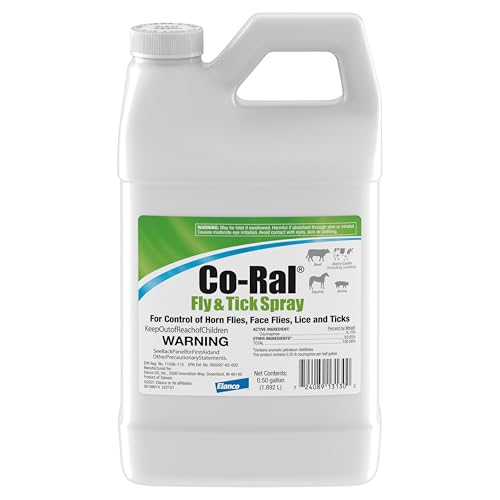
Product overview: Co-RAL Fly & Tick Spray provides direct-on-animal insecticide protection and claims both initial and residual control against horn flies, face flies, lice, and ticks on cattle, swine, and horses. It supports residual activity after application.
Best for: Beef and dairy cattle needing sustained protection from multiple pests with a single spray treatment per animal session.
Why selected: It emphasizes onboard application with lasting effects, useful in farms where insects are a recurrent problem and a longer interval between sprays is desirable.
Limitation: As with any chemical spray, careful handling and compliance with label directions are essential to minimize exposure risks for animals and handlers.
Absorbine UltraShield Green Fly & Insect Repellent

Product overview: Absorbine UltraShield Green uses botanical essential oils to repel and control pests on animals, including biting flies, mosquitoes, ticks, and gnats. The formula emphasizes an eco-friendly approach with a fresh botanical scent.
Best for: Riders and livestock operations that prefer a natural fragrance and plant-based protection for horses, dogs, and cattle alike.
Why selected: The botanical composition provides a clear natural alternative to synthetic repellents, suitable for farms seeking lower chemical exposure and a gradual repellent effect.
Limitation: Botanical blends may require more frequent reapplication in hot or sweaty conditions to maintain strong repellent coverage.
Champion USA JustiFLY Feedthrough Cattle Fly Control (6 Pack)

Product overview: This is the six-pack version of the JustiFLY feedthrough larvicide, designed for larger herds or farms with ongoing fly pressure. It treats free-choice minerals to disrupt the fly life cycle and reduce population growth over time.
Best for: Large operations that want a bulk option to maintain continuous larval control alongside other fly-management strategies.
Why selected: The 6-pack format increases convenience and cost-effectiveness for farms requiring steady, long-term larval suppression across multiple pastures or herds.
Limitation: Like the single-pack variant, it relies on consistent mineral supplementation and integrated pest management for optimal results.
Buying Guide: Natural Fly Control For Cattle
What should you consider when choosing natural fly control?
- Target pest profile: Identify the dominant flies (horn flies, face flies, stable flies, biting flies) and choose products addressing those species.
- On-animal vs. larvicide: On-animal sprays offer immediate repellence, while larvicides (feedthrough) reduce new adult populations over time. Combining both often yields better year-round control.
- Safety and environment: Prefer pesticide-free or botanically derived formulations where possible, especially near calving or lactating animals.
- Feedthrough logistics: If using larvicides, ensure compatibility with minerals and administration routines to maximize effectiveness.
- Residual activity: Some products provide longer protection after application; plan rotations to avoid resistance and ensure continuous coverage.
- Applicator handling: Consider ease of use, spray patterns, and required application frequency to balance labor and effectiveness.
Practical Buying Considerations
- Herd size and management style: Large herds may benefit from bulk larvicide packs, while smaller operations might prefer ready-to-use sprays.
- Pasture layout and rotation: Farms with multiple pastures may need products with strong residual effects to reduce re-infestation during moves.
- Non-target impact: Evaluate environmental safety and potential effects on beneficial insects when selecting products.
- Regulatory compliance: Follow label directions and local regulations for use and withdrawal periods if applicable.
FAQ
- What is the difference between spray-on repellents and larvicides?
- Can I use these products on lactating cows?
- How often should I reapply natural repellents?
- Is a combination of spray and feedthrough recommended?
- Are botanical repellents effective for all horseflies and mosquitoes?
- What should I do if fly pressure remains high after treatment?
Spray-on repellents deter adult flies from landing on cattle, while larvicides disrupt the life cycle by reducing new adult flies from larvae in the environment.
Yes, several products in this list are labeled for use on beef and dairy cattle, including lactating animals, but always follow the product label for safety instructions.
Frequency depends on environmental conditions, rainfall, and animal activity. In hot or wet conditions, reapplication may be more frequent to maintain protection.
Yes. An integrated approach that combines a spray-on repellent with a larvicide feedthrough (or other long-acting control) generally provides broader and longer-lasting fly control.
Botanical repellents offer strong deterrence against many pests, but performance can vary by species and environment. They are often best as part of a multi-faceted strategy rather than a sole solution.
Review rotation plans, ensure proper application according to labels, and consider adding a complementary product (e.g., a different mode of action) to break the pest life cycle more effectively.