Choosing the right liquid weed control helps keep lawns green and healthy while targeting common broadleaf weeds. The products below offer a range of active ingredients, application styles, and fertilizer components. This guide highlights five well-regarded options for American lawns, with a focus on broadleaf weed control, compatibility with common turfgrass, and ease of use.
| Product | Brand | Key Benefit | Form |
|---|---|---|---|
| Scotts Liquid Turf Builder with Plus 2 Weed Control | Scotts | Kills weeds and boosts greening with fertilizer | Liquid weed killer + fertilizer |
| Liquid Harvest Lawn Weed Killer – Gallon | Liquid Harvest | Three-way control for broadleaf weeds | Concentrate liquid |
| Liquid Harvest Lawn Weed Killer – 32 Ounces | Liquid Harvest | Three-way control, low-odor formulation | Concentrate liquid |
| Southern Ag Amine 2,4-D WEED KILLER | Southern Ag | Economical broadleaf weed control for turf and more | Liquid concentrate |
| Scotts Liquid Turf Builder 2 Step Lawn-Care with Plus 2 Weed Control and Food | Scotts | Two-step care with weed control and lawn food | Liquid weed control + fertilizer |
Note: All products listed are for lawn use and target broadleaf weeds. Always follow label directions for correct mixing rates, application timing, and safety precautions.
Scotts Liquid Turf Builder With Plus 2 Weed Control

Scotts Liquid Turf Builder with Plus 2 Weed Control combines weed-killing action with a quick nitrogen boost to promote greener, healthier turf. It targets a range of broadleaf weeds such as dandelion, clover, ground ivy, henbit, chickweed, and plantain, among others. The product is designed for active-growth periods, making it practical for spring or early summer applications when weeds are most vulnerable. The fertilizer content helps feed the lawn while weeds are being controlled, supporting overall turf vigor over time.
Liquid Harvest Lawn Weed Killer – Gallon

This three-way herbicide focuses on broadleaf weeds while minimizing harm to common lawn grasses. With active ingredients including 2,4-D, MCPA, and Dicamba, it provides a robust broadleaf control profile. The gallon size offers convenience for larger lawns, and the formulation is designed to be effective yet relatively low-odor during application, enhancing user comfort during use. Proper watering after application improves weed uptake and performance.
Liquid Harvest Lawn Weed Killer – 32 Ounces

This 32-ounce concentrate provides three-way control against common broadleaf weeds while being formulated to spare most grasses. It carries the same trio of active ingredients (2,4-D, MCPA, Dicamba) for effective weed suppression. The low-odor formulation helps reduce application odor, which can improve the user experience during treatment. As with all concentrates, follow mixing instructions carefully and apply during active weed growth for best results.
Southern Ag Amine 2,4-D WEED KILLER
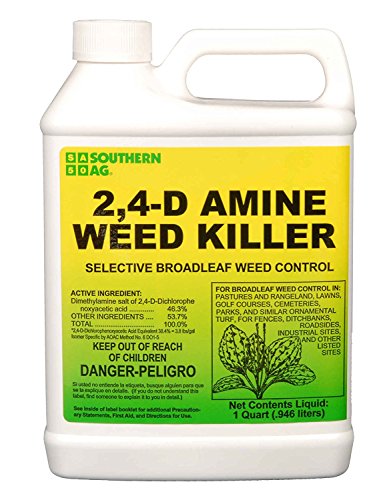
Southern Ag Amine 2,4-D WEED KILLER is an economical option for broadleaf weed control in turf settings. It supports use in turf, pastures, rangeland, ditch banks, fences, and similar outdoor areas, making it versatile for homeowners with larger landscapes or adjacent non-t lawn areas. The product emphasizes a low-use rate while delivering effective control of many broadleaf weeds, which can appeal to budget-conscious buyers seeking broad coverage per application.
Scotts Liquid Turf Builder 2 Step LawnCare With Plus 2 Weed Control

This two-step program combines weed control with lawn food, supporting both weed management and turf nourishment in one package. The Plus 2 Weed Control targets the same broadleaf weeds common in home lawns, including dandelions and clover, while the lawn food helps maintain overall bedrock health for a resilient turf. The approach is convenient for homeowners seeking a streamlined treatment that addresses both weed suppression and feeding needs in a single plan.
Liquid Harvest Mesotrione – 8oz (Compare to Tenacity)

Mesotrione-based products offer pre- and post-emergent weed control for lawns and turf grasses. While effective against many broadleaf and certain grassy weeds, its use is best understood in the context of specific turf types. The 8-ounce concentrate is designed to provide targeted control with a potentially longer residual effect, depending on application timing and weather conditions. Always read product labels for compatibility with your grass species and irrigation requirements after application.
Buying Guide: Key Purchase Considerations
Weed targets and compatibility
Identify the weeds most problematic in your lawn (dandelion, clover, plantain, etc.) and ensure the product’s active ingredients effectively target those species. Verify compatibility with your grass type (cool-season vs. warm-season) to minimize risk of turf injury.
Form and application style
Liquid formulations offer straightforward mixing and rapid uptake, but some homeowners prefer ready-to-use sprays. Concentrates give you more control over dilution but require accurate measuring and mixing. Consider your landscaping size, sprayer capacity, and comfort with DIY mixing.
Fertilizer content and lawn health
Some products include fertilizer (weed and feed) which can boost lawn color and growth alongside weed suppression. If you want a dedicated weed control product, choose a formulation without fertilizer to avoid overfeeding or fertilizer misalignment with your lawn care schedule.
Odor, ease of use, and time to effect
Formulations vary in odor and user experience. Low-odor products can make application more comfortable, especially in close-quarters environments. Note that weed death timing can vary: some weeds die within days, while others may take weeks depending on weather and weed stage.
Re-entry and safety considerations
Follow label guidance on drying times, reentry intervals, and protective gear. Store products safely away from children, pets, and food areas. When treating near ornamental plants or vegetable gardens, check label restrictions to avoid unintended damage.
Cost and coverage
Consider per-acre or per-square-foot coverage, bottle size, and dilution rates to estimate treatment costs over a season. Concentrates may offer more value for larger lawns, while ready-to-use sprays are simpler for small yards.