Choosing the right pH buffer for a koi pond helps maintain stable water conditions, supporting fish health and plant life. This guide highlights effective pH buffering and KH/alkalinity products, suitable for hobbyists and professional pond keepers alike. The selected products are practical for different pond sizes and water chemistry goals.
| Product | ||
|---|---|---|
| The Pond Guy pH Stabilizers | Pond pH Buffer | Small to medium ponds needing steady pH without guesswork |
| Pond pH Buffer, 2 L (Water Garden Oasis) | Pond pH Buffer | Ponds needing buffer between 7.2–8.2 and phosphate-free formula |
| Pond pH Buffer, 4 L (Water Garden Oasis) | Pond pH Buffer | Medium to large ponds requiring sustained pH stabilization |
| Aquascape Alkalinity Booster with Phosphate Binder | KH/Alkalinity Booster | Ponds needing higher KH and alkalinity with phosphate binding |
| API POND pH UP / pH DOWN | pH Up / pH Down | Fine-tuning pH in response to pond conditions |
The Pond Guy pH Stabilizers

The Pond Guy pH Stabilizers are designed to balance pond pH without guesswork, supporting fish health and safe for fish plants and wildlife. This product is best for small to mid-sized ponds with fluctuating pH where a straightforward buffering solution helps maintain consistent conditions. A potential limitation is that it does not specify KH impact beyond pH stabilization, so users with very low alkalinity should monitor total hardness and buffering needs.
Pond pH Buffer, 2 L (Water Garden Oasis)

Designed to raise and buffer pH in decorative ponds, this product maintains a pH range between 7.2 and 8.2 and is phosphate-free. It is better for hobbyists with ponds that house koi and plants but want a straightforward, phosphate-free buffering option. Use skepticism if your pond experiences rapid pH swings, as buffer products typically work gradually and require dosing consistency.
Pond pH Buffer, 4 L (Water Garden Oasis)
This larger-volume buffer raises and stabilizes pH while staying within the 7.2–8.2 range and remaining phosphate-free. It suits medium-to-large ponds or setups needing longer intervals between doses. The main consideration is ensuring proper mixing and distribution, especially in deeper or heavily planted ponds where dosing might need adjustment.
Aquascape Alkalinity Booster with Phosphate Binder

Aquascape’s booster increases overall KH and alkalinity, with lab-tested and pharmaceutical-grade quality. It dissolves completely in pond water, making it suitable for ongoing alkalinity management. Best for ponds that need consistent buffering to neutralize acid inputs and stabilize pH, particularly in climates with seasonal pH shifts. A potential limitation is that it focuses on KH/alkalinity rather than direct pH modification; users should monitor pH alongside KH levels.
API POND pH UP

API POND pH UP raises pond water pH with a phosphate-free formula and slowly neutralizes alkaline substances that cause high pH. This product is best for ponds that experience high pH spikes due to factors like rain, algae growth, or koi waste. Choose this if you need a gradual, controlled pH increase. A limitation is that it does not address low pH corrections; you would pair it with a separate pH DOWN product if needed.
API POND pH DOWN

API POND pH DOWN lowers pond water pH with a phosphate-free formula, slowly neutralizing alkaline substances that cause high pond pH. This is better for ponds that tend toward alkaline conditions or after high pH readings. It is best used in a controlled manner to avoid overshooting pH and stressing koi. Limitations include potential sensitivity in very low alkalinity systems, where buffering capacity is already minimal.
Aquascape Alkalinity Booster with Phosphate Binder (9-Pound)
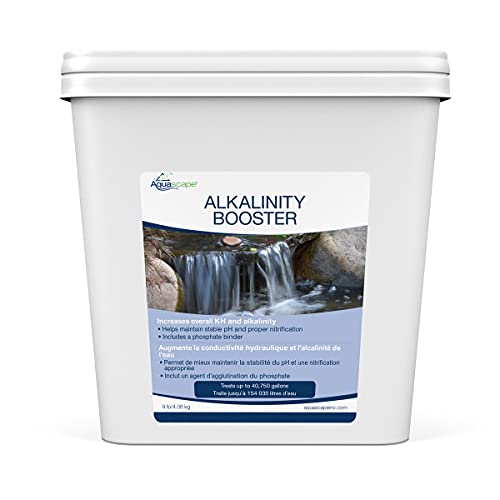
This larger Aquascape alkalinity booster lifts KH and alkalinity levels, with binder to help manage phosphate. It is best for ponds with significant buffering needs or after introducing aeration and fish that drive pH downward. A consideration is the larger bag size requiring appropriate storage and dosing planning for smaller or irregularly sized ponds.
Buying Guide: How to Choose The Right Koi Pond pH Buffer
- What is your pond size and stocking level? Smaller ponds require simpler buffering, while larger koi ponds may need higher alkalinity maintenance (KH) to prevent pH swings.
- Do you need phosphate-free formulas? Phosphate-free buffers prevent nutrient loading that can spur algae growth, beneficial in planted or koi-dense ponds.
- Is your goal direct pH adjustment or KH stabilization? Some products focus on pH alone, others raise alkalinity to keep pH stable over time.
- How quickly should the pH respond? Gradual dosing reduces stress on fish; rapid changes can be harmful.
- How easily can you mix and distribute the product? Deeper ponds or heavily planted ponds may require longer mixing times or multiple dosing points.
- What monitoring plan will you use? Regular testing (pH, KH, ammonia) helps you tune dosing and avoid overshoot.
Frequently Asked Questions
- Q: What is the difference between pH buffer and KH booster? A: pH buffers aim to stabilize the pH directly, while KH boosters raise alkalinity (KH), which helps resist pH changes over time.
- Q: How often should I test pond water after adding a buffer? A: Test after dosing as recommended by the product, then monitor weekly or after significant weather events or feeding changes.
- Q: Can I use multiple buffers at once? A: It’s best to space dosing and ensure compatibility; avoid layering products that may interact unexpectedly. Follow product guidelines.
- Q: Which product is best for a beginner with a koi pond? A: A simple pH buffer labeled for ponds with clear dosing instructions is a good start; consider a separate KH booster if you notice frequent pH swings.
- Q: Should I use phosphate binders with the buffer? A: If using a phosphate binder, ensure compatibility with other buffers; phosphate binds can support algae control alongside pH stabilization.
- Q: What if my pH remains unstable after dosing? A: Reassess alkalinity, aeration, and pond volume; consider a KH/alkalinity booster to build buffering capacity before adjusting pH again.