Answering buyers’ needs: a hydroponic environmental control system helps automate climate, watering, and nutrient delivery for consistent yields. This guide highlights five top options, explaining who each is best for and why they stand out. Ideal for home growers, small tents, or multi-bucket systems seeking automation and reliability. Use the quick comparison table below to choose quickly, then dive into detailed product sections for specifics.
| Product | Best For | Why It Stands Out |
|---|---|---|
| Active Aqua GFO7CB Hydroponic Electric Grow Flow | Growers needing centralized flow control with fail-safe protections | Group hydration, scalable up to many modules, emergency shut-off, robust water flow management |
| MARS HYDRO iControl for Grow Tent | Automated climate control in grow tents | Real-time VPD-based adjustments, stage-based automation, expandability with sensors |
| MARS HYDRO DWC Hydroponics Grow System with iControl | Deep water culture setups needing built-in automation | Includes dual 5-gallon buckets and iControl for temperature/humidity/VPD with automation |
| VEVOR RDWC Hydroponics Grow System | Recirculating deep water culture with top-drip | Strong pump system, multi-bucket configuration, oxygen-rich circulation |
| Ahopegarden Hydroponics Growing System Kit | Compact, smart indoor herb gardens with environmental monitoring | Full-spectrum lighting and LCD monitoring for temperature/humidity with low maintenance |
Active Aqua GFO7CB Hydroponic Flow and Control System

Best for growers who want centralized control of irrigation across multiple modules. The GFO7CB integrates a Grow Flow Controller that can manage up to 24 five-gallon modules or 48 two-gallon modules, ensuring consistent hydration across plant communities. An emergency shut-off valve provides fail-safe overflow protection, and heavy-duty float switches regulate water flow for reliable operation. Submersible pumps synchronize water delivery within plant sites. Choose this if you need scalable, safety-focused water management for larger home setups.
Who it’s best for: home basement or garage growers with several plant sites that require coordinated irrigation and overflow protection. Limitation: setup complexity increases with larger module counts, and it relies on compatible pump and module configurations.
MARS HYDRO iControl for Grow Tent
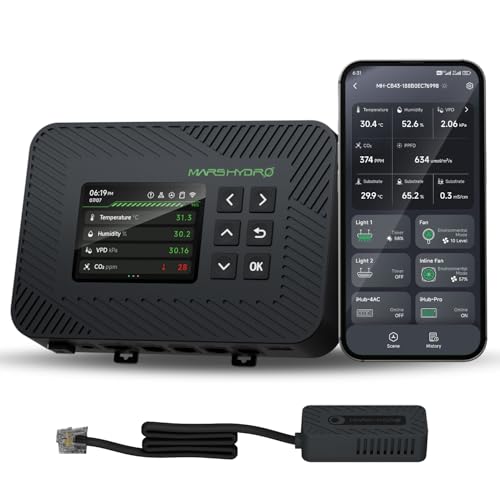
Best for automated climate management inside grow tents. iControl uses temperature and humidity strategies with real-time VPD monitoring and automatic adjustments to fans, humidifiers, and dehumidifiers (RJ12 required). Stage-based automation tailors environmental conditions for seedling, vegetative, and flowering phases, delivering a hands-off cultivation experience. Optional PPFD, soil, and CO2 sensors expand monitoring and automation capabilities. Choose this if you want a comprehensive, automated environmental solution within a tent.
Caution: some features require additional sensors or accessories to unlock full automation, and setup may require planning around power and sensor placement.
MARS HYDRO DWC Hydroponics Grow System with iControl

Best for deep-water culture fans seeking integrated automation. This 5-gallon bucket system includes an 8W air pump, air stones, and a top-drip kit, with iControl support for temperature, humidity, and VPD guidance. The design supports scalable DWC configurations and ensures oxygen-rich roots. Choose this if you want fast growth and higher yields from a dual-bucket setup with smart environmental control.
Limitation: it emphasizes hydroponic water management and may require careful calibration of air flow and nutrient delivery for different crops.
VEVOR RDWC Hydroponics Grow System

Best value for a robust RDWC setup with top-drip capability. The system uses a deep water culture approach with a primary reservoir and multiple buckets, supported by a powerful air pump and air stones to oxygenate the nutrient solution. It balances flow and aeration to promote rapid root growth and stable pH/EC. Choose this if you want a durable, recirculating system with solid pump and aeration performance.
Warning: while comprehensive, RDWC requires regular monitoring of nutrient levels and system seals to prevent leaks across buckets.
URUQ Hydroponics 8-Pod Indoor Garden

Best for compact, smart indoor herb and small-vegetable gardens. This 8-pod system uses a 24-watt LED grow light with adjustable height and a quiet, automated water pump cycle. An LCD display provides real-time temperature and humidity monitoring, plus a low water alarm to prevent plant stress. Choose this if you want a turnkey, space-saving hydroponic setup with automated light and watering in one unit.
Caution: seeds are not included; plan to source compatible plant starts and ensure space for light range and height adjustments.
Buying Guide: Key Considerations for Your Hydroponic Environmental System
- Growing space and scale: Match system size to tent or room dimensions and the number of plants you intend to manage. Larger systems require more robust controllers and monitoring.
- Automation level: Decide between basic timers and full environmental automation with VPD, CO2, and PPFD integration. Consider future expansion if you plan to scale up.
- Sensor variety: Temperature, humidity, pH, EC, and water level sensors improve reliability. Optional sensors (PPFD, CO2, soil moisture) add data-driven control.
- Maintenance needs: Systems with top-drip or RDWC require regular checks on seals, pumps, and nutrient flow paths. Quiet pumps and accessible reservoirs reduce upkeep.
- Compatibility and flexibility: Ensure the controller works with your chosen grow medium (soil-less systems, RDWC, or DWC) and is easy to upgrade with additional modules.
- Safety features: Look for overflow protection, emergency shut-offs, and leak prevention to protect your grow area.
- Energy use and noise: Consider energy-efficient pumps and low-noise designs for residential spaces.
Frequently Asked Questions
- What is an environmental control system in hydroponics?
– It is a setup that automates climate control (temperature, humidity), irrigation, and sometimes CO2 and lighting to optimize plant growth. - Do I need sensors beyond a basic timer?
– Optional sensors (VPD, PPFD, CO2, soil moisture) provide data-driven adjustments that improve yields and consistency. - Is RDWC better than DWC for automation?
– RDWC offers efficient nutrient circulation across multiple buckets, which can enhance automation and scalability; DWC emphasizes individual bucket control and simplicity. - Can these systems be used in small apartments?
– Yes, many compact models are designed for tents or small rooms, with quiet pumps and space-saving layouts. - Do I need a separate controller for every function?
– Some ecosystems include integrated control (iControl or similar), but expandability for sensors may require additional modules. - What maintenance should I plan for?
– Regularly check pumps, seals, water levels, nutrient concentrations, and sensor calibration to maintain consistent growth.