When choosing fencing for a horse arena, durability, safety, and ease of installation are top concerns. This guide reviews five leading options to help you compare materials, mesh sizes, and designs that balance horse welfare with practical farm needs. Below is a quick snapshot of the featured products.
| Product | Key Benefit | Material | Size |
|---|---|---|---|
| 4x100ft Heavy Duty Horse Fence | Corrosion resistance; strong against impacts | Galvanized steel wire | 4×100 ft |
| STEELAID Portable Horse Pen 8’x8′ | Portable, quick setup for temporary pens | Steel tubing | 8×8 ft panels |
| 4ft x 100ft Galvanized Horse Fence | Stable, low-sag 2×4 inch mesh | Galvanized steel wire | 4×100 ft |
| Premier 1 Horse QuikFence Electric Netting | Safe containment with electrified option | Plastic/steel components | 48 in x 50 ft |
| TOYMANY Corral Fencing Playset | Educational play accessory with realistic design | Plastic | Various small panels |
Note: This article focuses on fencing suitable for horse arenas and paddocks, emphasizing safety, durability, and practical installation. Each product is presented with its core features to support an informed comparison for American horse owners and managers.
4x100ft Heavy Duty Horse Fence, 2×4 Inch Mesh
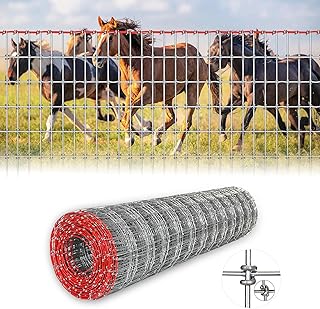
The 4x100ft Heavy Duty Horse Fence uses a 12 gauge wire with a durable galvanized coating, delivering strong corrosion resistance for outdoor arenas in varying climates. Its 2×4 inch mesh helps prevent horses’ hooves from getting caught, while the top red 9 gauge wire serves as a visual warning to reduce accidental contact. The overall height and robust construction provide resilience against horse impacts and weather-induced sagging, maintaining fence integrity over time. This option suits larger paddocks and perimeter containment where long-term performance is valued.
STEELAID Portable Horse Pen 8’x8′

This portable 8×8 corral provides a safe space for smaller horses, ponies, and other livestock. Its high-tensile 1.1″ OD 19-gauge tubing and welded corner frames offer durability, while straight end posts and reinforced loop legs stabilize the structure. The setup is designed for quick assembly and disassembly, making it ideal for temporary stalls, trail riding away from crowds, or separating animals as needed. While portable, it maintains a sturdy profile suitable for frequent relocation.
4ft x 100ft Galvanized Horse Fence

Constructed from 14-gauge galvanized steel, this 4x100ft roll prioritizes durability in demanding environments. The 2×4 inch rectangular mesh maintains safe distances for hooves and heads, reducing the risk of entanglement or injury. Square knots ensure even tension, minimizing sag over time and supporting long-term stability. The fencing is versatile enough to be combined with other fencing types, making it suitable for large pastures, arenas, and mixed-use farms where a robust perimeter is needed.
Premier 1 Horse QuikFence Electric Netting

The Premier 1 QuikFence Electric Netting is a 48″ tall, easily movable net designed to safely contain horses while supporting quick setup. The fence includes 3/4″ diameter posts with steel double spiked feet and spacing every 12.5 feet. The mesh sits about 4 feet above ground when installed, suspended roughly 1 foot above soil, and features plastic verticals that break under excessive pressure to prevent injuries. This option blends traditional fencing with electrified containment for enhanced boundary control and animal safety.
TOYMANY Corral Fencing Playset

The TOYMANY corral fencing playset is a versatile educational accessory, featuring 18 grey fence pieces and 2 gate pieces. Sized for smaller setups, it serves as a teaching tool or children’s play environment to illustrate farm layout concepts. While not a primary fencing solution for full-size horses, it can complement larger systems in demonstrations, clinics, or model barns where scaled visualization aids are beneficial. Its durable plastic construction supports frequent handling by young learners.
Buying Guide: Key Purchase Considerations For Horse Arena Fencing
- Horse safety and mesh size: For adult horses, 2×4 inch mesh minimizes hoof entrapment and leg injuries. Larger animals may require reinforced designs or higher fences to deter climbing or pushing.
- Material and durability: Galvanized steel wire and coated metals resist rust and weathering, offering long-term performance in barns, paddocks, and outdoor arenas. Consider corrosion resistance for coastal or humid climates.
- Fence height and visibility: Visual warnings (like the red top wire) help reduce collisions. Taller fences deter crossing and standing on the top rail, especially for jump-heavy arenas.
- Portability vs. permanence: Portable pens are ideal for clinics or travel, while fixed fences suit permanent arenas. Quick-assembly designs save labor and downtime during events or reconfigurations.
- Installation and maintenance: Look for simple installation with clear posts, tensioning, and post spacing. Regular inspection for sag, loose knots, and corrosion extends lifespan.
- Electrical options: Electric netting adds a safety layer, aiding boundary control in open fields or multi-animal settings. Ensure compliance with local regulations and safety practices.
- Compatibility and expansion: If you anticipate growth or layout changes, choose modular fencing that can be expanded or integrated with other fencing types.
When selecting fencing for a horse arena, balance durability, safety, and cost. Consider the typical weather, horse temperament, and arena size to determine whether a fully fixed fence, portable pens, or a hybrid approach best meets your management goals. The products above illustrate a range of configurations—from heavy-duty fixed rolls to mobile corrals and even educational accessories—that can adapt to diverse fencing strategies for equestrian facilities.