Soil sampling is essential for accurate soil analysis, nutrient management, and informed landscaping or agricultural decisions. Hand augers and soil samplers offer portable, low-cost options for collecting representative soil cores in the field. This guide reviews five reliable hand augers designed for soil sampling, highlighting build quality, ease of use, and best-use scenarios. A quick summary table of the chosen products is included to help you compare features at a glance.
| Product | |||
|---|---|---|---|
| INTBUYING 40” Soil Sampler Probe | 40″ length; 1.6″ diameter | Foot pedal, rubber handle, ergonomic T-handle | Deeper sampling in lawns, gardens, and agricultural plots |
| Eijkelkamp All-Purpose 2 3/4″ | 2.75″ diameter | Open blade layout for clean entry and recovery | General-purpose soil sampling in varied soils |
| Eijkelkamp All-Purpose 2″ | 2″ diameter | Compact, easy-to-use for narrow points | Tight spaces and multiple sample points |
| Eijkelkamp All-Purpose 1 1/2″ | 1.5″ diameter | Narrow profile with good penetration | Shallow, precise sampling in confined areas |
| One-Piece Clay Edelman Soil Auger, 3 1/4″ | 3.25″ diameter | One-piece welded steel for strong clay performance | Clay soils and cohesive substrates |
Below, each product is explored with its core features, typical use cases, and practical considerations. The information drawn from listed features helps compare performance attributes for field work and lab-ready sampling.
INTBUYING 40 Inch Soil Sampler Probe
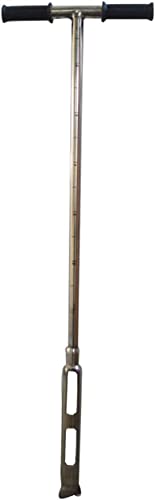
The INTBUYING probe combines a long 40-inch overall length with a 1.6-inch diameter stainless steel tube, designed for deeper soil sampling. The unit features a sample ejector roughly 11.8 inches long, a foot pedal, and a dozer rod to assist entry into the ground. Rubber-grip handles and an ergonomically shaped T-handle contribute to comfortable operation over extended sampling sessions. Made from rust and corrosion-resistant 304 stainless steel, the probe aims to deliver reliable performance in varied field conditions. This model is well-suited for lawn, garden, and agricultural soil profiling where deeper cores are beneficial.
Considerations: The 40-inch length is advantageous for deeper layers but may be heavier to transport. The open bore and ejector facilitate efficient sample retrieval, which is helpful for lab submission. Users should verify compatibility with their soil type and depth requirements, and ensure proper maintenance to prevent any residue buildup after use.
Eijkelkamp All-Purpose Soil Auger – 2 3/4″

This one-piece auger with a 2 3/4-inch diameter is designed for balanced sampling across a broad range of soils, including sandy, silty, and clay textures. The open blade layout supports clean soil entry and efficient recovery, reducing sample contamination and making lab preparation simpler. Its all-purpose design makes it a strong default choice for field surveys, environmental assessments, and agricultural soil testing where reliable core retrieval matters.
Considerations: Larger diameters provide more representative samples but require more effort to penetrate tougher soils. Proper technique and steady pressure help maximize soil retention and minimize disturbance at the sampling site. The one-piece construction minimizes assembly points, increasing field reliability.
Eijkelkamp All-Purpose Soil Auger – 2″

The 2-inch variant offers a compact option for sites with tight sampling points or when multiple cores are required in a small area. As with larger Eijkelkamp models, the open blade design aids in aseptic soil entry and sample retention, supporting consistent sampling results across different soil types. This size is often favored for precise depth control in shallow profiles or when working within restricted spaces such as under overhead vegetation or in raised beds.
Considerations: Narrower diameters can limit the volume of each sample, which may affect lab analysis if a larger sample is preferred. Operators should balance the need for access in confined spaces with the desired sample representativeness.
Eijkelkamp All-Purpose Soil Auger – 1 1/2″

The 1.5-inch variant emphasizes a narrow profile designed for shallow sampling and limited access locations. Its smaller diameter improves penetration in dense or compacted soils and makes it easier to carry on longer field routes. It’s suitable for rapid sampling in garden beds, turf, and small plots where a larger core would be impractical.
Considerations: While depth capability is adequate for shallow assessments, users requiring deeper cores may opt for larger diameters. The balance between penetration ease and core volume should guide diameter choice based on the target soil and analytical needs.
One-Piece Clay Edelman Soil Auger, 3 1/4″

This Eijkelkamp product is engineered for clay soils with a narrow blade design that reduces resistance when cutting through cohesive substrates. The one-piece welded construction enhances strength and durability, reducing the risk of parts loosening in the field. It’s particularly well-suited for challenging clay-rich soils where consistent power and core integrity are essential for reliable sampling.
Considerations: The 3 1/4-inch diameter yields larger cores but requires more effort to penetrate dense clays. Maintenance of the blade geometry and periodic cleaning can help preserve performance in sticky soils. This model is best for professionals dealing with problematic clay profiles.
Buying Guide: Key Purchase Considerations And Comparisons
- Soil type and sampling depth: Choose diameter and length to match expected soil texture and desired core depth. Larger diameters collect more material but require more effort. Longer probes reach deeper layers but are heavier to transport.
- One-piece versus multi-piece: One-piece designs remove the risk of loose parts in the field. They’re typically more robust, but some users prefer smaller, modular sets for portability and versatility.
- Blade design and entry: Open blade configurations facilitate clean entry and reduced soil clogging, which supports easier sample recovery across a range of soils, especially clays and silts.
- Ergonomics and handling: Foot pedals, T-handles, rubber grips, and overall balance affect fatigue during extended sampling. Ergonomic features are especially important for professional fieldwork.
- Corrosion resistance and materials: Stainless steel cores resist rust and corrosion, extending the service life in humid or damp environments. Consider maintenance needs and cleaning after field use.
- Portability vs. performance: Weighing long probes against lighter, compact options helps determine suitability for budget, transport, and sampling logistics. Field conditions often dictate the best balance.
- Maintenance and care: Proper cleaning, drying, and lubrication of moving parts extend tool life. Rust prevention for stainless variants and blade edge retention are important.
- Lab compatibility: Consider the sample size required by the preferred lab protocol. Coarser cores may be suitable for some analyses, while others require more material for reliable results.
- Cost versus value: While price influences purchasing decisions, prioritize durability, ease of use, and coverage of soil types most common to your projects.