Yes, you can grow plants indoors year-round with the right grow lights. This guide highlights five reliable options for different indoor gardening needs, from compact desk lamps to adjustable tripod systems. Each product is evaluated for suitability by plant type, growth stage, and user preferences such as timer ease, dimming, and adjustability. The top picks are best for: busy homeowners seeking auto schedules; beginners needing simple setups; and advanced growers who want fine-tuned control over spectrum and intensity.
| Product | Best For | Key Benefit |
|---|---|---|
| LEOTER Grow Light | All stages, compact plant sets | Full spectrum with 10 dimmable levels and 3 spectral modes |
| FOXGARDEN Grow Light Stand | Seedlings to flowering, adjustable height | 108 LEDs with auto timers and multiple brightness levels |
| Hlite 16 Inch 4 Pack | Multiple plants, budget-friendly | Linkable design, full spectrum and high PPFD |
| GooingTop LED Grow Light | Desk or small shelves, quick setup | 6000K white with red LEDs and multiple timers |
| yentbokj 5 Heads | Large setups, adjustable tripod | Remote control and auto timing across independent heads |
LEOTER Grow Light For Indoor Plants
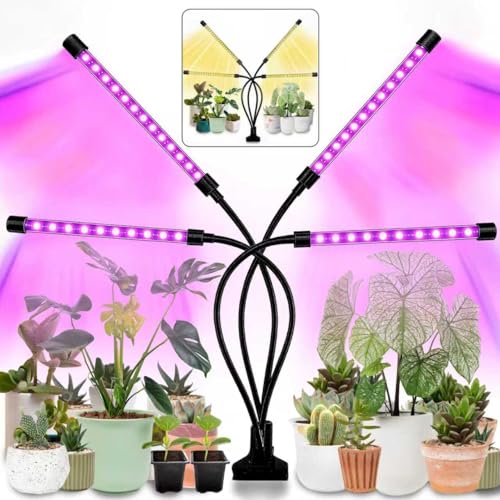
Best for compact, all-in-one indoor gardens. The LEOTER unit uses 80 LEDs (32 red, 12 blue, 36 full spectrum) across full-spectrum, red/blue, and mixed modes to support root, bloom, and fruit development. Features include a circular memory timer with 3H, 9H, and 12H options and 10 dimmable levels. This is well-suited for small apartment gardens, balcony planters, or desk-side seed starting. Caution: The timer must be reset if power is interrupted, which can disrupt automated schedules.
FOXGARDEN Grow Light Stand

Best for seedling-to-flowering transitions with adjustable height. The FOXGARDEN system uses 108 LEDs (60 cold white, 32 warm white, 16 red) for balanced spectrum. It includes auto on/off timers with 4/8/12-hour options and six brightness levels. Height range from about 11 to 21 inches accommodates various plant heights. It’s ideal for windows-less grow spaces or on a stand in a basement, garage, or kitchen. Limitation: Setup requires some initial assembly and positioning to achieve optimal distance from plants.
Hlite 16 Inch 4 Pack LED Grow Lights

Best for expanding plant coverage with a budget-friendly multi-light setup. Each 16-inch strip offers full-spectrum output with high PPFD and a plug-and-play, linkable design. The kit allows linking up to six units for larger shelves or benches, making it suitable for homes that want to grow herbs, leafy greens, or starter plants across multiple pots. Limitation: While compact, each strip covers a smaller footprint than larger standalone fixtures, so more units may be needed for big installations.
GooingTop LED Grow Light
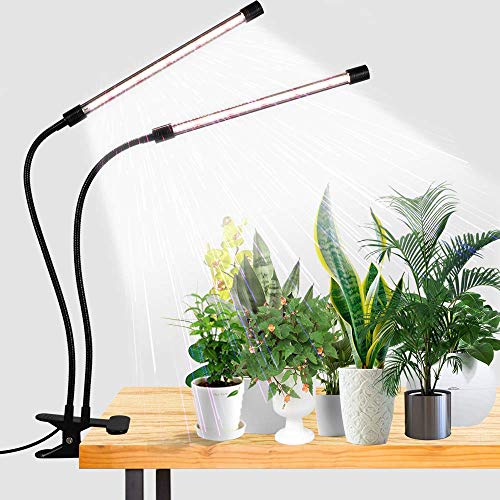
Best for adjustable desk or shelf setups with strong timer features. GooingTop provides 6000K white light, plus red LEDs, with 5-level dimming and auto on/off timing across 4/8/12 hours. The flexible gooseneck and clamp enable precise positioning on a desk, shelf, or plant stand. Caution: USB-powered setups may require port capacity checks if used with multiple devices.
yentbokj Grow Lights With Tripod Stand
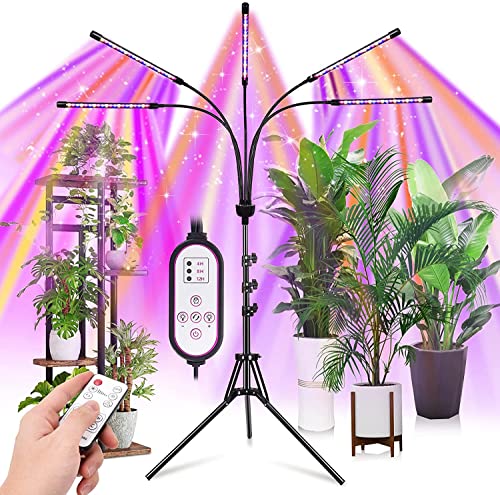
Best for larger, flexible setups with independent head control. The yentbokj system features five LED heads on a 15″–63″ adjustable tripod, plus both inline and RF remote controls and auto on/off timers (4H/8H/12H). It supports multi-angle lighting across a range of plants and can cover larger shelves or tables. Limitation: Higher setup complexity due to multiple heads requiring careful alignment for uniform coverage.
Buying Guide
- Light spectrum: For seedlings and leafy greens, a full-spectrum or white+red mix is generally effective. For flowering and fruiting, red and blue wavelengths boosted by full-spectrum light help support bloom intensity.
- Timer functionality: Auto on/off timers reduce daily maintenance. Look for cycle memory and multiple options (4/8/12 hours) to fit plant growth cycles and your schedule.
- Adjustability: Goosenecks, adjustable stands, and height ranges help position lights at an optimal distance from plant canopies, improving light use efficiency.
- Power and footprint: Compact units work well for desks or small shelves; larger strips or multi-head systems suit bigger plantings. Consider how many plants and the space you have.
- Dimability and spectrum modes: More dimming levels and spectral modes allow tailoring light to specific growth stages, boosting photosynthesis while reducing energy use when full power isn’t needed.
- Installation and compatibility: Check whether fixtures require USB, wall outlets, or battery power. Ensure you can mount or place lights securely in your chosen area.
FAQs
- What is the best grow light spectrum for tomatoes indoors?
– A full-spectrum light with red and blue channels supports vegetative growth and fruiting, typically yielding better blooms on tomato plants indoors. - How many hours per day should grow lights be on?
– Most plants benefit from 12–16 hours of light during peak growth, with a shorter day cycle for some leafy greens; use timers to maintain consistency. - Are LED grow lights expensive to run?
– LEDs are energy-efficient, usually consuming less power than traditional grow lights while providing sufficient intensity for many setups. - Do I need multiple lights for a larger garden?
– Yes, for even coverage across many plants, multiple light units or longer strips help avoid dark spots and ensure uniform growth. - Can I use grow lights on a shelf or desk with a USB power source?
– Some models support USB power; verify power requirements and the available USB port capacity to avoid overloading.