Growing healthy indoor plants requires reliable lighting that matches their spectrum needs and daily schedules. The following selection highlights five standout grow lamps designed to support seedling development, flowering, and year-round greenery. Each option emphasizes full spectrum output, adjustable brightness, timers, and flexible mounting to fit desks, shelves, or stands. This guide helps you compare features, energy use, and ease of use to choose a lamp that aligns with your plant types and space.
Summary of selected products
- GooingTop LED Grow Light — 6000K full spectrum with Gooseneck clamp, 4/8/12 hour timer, USB/AC power.
- LEOTER Grow Light — 80 LEDs (32 red, 12 blue, 36 full spectrum), 10 dimmable levels, 3 timer modes.
- yentbokj Grow Lights — 4-head full spectrum with adjustable tripod, 3 spectral modes, 10 brightness levels, remote control and timer.
- LBW Desk Grow Light — 214 LEDs, full spectrum, 3/6/12 hour timer, 6 dimming levels, modular light controls.
- LBW Latest Grow Light — 428 LEDs dual-head, advanced full spectrum, 3/6/12 hour timer, 6 brightness levels, tall tripod.
GooingTop LED Grow Light Review
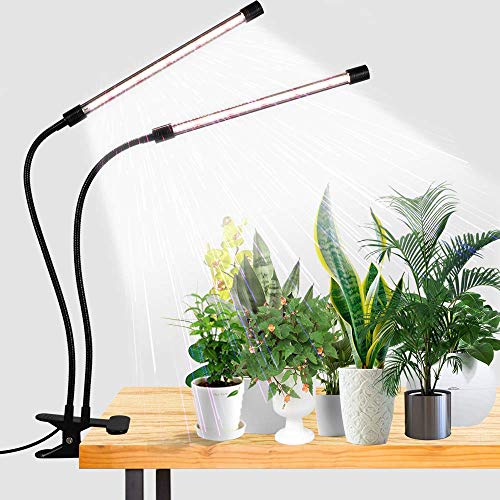
The GooingTop LED Grow Light uses a 6000K white light mix combined with 74 white LEDs and 10 red LEDs to emulate noon sunlight. It offers a high color rendering index up to 95% for accurate plant and reading light. The unit includes a flexible gooseneck and a strong clamp, enabling precise lighting angles for various plant configurations. A 24-hour timer supports 4H/8H/12H settings, cycling automatically to ensure plants receive consistent daily light. It can operate via USB or an AC power plug, making it a versatile option for desks, shelves, or plant corners.
Reference features include full-spectrum output, flicker-free operation, a multi-stage timer, and easy installation. This model is well-suited for seedlings, herbs, and houseplants that benefit from stable, noon-like light. Its compact design minimizes footprint while maximizing grow efficiency, particularly in small apartments or home offices where space is limited. Users should ensure the USB power source supplies adequate current for continuous operation, especially when running additional lamps on the same circuit.
LEOTER Grow Light For Indoor Plants
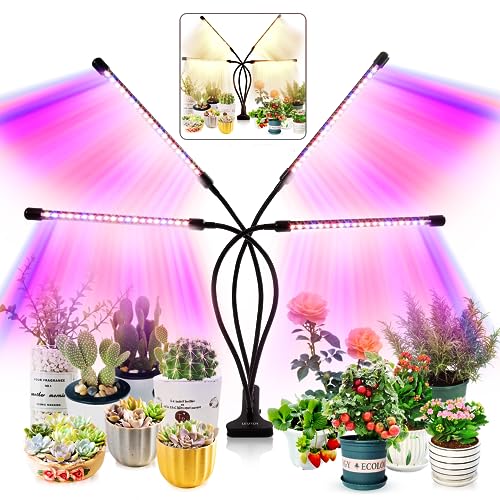
LEOTER’s upgraded model uses 80 LEDs in a combination of 32 red, 12 blue, and 36 full-spectrum diodes. The full spectrum (380nm-800nm) supports a wide range of plants from seed to maturity, while the red-blue mix targets flowering and fruiting stages. The circular memory timer automatically turns the light on and off at the same time daily (3H/9H/12H options) and requires a reset if power is interrupted. With 10 dimmable brightness levels, this lamp adapts to different growth phases and species, from seedling to canopy formation, without overheating thanks to an efficient design.
LEOTER’s multi-mode approach makes it suitable for balconies, windowsills, or workspaces where natural light is insufficient. The timer and dimming features reduce energy use while maintaining consistent photoperiods. Remember to reset the timer if you unplug the unit, and consider pairing with a reflective surface to maximize light reach for dense foliage or taller plants.
yentbokj Grow Lights With Tripod Stand
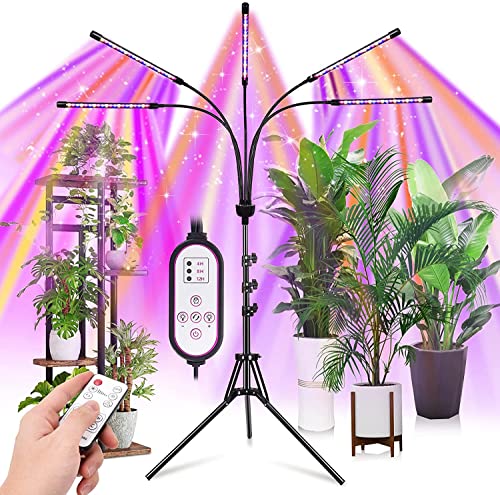
yentbokj offers a 4-head full-spectrum grow light on a flexible tripod stand, capable of extending from 15″ to 63″ with 360-degree neck rotation. This setup is ideal for multi-plant arrangements or taller specimens that require adjustable height and angle. It features three spectral modes—Red+Blue, White, and a White+Red+Blue mix—with 10 brightness levels to match growth stages from seedling to flowering. Timers provide 4H/8H/12H options, and an inline controller plus RF remote ensure convenient operation from up to 30 meters away. Each LED head can be controlled independently for tailored coverage.
From a usability perspective, the tripod and independent head controls simplify scene customization and plant zoning across a single grow area. Potential drawbacks include more moving parts requiring careful setup and occasional battery replacement for the RF remote. This lamp is well-suited for hobbyists growing a mix of herbs, succulents, and leafy greens in home basements or sunless rooms.
LBW Desk Grow Light With Stand

LBW’s desk light focuses on compact versatility with 214 full-spectrum LEDs spanning 380nm to 780nm. It provides uniform brightness across a broad surface, supporting plant health and consistent photosynthesis. The product includes 3 timing options and 6 dimmable levels, allowing gardeners to customize daylight hours and intensity for seedling care or mature foliage. Its upgraded light panel measures 11 by 4.7 inches, with heat-dissipation features to extend lifespan. The unit supports individual light control across three switches, enabling tailored coverage for small to medium plant clusters on desks or shelves.
Practical considerations include the need for a stable mounting surface due to its desk-oriented setup and the possibility of adding an external reflector to broaden the effective footprint. This lamp suits apartment growers, herb kits, and small houseplants that require steady, bright, full-spectrum illumination without excessive heat generation.
LBW Latest Grow Light For Indoor Plants

This latest LBW model features a dual-head design with 428 LEDs to deliver a robust full-spectrum output. It emphasizes high PPFD and broad coverage, ideal for larger plant collections or tall specimens. The light offers 3, 6, or 12-hour timers and six brightness levels, along with three switch modes for independent control of each head. The tall, 75-inch tripod provides substantial height range, enabling users to illuminate plants at varying distances to optimize growth. This setup is designed for standing floor use, offering strong performance for herb gardens, orchids, tropicals, and leafy vegetables indoors.
Notes for use include ensuring stable anchoring of the tripod in open spaces to avoid tipping and pairing with reflective surfaces to maximize light efficiency. The separate head controls help in directing light to dense canopies or staggered plant rows, making this an appealing option for growing multiple tall plants in a room or greenhouse corner.
Buying Guide: Key Purchase Considerations
When selecting a grow lamp for indoor plants, begin with spectrum and plant stage compatibility. Full-spectrum lamps that cover blue and red wavelengths broadly support germination, vegetative growth, and flowering, while supplemental red/blue channels can accelerate specific stages. Consider the following factors:
- Spectrum options: Look for lamps offering full-spectrum (roughly 380-800 nm) plus targeted red/blue channels for flowering or blueprint growth. Multi-mode lamps add flexibility for different plant types.
- Intensity and coverage: Higher LED counts generally yield more PPFD at a given distance. Assess the coverage area relative to plant arrangement and the height of ceiling or stand.
- Adjustability: Gooseneck, arms, tripods, and multiple head configurations enable precise light placement for uneven canopies or tall specimens.
- Timers and power: Inline timers (4/8/12 hours) automate care, while USB vs. AC power affects placement and portability. Ensure compatibility with your power setup.
- Energy efficiency and heat: Efficient LEDs reduce electricity use and heat output, which helps prevent heat stress for sensitive plants.
- Durability and setup: Metal housings and robust clamps/stands improve longevity. Check ease of setup and stability on your chosen surface.
- Expandability: For growing multiple plants, models with modular heads or longer stands provide room to scale upward.
Purchase considerations also include plant type and growth stage, space constraints, and whether you prefer a desk-friendly solution or a tall standing lamp. For seed starting, a stable 8-12 hour cycle with gentle brightness can minimize stress, while flowering species may benefit from higher light intensity and specific spectrum blends. Compare similar models by evaluating PPFD, dimming steps, timer reliability, and the ability to customize angles and distances from the plant canopy. Finally, read user reviews for real-world performance in environments similar to yours to anticipate issues like heat buildup or fixture stability.