Enhance deer forage and improve winter nutrition with radish seed blends designed for food plots. This guide highlights five top options that combine late-season attractants with robust growth, tubers, and high-protein components. Each product listing includes key features to help you compare performance, flavor, and nutritional value for deer. Read on to compare varieties, planting notes, and considerations for selecting the right mix for your land and climate.
| Product | Brand | Notes |
|---|---|---|
| Whitetail Institute Ravish Radish | Whitetail Institute Store | Early fall to late winter forage; tubers help deer through cold months |
| Rack’M Radish Pro | Evolved Harvest Store | Biostimulant-coated, high-protein blend |
| Daikon Radish Seed | Hale Habitat & Seed Store | 5 lb bag; covers about 1/2 acre |
| Throw & Gro X-treme | Evolved Store | Easy-to-plant, fast-growing, no-till ready |
| Beets & Greens | Whitetail Institute Store | Blend of beets, kale, turnip, radish for broader attraction |
The selections below focus on radish-forward mixes that are simple to sow, seasonally appealing to deer, and suited for various plot sizes. Consider your climate, planting window, and whether you want additional forage components like kale, turnips, or beets to extend attraction through winter. Each product section includes a brief overview, notable benefits, and planting considerations to help you decide which seed blend best matches your habitat management goals.
Whitetail Ravish Radish Seed for Deer
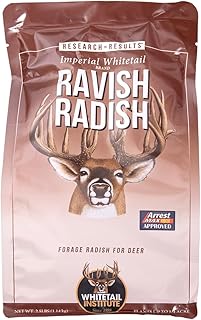
Contains WINA 412 radish varieties exclusive to Whitetail Institute, designed for rapid establishment in late summer. The blend emphasizes tuber production to help deer endure winter months, offering abundant forage from early fall through late winter. The seed mix is calibrated to establish quickly and provide a dense root structure that supports deer foraging needs in cooler seasons. Consider plot size and soil preparation to maximize tuber yield.
Rack’M Radish Pro Forage Seed

This late-season forage blend combines high-protein radish with daikon and a turnip/rape hybrid, delivering nutrients as deer prepare for winter. The Pro coating, powered by ProGro Biostimulant, aims to yield stronger plants and more forage per acre. The mixture is particularly attractive for archery season and beyond, offering digestible forage that supports herd health. Plan for adequate soil moisture and proper seeding rates to ensure dense stand establishment.
Hale Habitat & Seed Daikon Radish

This 5 lb bag provides a cost-effective option that covers about half an acre. The seed is certified for maximum growth and attractive performance, with emphasis on robust radish roots that help to draw deer into plots in late fall. Consider weather windows for late summer planting to ensure strong germination and root development before winter temperatures set in. Pairing with complementary forage can extend attraction into deep winter.
Throw & Gro X-treme Radish Forage

This seed blend emphasizes easy planting and fast growth, suitable for no-till plots. While radish is a central component, the product is marketed for general forage with a focus on timely establishment and rapid ground cover. It is a practical choice for beginners or plots where minimizing soil disturbance is a priority. Consider soil fertility and moisture for best germination, especially in drier seasons.
Whitetail Beets & Greens For Deer

This blend stacks sugar beets with kale, turnips, and radish to broaden the attractiveness window from fall through winter. The combination is designed to provide both above-ground greens and below-ground roots, supporting deer with a varied nutrient profile. It is suitable for plots seeking diversity in forage and a staggered harvest timeline to maintain deer use across seasons. Evaluate compatibility with existing plots and soil condition before planting.
Buying Guide: Key Purchase Considerations
Selecting the right radish-based food plot mix involves balancing palatability, forage quality, and planting practicality. Consider your target deer population, local climate, soil health, and available planting windows. Radish varieties can provide quick ground cover and tuber development, but nutrient-rich companions like beets, kale, or turnips can extend seasonal attractiveness. Look for blends with disease-resistant seeds, proven field performance, and reputable brands.
- Planting window: Choose seeds that establish before frost and develop tubers in late fall for winter forage.
- Soil readiness: Ensure good soil drainage and pH suitability for brassicas and radishes; amend soil if needed.
- Forage diversity: Mixing radish with kale, turnips, or beets can broaden attraction and resilience to weather.
- Biostimulants and coatings: Some blends include biostimulants that may improve germination and vigor; weigh benefits against cost.
- Plot size and seeding rate: Align seed quantities with area and seeding depth to achieve a dense stand without over-seeding.
- Maintenance: Plan for irrigation or water management during establishment and consider predator- and weed-control needs.
Overall, the best radish seed choice depends on your plot goals, whether you prioritize rapid establishment, enhanced tuber production, or a broader mix for extended deer attraction. For smaller plots, concentrated radish varieties can deliver quicker forage; for larger plots, mixes that combine tubers with leafy greens may promote longer season use and improved herd health.