Introduction
Finding the right drip irrigation system for a greenhouse can save water, reduce labor, and improve plant health. This guide profiles five top options that suit small-to-medium setups, raised beds, or community greenhouses. Each product emphasizes quick connections, adjustable emitters, and reliable tubing configurations. Use the table below to compare core capabilities at a glance, then dive into detailed product sections to see which model aligns with your layout and watering goals.
| Product | Tubing Size | Length/Reach | Key Benefit | Ideal For |
|---|---|---|---|---|
| Bonviee Drip Irrigation System | 1/4″ & 5/16″ | 230 ft | Push-to-connect, high coverage, water efficiency | Greenhouses, raised beds |
| Thiswing 360° Drip System | 5/16″ | 50 ft | 360° spray, durable copper nozzle | Compact greenhouses, borders |
| HEKIWAY Drip System With Timer | 5/16″ | 50 ft | Smart timer, 360° nozzle | Automated greenhouse setups |
| MIXC 230FT Quick-Connect System | 1/4″ & 1/2″ | 230 ft total | Quick-connect, up to 32 emitters | Large greenhouse areas |
| RAINPOINT Indoor Waterer | Flexible tubing | Indoor plants | Cycle & soak, easy programming | Grow tents, offices |
Bonviee Drip Irrigation System

The Bonviee kit provides a comprehensive 230-foot drip line with 1/4″ and 5/16″ tubing and adjustable emitters. Its Push-to-Connect fittings simplify installation—no heating or tools required. The system promises leak-proof connections in seconds, making setup fast even for beginners. It aims to cut water waste by offering adjustable emitters that deliver precise moisture to roots, particularly helpful in greenhouse environments where uniform hydration matters.
Thiswing 360° Adjustable Drip Irrigation System

Thiswing’s kit centers on 5/16″ tubing and 16 misting nozzles with 360° bendable spray. The 360° spray capability and adjustable nozzles allow flexible coverage around plant rows and corners, reducing dry spots. The package includes tees, replacement cores, clamps, and fixings, delivering a complete system for greenhouse layouts that require tailored spray patterns and dependable water flow.
HEKIWAY 60FT Drip Irrigation System With Timer

HEKIWAY pairs a 60-foot hose with a smart timer, enabling hands-free watering and programmable schedules. Features include a rain delay mode, a child lock, and 360° adjustable sprayers with bendable tubing for precise plant coverage. This setup is suitable for greenhouse configurations where automation helps maintain consistent soil moisture levels with minimal manual intervention.
MIXC 230FT Quick-Connect Drip System

This MIXC kit emphasizes quick-connector technology and a dual-tube approach (1/4″ and 1/2″ tubing) to distribute water efficiently. It supports up to 32 emitters and includes 197 feet of 1/4″ tubing plus 33 feet of 1/2″ tubing. The kit is designed for straightforward installation with minimal tools, making it suitable for larger greenhouse spaces that require modular expansion.
RAINPOINT Indoor Waterer With Cycle & Soak
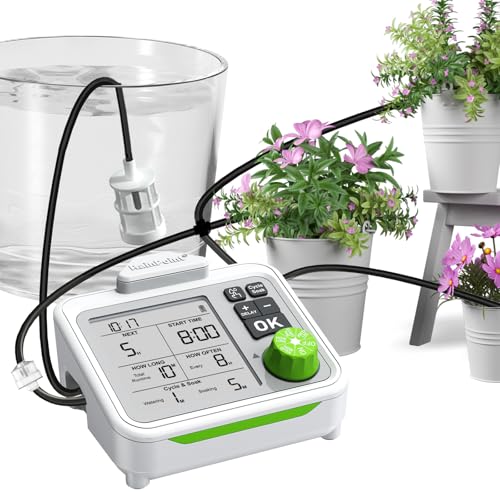
RAINPOINT focuses on cycle-and-soak irrigation for indoor plant setups, offering a manual-then-automatic workflow. The device can water from 8 hours to 30 days, with a cycle-and-soak mode that aims to save water while maintaining soil moisture. It’s well-suited for greenhouses with limited space or for grow tents where automatic, controlled watering is preferred over open-ended irrigation cycles.
Buying Guide
When choosing a drip irrigation system for a greenhouse, consider these essential factors:
- Coverage and tubing diameter: Bigger tubing (5/16″ vs 1/4″) can improve flow and reduce pressure loss in longer runs. Match tubing to emitter type and layout to minimize dead zones.
- Emitters and spray patterns: Adjustable emitters and 360° nozzles allow precise targeting of plant beds, especially in irregular greenhouse layouts. Copper nozzles tend to be durable for long-term use.
- Connection efficiency: Quick-connect fittings save setup time and reduce leak risk. Confirm compatibility with your water source and mainline sizing for scalable expansion.
- Automation vs. manual control: Timers, rain delay, and cycle-and-soak modes help optimize water use. For busy growers, automation can prevent missed irrigation.
- Water efficiency claims: Look for systems that advertise potential water savings and verify whether the emitters are adjustable to match plant needs.
- Expandability: A greenhouse may grow; select a system that adapts to longer beds, multiple zones, and new planters without replacing tubing.
- Durability and materials: Copper or metal components provide longevity in greenhouse environments where sun exposure and temperature changes occur.
In practice, the best choice depends on greenhouse size, plant variety, and your preferred balance of automation versus control. For larger spaces with multiple zones, a 230 ft or longer mainline with quick-connect fittings offers flexibility. For smaller setups or grow tents, a compact 50 ft system with a programmable timer can deliver reliable, low-maintenance irrigation. Finally, a cycle-and-soak capable indoor waterer is ideal for potted plants or display areas where uniform soil saturation is critical.