Answering the common question: which dethatcher attachment is best for your lawn mower? This guide highlights five top options designed to remove thatch, loosen compacted soil, and promote healthier grass. Each picks best serves a specific type of buyer, from large-yard caretakers to weekend gardeners with ATVs or riding mowers. Below is a quick comparison to help you decide before you buy.
| Product | Best For | ||
|---|---|---|---|
| Suchtale 48-Inch Tow Behind Dethatcher | Large lawns; riding mower users | 48 inches | 24 spring steel tines |
| YITAMOTOR 40 Inch Tow Behind Dethatcher | Medium to large yards; durable build | 40 inches | 20 steel tines |
| AugFir 48-Inch Tow Behind Dethatcher | Large properties; wide coverage | 48 inches | 20 spring steel tines |
| BlumeTrec 48 Inch Tow Behind Dethatcher | Large lawns; quick passes | 48 inches | 20 spring steel tines |
| Suchtale 40-Inch Tow Behind Dethatcher | Smaller to mid-size yards; lighter-duty | 40 inches | 20 spring steel tines |
Typical buyers include homeowners with riding mowers seeking faster coverage (Suchtale and BlumeTrec 48″), property managers needing durability and deep thatch removal (YITAMOTOR and AugFir), and those prioritizing lighter loads for easier handling in mid-size yards (Suchtale 40″). The following sections break down each option with practical pros, who it’s best for, and any notable limitations.
Suchtale 48-Inch Tow Behind Dethatcher

This model uses 24 heat-treated spring tines designed to uproot dead, matted grass and loosen hard-packed dirt. It’s built on a full steel frame with a 70 lb ballast platform and a bearing-supported wheel system to improve load distribution. It attaches via a hitch pin and is designed for riding mowers or tractors. Best for large lawns where time is a factor; avoid if your terrain includes frequent hard obstacles that could impede the wide 48-inch pass.
Best for: Large lawns, riding mower owners who want efficient coverage. Why selected: the two-row, independently flexing tines are aimed at quick thatch lifting, with a durable frame for repeated use. Caution: ensure the working part is clean after each use to prevent residue buildup.
YITAMOTOR 40 Inch Tow Behind Dethatcher

Equipped with 20 heat-treated steel tines, this dethatcher delivers deep thatch removal and light aeration. A reinforced steel frame supports a 70 lb ballast tray, and rust-proof, replaceable tines are designed for long-term use. A safety bar minimizes mower blade strikes. Height is adjustable via a simple lift handle, enabling quick shifts between work and transport. Best for: Large properties with routine dethatching needs; choose this if you value a robust build and easy height changes. Caution: check clearance when turning around obstacles since the wide 40-inch width can catch on borders.
AugFir 48-Inch Tow Behind Dethatcher

With a 48-inch working width and two rows of independently flexing tines, this dethatcher is designed to cover large areas quickly. It features a heavy-duty carbon steel frame and a tray that supports up to 150 lbs of ballast, enabling deeper tine penetration. Height is adjustable via a simple control handle, and an anti-slip stopper helps prevent accidental shifts during turns. Best for: Large yards and golf-course-like properties where fewer passes matter. Caution: heavier ballast means extra care when maneuvering around delicate landscaping near borders.
BlumeTrec 48 Inch Tow Behind Dethatcher

BlumeTrec references a durable 48-inch carbon steel frame, 20 heat-treated, rust-proof tines, and a 100 lb ballast tray for deeper penetration. The wider width reduces the number of passes, and the hitch is compatible with riding mowers, tractors, ATVs, or UTVs. Two rows of independently flexing tines lift thatch and debris effectively, with easy assembly. Best for: Homes with large lawns needing efficient coverage; choose this if you want a robust, multi-use attachment. Caution: ensure the ballast weight is properly secured to avoid stability issues on sloped terrain.
Suchtale 40inch Tow Behind Dethatcher

This 40-inch model offers 20 spring tines on a full steel frame with a 70 lb ballast platform. It uses a hitch pin for easy attachment and features a wheel with bearings to improve load-bearing capacity. It’s designed for lighter-duty dethatching and is suited to mid-size yards. Best for: Homeowners with smaller to medium yards who want an easy-to-handle dethatcher. Caution: performance is best on even terrain; avoid very uneven ground where the smaller width may require more passes.
BlumeTrec 48 Inch Tow Behind Dethatcher
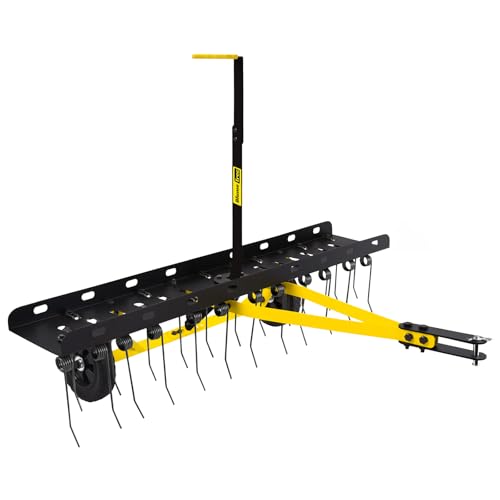
With 24 heat-treated, rust-proof tines and a 48-inch working width, this BlumeTrec model offers deep dethatching and efficient coverage. The dual-row layout helps loosen thatch and debris thoroughly, while the 100 lb ballast tray supports deeper tine penetration. It attaches via a universal pin-style hitch for compatibility with a range of riding mowers, tractors, ATVs, or UTVs. Best for: Large lawns that need fast, thorough thatch removal. Caution: ensure you have stable ballast management on sloped terrains.
Buying Guide
What to consider when choosing a dethatcher attachment:
- Working width: Larger yards benefit from 40–48 inch models to reduce passes; smaller lawns can manage with 40 inches.
- Tine design: Spring steel, heat-treated tines provide durability and effective thatch removal; replaceability matters for long-term value.
- Weight and ballast: Heavier ballast increases penetration but requires careful handling on slopes or uneven ground.
- Mower compatibility: Check hitch type and compatibility with your riding mower, tractor, ATV, or UTV.
- Height adjustment: Easy-to-use lift handles help switch between dethatching and transport, preserving turf safety.
- Durability: Rust-proof tines and reinforced frames reduce maintenance and extend life in outdoor conditions.
- Best timing: Fall and early spring are common seasons for dethatching to improve water and nutrient penetration.
Practical buying questions
- Is a heavier dethatcher better for thick thatch? Yes, if ballast is used correctly, deeper penetration improves thatch removal.
- Do I need an ATV-ready model? If you need to access wide, uneven terrains, a universal hitch model offers broader compatibility.
- Should I choose 40″ or 48″?
- What maintenance is required?
- Can dethatching damage lawn roots?
FAQ
- What is thatch and why dethatch? Thatch is a layer of dead grass and roots that hampers water and nutrient flow. Dethatching removes it to improve lawn health.
- When is the best time to dethatch? Fall is ideal for preparing for spring growth; spring can also help after winter damage.
- Can I dethatch with a standard mower? Some attachments fit riding mowers or ATVs; check hitch compatibility and weight limits.
- How deep should the tines penetrate? Deep penetration improves thatch removal, but avoid gouging soil or roots on uneven ground.
- Do dethatchers also aerate? Some models offer light aeration while dethatching; consider dedicated aerators for deep aeration needs.
- Are replacement tines available? Yes, many models offer replaceable, heat-treated tines for durable long-term use.