Chicken manure-based fertilizers offer a natural way to boost soil fertility and plant growth. This guide highlights five top Amazon options, suitable for different garden sizes and Plant types. Best for gardeners seeking ready-to-use, organic nutrients without mixing, these products support flowers, vegetables, trees, and shrubs. Each section explains who benefits most, why the product was chosen, and any practical limits to consider.
Quick product comparison
| Product | Best For | Key Benefit |
|---|---|---|
| Espoma Organic Chicken Manure 25 lb. Bag | Medium to large gardens, general use | Ready-to-use, 5-3-2 with calcium |
| Espoma Organic Chicken Manure 3.75 lb. Bag | Small gardens, containers | Compact, same analysis; monthly use throughout season |
| True Organic Chicken Manure | Soil health and microbial activity | Enhances soil structure, moisture retention, microbial activity |
| Coop Gro Organic Chicken Manure Fertilizer 6 lb. | Budget-conscious, mixed garden beds | 3-3-4 with 27% carbon; OMRI certified |
| Fancy Chicken 40 lb All-Purpose | Lawn and large outdoor spaces | High nitrogen for vigorous green growth |
Notes: all products are plant fertilizers derived from chicken manure with varying packaging sizes. This guide avoids price references and focuses on applicability, soil impact, and best-use scenarios for American gardeners.
Espoma Organic Chicken Manure 25 lb. Bag
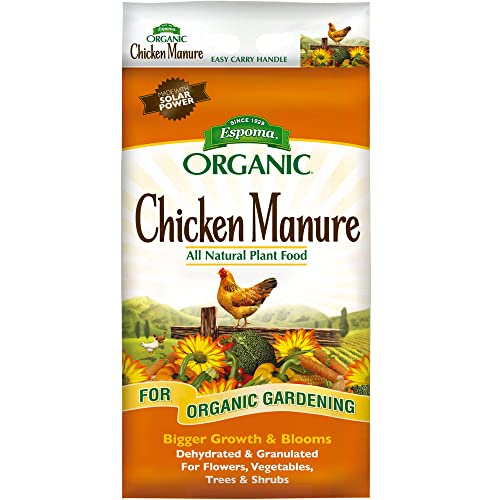
Best for general garden use. This dehydrated, granulated chicken manure is ready to apply with no mixing required. It has a 5-3-2 analysis and 8% calcium, supporting flowers, tomatoes, peppers, squash, lettuce, trees, and shrubs. The product is environmentally safe with no sludges or toxic ingredients. Use in spring and fall on trees and shrubs; for roses, flowers, and vegetables, apply monthly during the growing season. Apply to soil around the drip line and water thoroughly.
- Who it’s best for: homeowners with medium to large gardens seeking an all-purpose organic nutrient source.
- Why selected: strong nutrient balance, easy application, and broad plant compatibility.
- Caution: avoid applying directly on bare roots or during hot, dry conditions without watering.
Espoma Organic Chicken Manure 3.75 lb. Bag

Best for smaller gardens or container plantings. The 3.75 lb bag offers the same chemical profile (5-3-2 with 8% calcium) and preparation as the larger bag but in a compact format. It’s ready to use and requires no mixing, making it suitable for frequent, targeted feeds for annuals, perennials, roses, and vegetables. Use in spring, fall, and monthly through the growing season around the drip line, then water.
- Who it’s best for: gardeners with limited space or those who prefer a smaller, more manageable bag.
- Why selected: portability without sacrificing quality; straightforward maintenance.
- Caution: smaller bag requires more frequent replenishment for large plots.
True Organic Chicken Manure

Best for soil health and microbial activity. This natural fertilizer emphasizes improving soil structure, aeration, and drainage while helping soil retain moisture and resist erosion. It contains 3% nitrogen (0.90% water-soluble, 2.10% slow-release), 3% phosphate, 2% potash, and calcium. Choose this if your goal is long-term soil fertility and enhanced microbial ecosystems rather than immediate plant-only feeding.
- Who it’s best for: gardeners prioritizing soil biology and long-term soil quality.
- Why selected: strong emphasis on soil health and moisture management.
- Caution: may release nutrients more slowly; plan feeds accordingly for immediate crop needs.
Coop Gro Organic Chicken Manure Fertilizer 6 lb. Bag

Best for budget-conscious mixed beds and raised beds. This pelletized fertilizer offers a 3-3-4 analysis with 27% carbon and includes essential secondary and minor nutrients. It is OMRI certified for organic vegetable production and designed for easy application—one bag feeds up to about 200 square feet. It is pet- and child-safe when used as directed and can be applied without gloves in normal outdoor settings.
- Who it’s best for: gardeners seeking an affordable, OMRI-certified option for multiple bed types.
- Why selected: complete plant nutrition with balanced N-P-K and soil-building carbon.
- Caution: pellet texture can be dusty; rinse or water thoroughly after application to avoid dust dispersion.
Fancy Chicken 40 lb All-Purpose

Best for lawn and large outdoor areas. This 40-pound bag provides a high-nitrogen formula to support lush, green growth and robust foliage. It improves soil structure and moisture retention while fostering beneficial microbial activity. The product is pitched for broad lawn health and flowering root development, suitable for outdoor spaces that need substantial, ongoing nutrition.
- Who it’s best for: large lawns and expansive garden spaces needing substantial nitrogen enrichment.
- Why selected: high nitrogen availability supports rapid, visible growth.
- Caution: high nitrogen can lead to rapid growth that requires more frequent mowing or pruning; use as directed to avoid over-fertilizing.
Buying Guide: Chicken Manure Fertilizers For Gardens
What should I look for in chicken manure fertilizer?
Key factors include nutrient analysis (N-P-K), calcium content, application readiness (ready-to-use vs. requiring mixing), packaging size, and OMRI certification for organic gardening. A favorable balance like 5-3-2 supports a wide range of plants without excessive salt buildup if applied according to label directions.
Which product is best for my garden size?
Small spaces or containers perform well with 3.75 lb or similar compact bags. Medium-sized plots benefit from 25 lb bags, while large lawns or multiple beds may justify a 40 lb bag. If you rotate applications seasonally, consider ready-to-use options to simplify maintenance.
Is organic certification important?
OMRI-certified products are typically preferred for organic gardening. They confirm that the product meets organic standards and is suitable for vegetable beds and edible crops. For ornamental gardens, non-certified options can still be effective if they explicitly meet safety and environmental guidelines.
How often should I apply chicken manure fertilizer?
Use schedules vary by product. Generally, apply in spring and fall for trees and shrubs; apply monthly for flowering plants and vegetables during the growing season. Always water after application to help nutrients reach the root zone and to mitigate potential salt buildup.
What are common limitations?
Limitations include slower nutrient release in some brands, dust from granulated forms, and the potential for over-fertilization if misapplied. Always follow product-specific directions, and avoid applying right before heavy rainfall to prevent runoff.
Frequently Asked Questions
- Q: Can chicken manure fertilizers be used on edible crops? A: Yes, many are suitable for vegetables and fruit-bearing plants when used as directed and allowed by OMRI certification where applicable.
- Q: What’s the difference between pelletized and granular chicken manure? A: Pelletized or granulated forms are easier to apply and measure, while some granular products may be dustier or slower to break down.
- Q: How often should I water after applying? A: Water thoroughly after applying to help dissolve nutrients and reduce salt concentration at the root zone.
- Q: Are these products safe for pets and children? A: Most products are formulated to be safe when used as directed, but it’s best to keep children and pets away from freshly treated beds until the soil has been watered in and dried.
- Q: Do I need to mix these fertilizers with soil first? A: Many are ready to use without mixing; others may require simple mixing into the top layer before watering.