Begin with a rapid, at‑home answer: these affordable soil testing kits help you determine pH and nutrient levels without costly lab visits. They’re ideal for budget‑minded hobby gardeners, smallholders, or homeowners who want to understand soil health before planting. The top five products below are selected for clear results, ease of use, and value. Use the quick reference table to compare at a glance, then read detailed sections to match a kit to your specific needs and garden type.
Buying Guide Snapshot
| Product | Best For | Notes |
|---|---|---|
| Rapitest Soil Test Kit | General home gardens, lawns | Simple color‑comparators, 20 tests total |
| NewTest Soil pH Test Kit | Beginner to intermediate, precise pH | 125 pH tests, colorimetric blocks |
| SONKIR MS02 3‑in‑1 | Quick on‑site checks, no battery | Moisture, pH, and light in one |
| Dewilde 100‑Strip pH Kit | Frequent pH monitoring | 3.5–9 pH range, quick dip test |
| Leaping Lynx Complete Soil Kit | Comprehensive nutrient monitoring | 100+ tests for four parameters |
Rapitest Soil Test Kit for Gardens, Vegetables, Flowers and Lawns
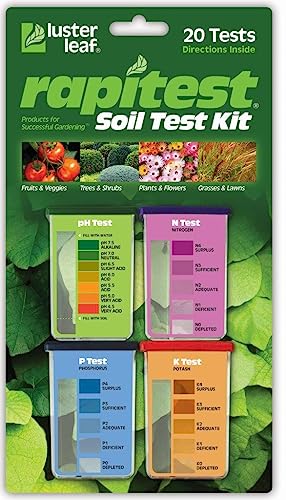
This kit provides quick, at‑home results for soil pH, nitrogen, phosphorus, and potash. It uses an easy capsule system with patented color comparators and includes components for 20 tests (5 tests each for pH, N, P, K). Best for: homeowners with gardens, lawns, or mixed flower beds who want a simple, budget option.
Best for budget‑mensitive gardeners who want a straightforward, color‑based readout without sending samples to a lab. Limitation: not a lab‑grade analysis; results are approximate and best used to guide planting decisions rather than precise nutrient management.
NewTest Soil pH Test Kit

The NewTest kit emphasizes accurate pH readings with upgraded 125 test strips and measuring cylinders. It aims to be easy for beginners while offering the rigor of professional methods in a home setting. Best for: gardeners who want a larger number of pH checks and consistent colorimetric readings.
Important note: this kit focuses on pH analysis and the included accessories are designed to improve accuracy by standardizing sample preparation. Caution: ensure proper sample dissolution and follow the color chart closely to minimize interpretation errors.
SONKIR Soil pH Meter, MS02 3‑in‑1

The SONKIR MS02 combines soil moisture, pH, and sunlight readings in one handheld device. It requires no battery, which can be convenient for quick, field checks. Best for: gardeners who want an all‑in‑one quick read without ongoing costs or batteries. Limitation: it provides general indicators rather than lab‑grade nutrient levels, so use as a quick guide rather than a definitive nutrient profile.
Dewilde Trading Co. Soil pH Paper Test Kit

This kit features 100 pH tester strips covering a wide 3.5–9 range. It is a cost‑effective option for ongoing soil pH monitoring across lawns, gardens, and indoor plants. Best for: cost‑conscious users who need frequent pH checks and prefer simple dip‑and‑read testing. Caution: strips measure pH only, not nitrogen, phosphorus, or potassium.
Leaping Lynx Complete Soil Test Kit

Leaping Lynx offers a comprehensive four‑parameter analysis: pH, nitrogen, phosphorus, and potassium, with 100+ tests in the kit. Best for: dedicated gardeners who want a more thorough, multi‑nutrient profile without sending samples to a laboratory. Limitation: as with many at‑home kits, results are approximate and best used to guide adjustments rather than precise fertilizer programs.
Buying Guide
How to choose a cheap soil testing kit that fits your needs:
- Purpose and scope: If you mainly need pH, a kit with many pH strips (NewTest, Dewilde) may be sufficient. For overall fertility, consider four‑parameter kits (Rapitest, Leaping Lynx).
- Frequency of testing: For ongoing monitoring, kits with many tests (100+ strips) offer longer value per purchase.
- Ease of use: No‑battery meters (SONKIR) are convenient for quick checks; color‑comparison strips require color interpretation but are inexpensive.
- Result interpretation: Some kits include color charts with wide ranges; others target precise numbers. Choose based on how exact you need the data to be for your plants.
- Type of data: Liquid tests and strips measure different parameters. Decide if you want just pH or also N, P, K for fertilizer planning.
FAQ
- Q: Are at‑home soil tests accurate enough for gardening? A: They provide useful guidance and relative comparisons, especially for pH and major nutrients, but they are not a substitute for professional lab analysis if precision is critical.
- Q: How often should I test soil in a home garden? A: For most home gardens, test once or twice per season and monitor changes over time. If you amend soil heavily, test after a few months to gauge impact.
- Q: Do these kits measure micronutrients? A: Most consumer kits focus on pH and macronutrients (N, P, K). Some may not provide complete micronutrient data.
- Q: Can I test hydroponic systems with these kits? A: Some kits measure pH effectively, but many are designed for soil. Check product details for suitability with hydroponics.
- Q: Do I need to prepare soil samples before testing? A: Yes. Dry, well‑mixed samples from multiple spots in the area give more representative results. Follow each kit’s instructions for mixing and dilution.
- Q: Which kit is the best value for a beginner? A: kits offering a broad set of tests at a low cost per test, such as Rapitest or Leaping Lynx, typically provide good value for beginners.