Answering the practical question, a brix refractometer for plants helps growers and hobbyists test sugar content in fruit juices, plant sap, honey, and other plant-derived liquids. The right model streamlines harvest timing, fermentation prep, and quality checks for home gardens, small farms, and educational settings. This guide features five reliable options suited for different needs—from hobbyist gardening to small-scale production. Each product section notes who it’s best for, why it stands out, and any limitations to consider. A concise buying table is provided to compare core specs at a glance.
Buying table (selected products)
- Aichose Brix Refractometer with ATC (0-32% Brix, SG 1.000-1.120)
- Tiaoyeer Brix Refractometer with ATC (0-32% Brix, SG 1.000-1.130)
- Vee Gee BX-1 Handheld Brix Refractometer (0-32% Brix, 1-year warranty)
- Flagfront Digital Brix Refractometer (0-55% Brix, IP58)
- Aichose 0-80% Brix Meter Refractometer (0-80% Brix, ATC)
Aichose Brix Refractometer With ATC
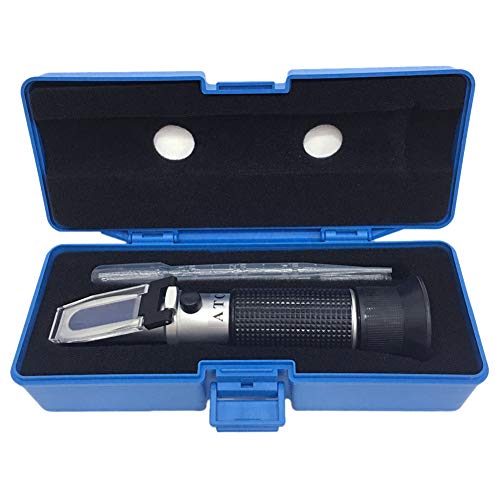
Best for hobbyists and home brewers who want a dual-scale tool for sugar content and specific gravity. This model covers 0-32% Brix and 1.000-1.120 SG, with ATC for temperature compensation. It’s straightforward for testing fruit juices, sap, and honey in garden produce or small-batch brewing. The kit is compact and waterproof enough for kitchen or field use. A potential limitation is the narrower Brix range when dealing with highly concentrated samples.
Tiaoyeer Brix Refractometer With ATC
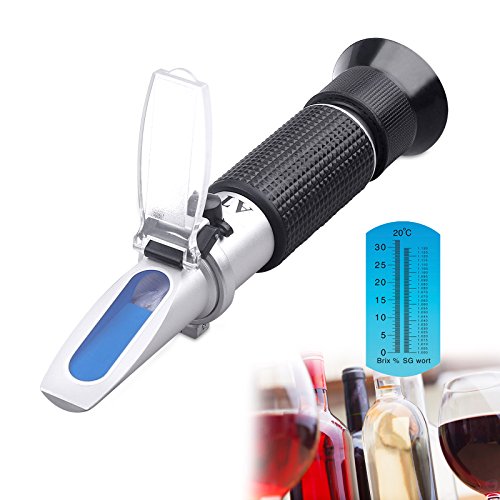
Best for growers who need robust ATC and straightforward samples from fruit juice, melons, or plant extracts. It provides 0-32% Brix and 1.000-1.130 SG with ±0.2% Brix accuracy and temperature compensation across 10℃–30℃. The dropper-and-prism workflow makes testing quick and repeatable. Choose this if you want precise sugar readings across a variety of plant-derived liquids; avoid if you need measurements beyond 32% Brix for thicker syrups.
Vee Gee BX-1 Handheld Brix Refractometer

Best for industrial-minded use with a focus on reliability and durability. The BX-1 offers 0-32% Brix, sharp high-contrast scales, and sturdy construction plus a non-roll stand feature for secure work in lab or field conditions. Its larger display aids quick readings, which is helpful when testing multiple plant samples. A limitation is that it does not list explicit SG measurements, which may matter for some users comparing recipes or densities.
Flagfront Digital Brix Refractometer

Best for fast, all-purpose sugar testing with higher range and weather resistance. The Flagfront model features a 0-55% Brix range, automatic temperature compensation, and a waterproof IP58 body. It provides quick results in about three seconds, making it suitable for field work with fruits, juices, beverages, and even coffee or honey. Use this if you need a broader Brix window and rugged, moisture-resistant design; note that it may be bulkier than pocket refractometers.
Honey Refractometer For Moisture, Brix And Baume
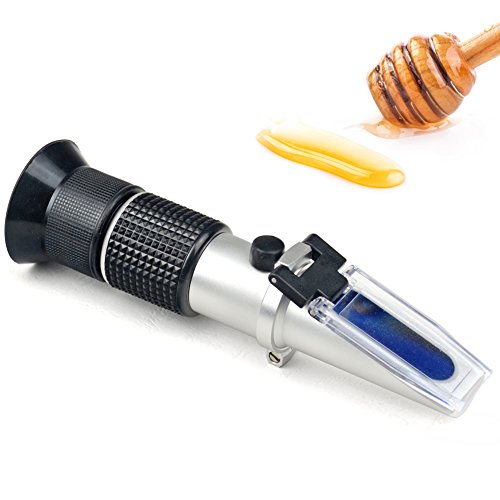
Best for beekeeping and sugar-rich plant products like honey and maple syrup. This 3-in-1 device provides moisture, Brix, and Baume readings, with a 58-90% Brix range suitable for high-sugar plant fluids. Its design targets beekeeping and natural sweeteners. A potential limitation is that the moisture reading can be sensitive to sample handling, so proper homogenization improves consistency.
Buying Guide
What should you consider when choosing a brix refractometer for plants?
- Sample type: Fruit juice, sap, honey, maple syrup, or coffee? Choose a model with the appropriate Brix range and sample compatibility.
- Brix range and accuracy: If you work with high-sugar liquids (honey, syrups), select instruments with wider ranges (0-55% or 0-80%) and acceptable accuracy (±0.1% to ±0.3%).
- Temperature compensation: Automatic Temperature Compensation (ATC) helps maintain consistent readings across field conditions. Essential for outdoor farming or variable environments.
- Durability and waterproofing: For garden and outdoor work, IP-rated housings and rugged construction reduce risk from dust or rain.
- Display and readability: Larger or backlit displays speed readings in bright sun or dim labs. Clear scales shorten interpretation time during busy workloads.
- Portability: Pocket-sized refractometers are convenient for field sampling, while larger units may offer more features like memory storage or SG readings.
- Maintenance: Look for dropper-based use and easy cleaning, especially when measuring viscous samples like honey or maple syrup.
Who Should Use These Refractometers?
- Home gardeners testing fruit ripeness or sap sugar for fermentation.
- Small-batch brewers and winemakers who need rapid sugar readings with temperature compensation.
- Beekeepers monitoring honey quality, moisture, and Baume for product consistency.
- Educational settings exploring plant sugar content and food science experiments.
Quick Comparison Summary
- Aichose Brix Refractometer With ATC: Great overall for homebrew and garden testing; balanced range and SG support.
- Tiaoyeer Brix Refractometer With ATC: Strong ATC performance; precise readings across common plant liquids.
- Vee Gee BX-1: Best for durability and field reliability; excellent display and stand feature.
- Flagfront Digital Brix Refractometer: Broadest Brix range among picks; rugged and waterproof.
- Aichose 0-80% Brix Meter: Wide range ideal for very sweet samples; ATC included for field use.
FAQ
- What is Brix in plant testing?
Brix measures the sugar content in liquids derived from plants, guiding harvest timing, fermentation readiness, and quality assessment.
- Do I need ATC on a refractometer for plants?
Automatic Temperature Compensation helps maintain accuracy across ambient temperature changes, which is common in outdoor farming.
- Can these devices read SG or RI?
Some models include specific gravity (SG) alongside Brix, while others focus on Brix or RI. Check product specs for SG compatibility.
- What’s a typical Brix range for fruit juice?
Many fruit juices fall within 0-32% Brix, with higher values for concentrates or sweeter samples like honey or maple syrup.
- How should I calibrate a refractometer?
Calibrate with distilled or purified water at a known temperature, following the manufacturer’s instructions for best results.
- Is a wider Brix range always better?
Wider ranges cover more sample types but may trade off some resolution. Choose based on your most common liquids.