Blue light plays a critical role in vegetative growth and overall plant health when natural sunlight isn’t readily available. This guide highlights five standout blue-rich or full-spectrum grow lights designed for indoor gardening. Each option blends red and blue with additional spectrum to support photosynthesis, flowering, and healthy foliage. Read on to compare features, timers, dimming, and mounting options to help your plants thrive.
Summary of selected products
| Product | Brand | Key Benefit | Spectral Focus |
|---|---|---|---|
| LEOTER Grow Light | LEOTER | Full spectrum with strong red/blue focus and timing automation | Full Spectrum + Red/Blue |
| Garpsen Grow Light | Garpsen | Two-head design with extended timers and rich spectrum | Full Spectrum (Red/Blue/White) |
| yentbokj Grow Lights | yentbokj | Five-headed, adjustable tripod with auto on/off and remote | Red/Blue/White Full Spectrum |
| Miracle LED 4KK | Miracle LED | High-quality blue-dominant bulb for vegetables and herbs | Blue Spectrum Focus |
| GooingTop LED Grow Light | GooingTop | High-output full spectrum with dimming and timer options | Full Spectrum (White + Red/Blue) |
LEOTER Grow Light For Indoor Plants
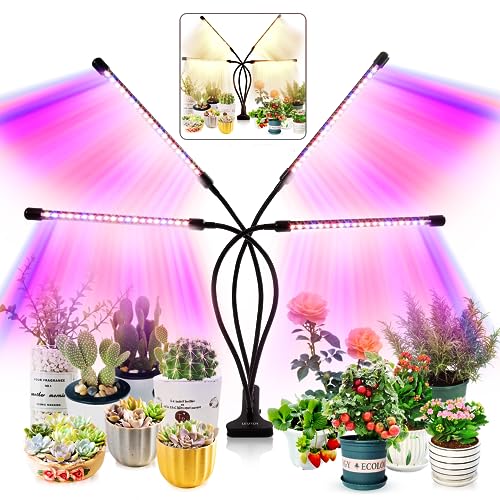
LEOTER’s upgraded model combines 80 LEDs across red, blue, and full-spectrum chips to cover all plant growth needs. Its full spectrum (380nm-800nm) supports rooting and sprouting, while targeted red (660nm) and blue (460nm) wavelengths promote flowering and fruiting. The design includes a circular memory timer with 3H, 9H, and 12H options, enabling automatic on/off cycles. Ten dimmable levels let you tailor intensity to developmental stages, making it suitable for seedling through mature foliage. The gooseneck is adjustable for precise light placement, and three switch modes offer flexible operation.
Garpsen Grow Lights For Indoor Plants

Garpsen offers a two-head clip setup with red, blue, and warm white LEDs, delivering a rich spectrum that supports all growth stages. It extends light timing beyond 12 hours with 6, 12, and 16-hour options, which is helpful for light-loving species. The system emphasizes energy efficiency with a spectrum that can replace traditional 50W horticultural lamps while consuming less power. It supports three lighting modes and five brightness levels, allowing growers to adjust intensity and color balance to seedling and vegetative needs.
yentbokj Five Heads Grow Lights
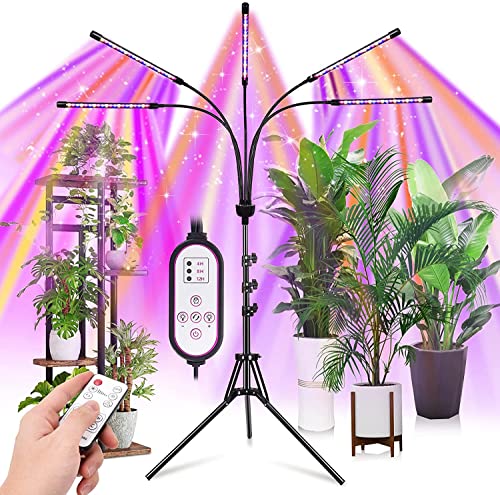
yentbokj presents a five-head grow light with an adjustable tripod stand and a remote for convenience. It offers three spectral modes (Red/Blue/White) plus a White-Red-Blue mix and 10 dimming levels from 10% to 100%. The inline controller and RF remote enable auto on/off timing for 4, 8, or 12-hour cycles, reducing daily maintenance. Each head can be controlled independently, allowing targeted lighting across a collection of plants and optimizing growth at various stages.
AURAZIGLI Led Grow Lights, 4 Heads

AURAZIGLI’s four-head design emphasizes a red, blue, and white mix to maximize photosynthesis, particularly for flowering and fruiting. It includes a cyclic memory timer with 3, 9, and 12-hour options, enabling hands-free operation. Ten dimmable levels let users dial in brightness to plant needs, from seedling germination to vegetative growth, ensuring consistent coverage and balanced light distribution across a broad growing area.
GooingTop LED Grow Light

GooingTop combines a high-output array with red, blue, and white LEDs to resemble natural full-spectrum sunlight. The device features a 3-mode control system and a dimmable range for light intensity. The built-in timer supports four, eight, or twelve-hour cycles, and the dimming function allows either 50% or full brightness. With its scientifically balanced spectral ratio, this lamp aims to support germination through harvest, making it suitable for a variety of indoor plants and corner-lit setups.
Ongoing testing and multi-perspective considerations
When selecting a blue-light-focused grow light, consider area coverage, plant type, and space constraints. Some users prioritize higher red-blue ratios for flowering, while others benefit from a broader spectrum that includes white light for more natural growth cues. Timers can reduce maintenance, while dimming options help match夜-to-day light requirements. For dense canopies, ensure there is overlapping light to prevent uneven growth. Depending on plant variety, longer daily exposure can drive faster vegetative growth, but overly intense light may require distance adjustments to avoid leaf burn.
Buying Guide: Key Purchase Considerations
- Spectral composition: Look for true full-spectrum options or clear red/blue emphasis. A mix that includes white light helps mimic natural sunlight and supports multiple growth stages.
- Intensity and distribution: Dimming levels and the number of LEDs influence how deeply light penetrates plant canopies. Consider the size of your growing area and distance to leaves.
- Timers and automation: Built-in timers reduce manual operation and support consistent day/night cycles. Check whether timers require reset after power loss.
- Adjustability: Flexible mounting, gooseneck arms, and adjustable tripods help place light precisely where plants need it most.
- Power efficiency: Energy use matters for longer grow cycles. LED options typically offer lower running costs and less heat output than legacy bulbs.
- Durability and safety: Look for sturdy clamps, heat dissipation design, and heat-sinking materials to prolong LED lifespans.
- Coverage area: Verify the recommended coverage area and ensure the model suits single-plant shelves or larger racking systems.
- Additional features: Remote control, multiple heads, and memory timers offer convenience and scalable setups for diverse plant collections.