Stocked with options for lakeowners and managers, this guide highlights five effective aquatic herbicides ideal for lakes. Each product targets common aquatic weeds and algae, helping protect shorelines and improve water quality. Best for pond managers, homeowners with lakefront property, and landscaping professionals seeking targeted, controllable solutions.
Summary of selected products:
| Product | Main Use | ||
|---|---|---|---|
| Hydrothol Aquatic Herbicide 20# Bag- Endothol 11% | Broad spectrum algaecide and herbicide | Lakes with persistent algae and weed growth | Granular formula; short environmental half-life |
| Tsunami DQ Aquatic Herbicide – Quart | Broad-spectrum diquat-based aquatic weed control | Ponds and lakes needing fast-acting control | State restrictions apply; fast results |
| Airmax Shoreline Defense Emergent Weed Control – 1 Quart | Emergent weed control along shorelines | Shorelines with cattails, phragmites, and grasses | Glyphosate-based; effective root kill |
| Navigate Granular Aquatic Herbicide – 50 lbs | Granular systemic weed control | Spot treatment for Eurasian milfoil and similar plants | Granular dispersion for targeted zones |
| Weedtrine D Aquatic Herbicide – 1 Gallon | Broad-spectrum aquatic weed control | Very fast control of duckweed and other weeds | Diqat-based; suitable for broad application |
Hydrothol Aquatic Herbicide 20# Bag- Endothol 11%

Key features include a granular formulation that uses 11.2% Endothall and is described as an effective herbicide and algaecide for a variety of aquatic nuisances. It is designed for active weed and algae growth periods and is positioned as a long-standing option in lake management. Environmentally considerate handling is noted, with a short environmental half-life and dissipation in water when used properly.
Best for: Lake managers seeking an established, broad-spectrum option to control algae and aquatic weeds with a short environmental footprint. Choose this if you prefer a granular product that distributes across the water column and has a history of use in aquatic environments.
Who it is for: Commercial applicators and serious lake managers who need a proven, long-standing algaecide/herbicide solution and are prepared to manage granular applications.
Caution: Verify local permitting requirements before application; algae susceptibility can vary by subspecies and environmental conditions.
Diquat Aquatic Herbicide (1 Gallon)

Features emphasize broad-spectrum weed and algae control in ponds, lakes, and surrounding landscapes, with activity against a wide range of aquatic plants. It is positioned for use in varied settings—from residential ponds to commercial landscapes—where rapid, broad suppression of aquatic growth is desired.
Best for: Lakes that require fast-acting, broad-spectrum control across multiple weed types, including floating and submerged plants.
Who it is for: Professionals managing multiple water bodies or lakefront properties needing reliable, quick results with a simple application approach.
Caution: Ensure compliance with local restrictions; product availability and permitted uses may vary by state.
Tsunami DQ Aquatic Herbicide – Quart

Designed as a diquat-based herbicide, Tsunami DQ targets a broad spectrum of aquatic weeds and algae to deliver quick results in ponds and lakes. It is marketed for fast-acting control of submerged, floating, and emerged weeds, aiming to improve water quality and accessibility for recreation.
Best for: Situations requiring rapid suppression of diverse aquatic weeds in small to medium water bodies.
Who it is for: Lake managers who need quick, decisive action to reclaim water areas with dense weed growth.
Caution: Not available in all states; check state restrictions before purchase and use.
Airmax Shoreline Defense Emergent Weed Control – 1 Quart

This emergent weed control product focuses on shoreline vegetation, including cattails, phragmites, grasses, and brush. It is a glyphosate-based option designed to kill roots and provide long-term suppression when applied with a surfactant. It is well-suited for protecting docks, beaches, and other shorelines from persistent growth.
Best for: Shoreline management where emergent aquatic weeds threaten access and aesthetics, plus areas requiring root-level control.
Who it is for: Property managers and homeowners who need targeted shorefront treatment with a straightforward spray application.
Caution: Apply with proper surfactants for best root absorption; local regulations may apply to glyphosate-based products along shorelines.
Navigate Granular Aquatic Herbicide – 50 lbs

Navigate Granular Aquatic Herbicide uses granule technology for controlled dispersion in water, focusing on spot-treating specific zones. It is particularly effective for Eurasian watermilfoil and other disruptive aquatic plants that require targeted, localized control rather than broad-area treatment.
Best for: Spot treatments where invasive milfoil or other localized weed clusters threaten water quality, navigation, or recreation.
Who it is for: Lake managers who want precise, zone-based control with minimal off-target impact and easier containment of treatment areas.
Caution: Best applied to clearly defined zones; inaccurate dispersion can reduce effectiveness in larger patches.
Weedtrine D Aquatic Herbicide – 1 Gallon
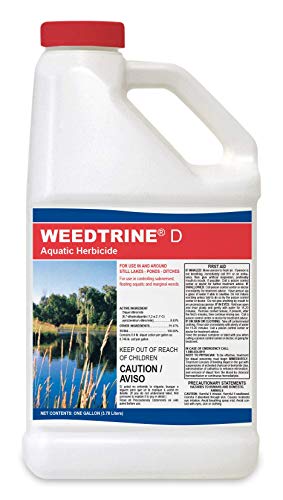
Weedtrine D is a diquat-active aquatic herbicide formulated for fast, broad-spectrum control of duckweed, floating, submersed, and emergent weeds. It is designed for professional-grade use with straightforward application methods, making it suitable for water bodies needing rapid clearance of multiple weed types.
Best for: Quick, broad suppression across various weed categories in a single treatment.
Who it is for: Professional lake managers seeking an efficient, widely effective herbicide with simple application steps.
Caution: Use restrictions may apply for irrigation, drinking water, and swimming; follow local regulations and label directions precisely.
Buying Guide: Key Considerations For Choosing An Aquatic Herbicide
- Target weed species: Identify whether your lake primarily needs control of submerged, emergent, floating weeds, or algae. Some products excel at broad-spectrum control, while others focus on specific plants like Eurasian milfoil or cattails.
- Application method: Consider whether you prefer granular, liquid, or concentrated formulations. Granular products often require dispersion planning, while liquids are typically easier to apply with spray equipment.
- Water body size and treatment area: Larger lakes may benefit from systemic formulations and treatments designed for longer-lasting control, while smaller, localized problem areas can be addressed with spot treatments.
- Environmental impact: Review the product’s environmental profile, including dissipation rate, non-target effects, and regulatory approvals in your region. Some products are designed to minimize impact on fish and aquatic habitats.
- Local regulations: Many aquatic herbicides are subject to state or federal restrictions. Verify permits, allowable uses, and any seasonal limitations before application.
- Safety and handling: Ensure appropriate personal protective equipment and storage practices. Follow label directions for mixing, application timing, and drift management to protect nearby wildlife and water users.
- Cost and labor: Balance product price, the need for repeated applications, and required labor or professional assistance when planning treatment schedules.
FAQ: Quick Answers For Aquatic Herbicide Questions
- What is the fastest way to control aquatic weeds in a lake?
– Fast-acting diquat-based products or broad-spectrum liquids typically deliver rapid suppression, but results depend on weed type and water conditions. - Can I use aquatic herbicides near the shoreline?
– Yes, but follow label directions and local regulations. Emergent-control products can target shoreline weeds, while cautions about drift and aquatic life apply. - Are granular herbicides safer for the environment?
– Granular formulations can reduce drift risk, but environmental impact depends on formulation and application method. Always follow label guidance. - Do I need professional help to treat a lake?
– For large or sensitive ecosystems, professional application ensures proper species targeting, timing, and regulatory compliance. - Can I combine herbicides with copper-based treatments?
– Some products can be used in rotation or combination, but specific compatibility should be confirmed on the label or with a permit-approved applicator. - What should I consider when choosing between a granular and liquid product?
– Granular products suit spot treatments and controlled dispersion; liquids are typically easier to apply over broader areas but may require surfactants for best uptake.