Managing cattails and other emergent aquatic weeds requires select, proven products that work in water and along shorelines. This guide highlights top options for cattail control, including specialized aquatic herbicides and compatible surfactants. Each entry covers target weeds, application focus, and key considerations to help you choose the right product for ponds, lakes, and shoreline habitats. Whether you’re restoring water flow, improving recreation, or protecting shoreline vegetation, these selections provide focused solutions with clear root-kill or selective control mechanisms.
| Product | Brand | Weed Target | Form | Notes |
|---|---|---|---|---|
| Airmax Shoreline Defense Emergent Weed Control (Quart) | Airmax | Cattails, Phragmites, grasses, brush | Liquid Concentrate | Broad spectrum; effective in fresh and brackish water; root-kill via foliar absorption |
| CattPlex Pro (Quart) | Crystal Blue | Cattails, water lilies, grasses, submerged and floating weeds | Liquid Concentrate | Uses Imazamox; aquatic-specific formulation with long residual activity |
| Tsunami DQ Aquatic Herbicide (Quart) | Crystal Blue | Wide range of aquatic plants and algae | Diquat-based | Fast-acting; broad aquatic weed control |
| Diquat Aquatic Herbicide (1 Gallon) | ALLIGARE | Aquatic weeds and algae in ponds, lakes, and aquatic margins | Liquid | Broad-spectrum aquatic weed control; suitable for larger applications |
| Plex Mate Aquatic Surfactant (Quart) | Sanco Industries | Support for herbicides and algaecides; enhances coverage | Surfactant | Increases product penetration and adhesion on aquatic weeds |
Note: This table provides a quick reference to the products profiled in this article. Each product’s label and local regulations should be consulted prior to use, and professional guidance is recommended for substantial weed problems or sensitive shoreline environments.
Airmax Shoreline Defense Emergent Weed Control (Quart)

Airmax Shoreline Defense Emergent Weed Control is a broad-spectrum liquid aquatic herbicide designed to control cattails and other emergent weeds along shorelines. It is suitable for use in fresh and brackish water and emphasizes root kill by foliar absorption. Application involves mixing in a tank sprayer and applying directly to foliage. When used as directed, it helps restore beach and dock areas by eradicating persistent emergent weeds at the root level. The product is often paired with a surfactant for optimal uptake and longevity of control in dynamic aquatic environments.
CattPlex Pro Aquatic Herbicide (Quart)

CattPlex Pro concentrates on cattail control with targeted action in both submerged and floating weed scenarios. The label details a full list of controlled weeds and emphasizes effectiveness within aquatic ecosystems. Notably, CattPlex Pro uses Imazamox rather than glyphosate, offering a mechanism tailored to aquatic environments and a potential advantage for long-term, selective cattail management. Users should follow the label for mixing rates and re-treatment intervals to balance effective control with environmental considerations in ponds, lakes, and waterways.
Tsunami DQ Aquatic Herbicide (Quart)

Tsunami DQ is a diquat-based aquatic herbicide designed to target a broad range of aquatic plants and algae. It is positioned for fast-acting control of submerged, floating, and emergent weeds in ponds, lakes, and similar water bodies. The product label outlines suitable application scenarios, and users should be mindful of any regional restrictions or state-specific requirements. Diquat-based formulations can provide rapid weed suppression, but may require follow-up treatments to maintain clean water conditions, depending on weed pressure and environmental factors.
Diquat Aquatic Herbicide (1 Gallon)

ALLIGARE’s Diquat Aquatic Herbicide provides broad-spectrum control for aquatic weeds along ponds, lakes, and marginal areas. The product targets floating, submerged, and marginal weeds, supporting maintenance of clearer water and improved usability of water bodies. As with any diquat-based formulation, appropriate safety precautions, water use restrictions, and label-based application guidelines are essential to ensure effective results while protecting non-target species and water quality.
Plex Mate Aquatic Surfactant for Herbicides (Quart)

Plex Mate is an aquatic surfactant designed to accompany herbicides and algaecides. It helps herbicides adhere to plant surfaces, breaks down waxy coatings to improve penetration, and can enhance overall treatment efficiency. While not a herbicide itself, Plex Mate is a valuable companion product when targeting cattails and other aquatic weeds, potentially reducing the number of applications needed for effective control. Always follow compatibility guidance on the herbicide label when using a surfactant.
CattPlex Pro Quart & Plex Mate Pair (8 oz + 32 oz)
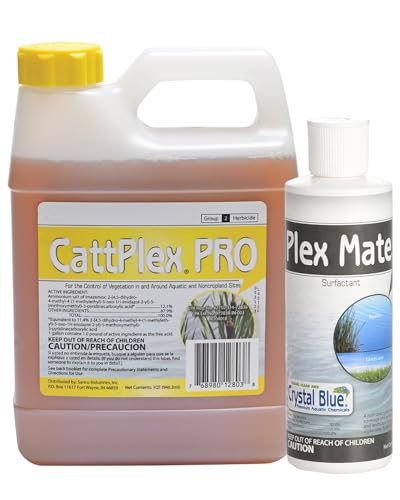
The CattPlex Pro line emphasizes cattail-focused control with aquatic-specific formulations. The pairing with Plex Mate aims to maximize coverage and penetration, improving effectiveness against both submerged and floating weeds. As with all herbicides used in aquatic settings, adherence to label directions and professional guidance is advised to manage ecological impact while achieving desired cattail suppression.
Buying Guide: Key Purchase Considerations For Aquatic Weed Control
When choosing an aquatic herbicide for cattails, consider weed type, water conditions, and regulatory constraints. Below are important factors to weigh from multiple perspectives:
- Weed target and site specificity: Some products are designed for emergent weeds (like cattails and phragmites) along shorelines, while others target submerged or floating weeds. Assess whether your priority is root-level control, rapid suppression, or long-term management.
- Water chemistry and habitat: Water salinity, pH, and the presence of other aquatic plants or beneficial organisms can influence product performance. In brackish conditions, some formulations may be less effective or require alternative products.
- Mode of action: Glyphosate-based products offer broad-spectrum control, while imazamox-based and diquat-based products provide more aquatic-specific action. Consider environmental impact, non-target plants, and potential resistance management.
- Application method and equipment: Tank sprayers, shoreline mowers, or land-based application equipment may be required. Surfactants can improve adhesion and uptake, but must be compatible with the chosen herbicide and water body.
- Residual activity and retreatments: Some products provide longer-lasting suppression, reducing re-treatment frequency. Others may require follow-up applications depending on weed pressure and environmental conditions.
- Regulatory and environmental considerations: Check local regulations for aquatic herbicides, water-use restrictions, and approval status for your region. Follow label directions to protect aquatic life and water quality.
- Professional guidance: For large weed problems, complex shoreline areas, or sensitive ecosystems, consult an aquatic management professional to tailor a management plan and ensure compliance with regulations.
In selecting a product mix, users often pair a primary herbicide with a compatible surfactant to improve efficacy, while considering non-chemical approaches such as mechanical removal or habitat restoration to support long-term cattail management. The right combination depends on site specifics, weed spectrum, and environmental stewardship goals.