Answer: An 80W LED grow light can effectively support seed starting, vegetative growth, and flowering in compact indoor setups. The best options balance full-spectrum clarity, energy efficiency, and even light distribution for 2×2 ft or similarly sized grow tents. The top picks below are ideal for hobby gardeners, apartment growers, and small-scale indoor farms seeking steady performance without high energy costs.
Buyer-friendly summary table of selected products:
| Product | Best For | Key Benefit | Potential Limitation |
|---|---|---|---|
| UAP800 80W LED Grow Light (Elufah) | All growth stages in 2×2 ft tents | Deeper penetration with uniform PPFD | New-gen lens design; frame heat dissipation noted but real-world coverage depends on tent height |
| SANSI T10 Standing Grow Light (80W) | Tall plants and adjustable staging | Five-dimming levels and wide coverage | Standalone unit; may require tall installation for some setups |
| SANSI 80W with Remote Timer and Wings | Medium to large houseplants | Remote timer and dimming; foldable wings for direction | Remote control adds convenience but relies on line-of-sight |
| Barrina T5 2ft 80W (8 x 10W) Kit | Seedlings to vegetative stages | High PPFD with easy installation | 2ft strip format may require multiple units for larger areas |
| SZHLUX 2FT Full Spectrum 80W (2 Pack) | Compact, expandable fixtures | Linkable design to grow larger areas | Driver compatibility noted; ensure chaining fits space |
UAP800 80W LED Grow Light — Elufah

The UAP800 uses a full-spectrum array combining 6200K white, 437.5nm blue, 660nm red, and 730nm far-red LEDs to support photosynthesis across seed starting, vegetative growth, and flowering. The lens design emphasizes deeper penetration and uniform PPFD across the 2×2 ft coverage, helping plants receive strong light from center to edge. It is energy efficient, operating at 80 watts with solid aluminum for heat dissipation, which helps extend lifespan. This setup is best for small to medium indoor tents where even light distribution is important.
Best for: Gardeners who want strong, depth-penetrating light in a 2×2 ft space without high energy costs. Choose this if you prioritize uniform spectrum and a steady, full-range output for multiple growth stages.
Caution: The product relies on its lens and layout to spread intensity; ensure your tent height supports even coverage, as too-close placement could intensify heat near the canopy.
SANSI T10 Standing Grow Lights — 80W

This vertical grow light uses 144 LEDs across four full-spectrum channels with a total output of 308 μmol/s/㎡ at 8 inches. It features five levels of dimming (20–100%) to suit seedlings through mature plants, plus a 4.34 ft stand that offers a wide illumination range. The fixture’s 120-degree coverage and adjustable height promote uniform light distribution across tall or multi-level plant stands, making it a strong option for bedrooms, studios, or dedicated grow rooms where flexibility matters.
Best for: Home growers with tall plants or multiple tiers who need a broad, adjustable light that covers a larger footprint with controllable intensity.
Caution: The unit is designed for fixed installations; ensure the stand height and room layout fit your space to prevent glare or shadowing on dense canopy areas.
SANSI 80W Grow Light With Wings — Remote Timer
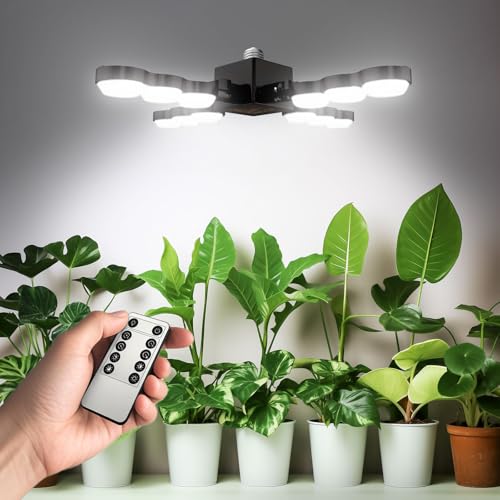
This 80W fixture emphasizes a flexible, winged design that increases coverage around middle and large plants. It delivers high PPFD with a claimed 720.9 μmol/s/㎡ at 1 ft, equivalent to much larger traditional fixtures in brightness while offering energy savings. A remote timer supports 4/8/12-hour cycles, and dimming options allow fine-tuning without repositioning plants. The wings help direct light to the canopy where it’s most needed, making it suitable for plant groups that need more headroom and angle control.
Best for: Growers with medium to large plants or uneven canopies who want a single-unit solution with remote timing and adjustable light focus. Choose this if you value flexible light direction alongside automation.
Caution: Remote control requires line-of-sight; obstructions may hinder timing accuracy in very cluttered setups.
Barrina T5 2ft 80W Full Spectrum LED Grow Light Kit

The Barrina T5 kit provides 2ft bars at 80W total, delivering full-spectrum light with high PPFD. It’s designed for easy installation with double-sided tape, clips, and cable ties, and it can be linked up to 16 lights in a series. This option is particularly practical for seedling trays, small starter setups, and modular arrangements. The kit emphasizes a balance between efficiency and ease of use and is best for rapid, scalable expansions in compact grow spaces.
Best for: New growers or modular setups focused on seedlings and vegetative growth who want simple plug-and-play installation and easy expansion. Avoid this if you need intense, single-point high-PPFD lighting for dense canopy plants.
mfxmf LED A19 9W Grow Light Bulbs — Full Spectrum

These A19 bulbs deliver a 150-degree spread with full-spectrum light (400–740 nm) designed to replace higher-wattage traditional bulbs while consuming less energy. The 20000-hour lifespan and robust cooling system support longer operation at moderate temperatures. They’re suited for open fixtures or light fixtures that accept E26 bases, making them a flexible option for desk or shelf setups where conventional lamps aid plant health.
Best for: Indoor gardeners seeking a low-wuss alternative to higher-wul wattage fixtures, especially in multi-light arrangements or fixtures that lack integrated grow optics. Choose this if you want easy retrofitting in standard lamps.
GHodec 80W Full Spectrum Clip Grow Light

The GHodec clip-on grows light provides 80W of full-spectrum light through a clip-on design with five dimmable levels and 4/8/12-hour timer options. It’s suited for clamp-on or gooseneck setups and is designed to help with consistent seedling and vegetative growth. The white LEDs bridge a range of wavelengths, supporting plant photosynthesis while maintaining an efficient heat profile through aluminum construction.
Best for: Small planters and desks where a flexible, clip-on solution helps focus light on a compact canopy. Avoid this if you need large-area coverage or a fixed, high-PPFD setup for mature plants.
SZHLUX LED Grow Light 2FT — 2 Pack

The SZHLUX 2FT grow light strips come in a two-pack 80W configuration, delivering a full spectrum designed to mimic natural sunlight. The trapezoid design increases the luminous area compared to traditional T5/T8 formats, and the system is designed to be easily linked in series using included cords. The approach favors energy efficiency and broad coverage for seedling and vegetative stages, with the option to scale up by adding more units as space allows.
Best for: Growers expanding a compact setup who want a scalable, easy-to-link solution with broad coverage. Avoid this if you require high-PPFD concentration on a single focal point or a fixture with more advanced automation built-in.
Buying Guide
What should I look for in an 80W LED grow light?
Key factors include full-spectrum output (covering blue and red wavelengths for vegetative to flowering stages), PPFD consistency across the footprint, energy efficiency, and heat management. Look for lenses or optical design that promote deep penetration and uniform coverage across 2×2 ft spaces. Consider dimming and timing options if you want automation or flexibility without moving fixtures.
How important is coverage area and spectrum?
For a 2×2 ft setup, you want uniform intensity from center to edges. A broad spectrum that includes blue (vegetative growth) and red (flowering) along with some far-red signals helps plants transition through growth stages. Fixtures with adjustable height, wings, or multiple LEDs can improve coverage in irregular layouts.
Which features boost ease of use?
Remote timers, multiple dimming levels, and easy installation (clip-on, plug-and-play, or linkable units) reduce setup time and maintenance. Consider the ease of height adjustment and whether the unit can be integrated into existing grow racks or tents.
What are common limitations to expect?
Liability differences exist in driver compatibility, heat dissipation, and how evenly light distributes in tall versus flat canopies. Some units may require additional mounting hardware or taller tent ceilings to prevent shadowing. When using multiple fixtures, ensure power outlets and timers scale without overloading circuits.
How should I compare options?
Assess the cost per lumen, the total PPFD offered at a practical working distance, and the ease of expansion if you plan to grow more plants. Compare whether a model provides direct benefit for your specific plant types (seedlings versus mature fruiting plants) and how programmable features align with your daily routine.
Maintenance and safety tips
Keep fixtures clean and dust-free to maintain light output. Ensure adequate clearance from heat-sensitive plants, especially in small tents. Use certified power adapters and avoid overloading extension cords. Regularly inspect cords and mounting hardware for wear or loosening.
FAQ
- What size grow tent is best for an 80W LED light? An 80W LED light is typically well-suited for a 2×2 ft tent, providing balanced light across the canopy with proper height adjustments.
- Do I need multiple lights for larger beds? Yes. For larger beds, you can link multiple fixtures or add more units to improve uniform coverage and PPFD depth across the canopy.
- Is dimming necessary? Dimming helps tailor light intensity to different growth stages and plant species, saving energy when full power isn’t required.
- Can I use 80W LEDs for flowering? Many 80W options cover flowering spectra; however, ensure your fixture provides adequate red and far-red wavelengths to support bloom development.
- Are these lights suitable for tall plants? Vertical or stand-mounted designs can accommodate taller plants; check your fixture’s stand height or adjustability to avoid casting shadows on upper leaves.
- How long should the lights stay on each day? Seedlings often do well with 12–16 hours of light, while mature flowering plants may benefit from 12 hours of light with a complementary dark period.