The following article highlights top grow lights and related fixtures suitable for seekers of high-intensity indoor lighting. While traditional 1200W HPS systems exist, modern LED and HID alternatives offer comparable output with energy savings, cooler operation, and long lifespans. Below you’ll find five carefully chosen options, each with real-world specs and what to consider when selecting a unit for seed starting, vegetative growth, and flowering phases.
Summary Table of Selected Products
| Product | Brand | Light Type | Approximate Power Draw | Notable Feature |
|---|---|---|---|---|
| FECiDA 1200W Equivalent LED Grow Light | FECiDA | LED | 130W | Daisy chain; full spectrum 380–780 nm |
| SunStream 1000 Watt DE HPS Grow Light System Kit | SunStream | HPS | Kit with ballast | Digital dimmable ballast; multi-volt compatibility |
| Vegelumax 1000W HPS Bulb | Vegelumax | HPS | HPS bulb (1,000W equivalent) | High PAR red/orange spectrum |
| Beelux 1000W LED Grow Light | Beelux | LED | Actual ~100W (1000W HPS equivalent) | Dual chips; lower running costs |
| TATU 1000W LED Grow Light | TATU | LED | Actual 100W (1000W HPS equivalent) | Full spectrum with veg/bloom switches |
FECiDA 1200W Equivalent LED Grow Light

The FECiDA unit markets a 1200W equivalent brightness while drawing only about 130W, offering balanced full-spectrum output across 380–780 nm suited for seedling through bloom. It features 0–100% dimming and a daisy-chain port to scale a multi-light setup without additional outlets. A quiet cooling system combines a aluminum heat sink and low-noise fan to extend lamp life beyond 50,000 hours, making it suitable for compact grow tents and home gardens. This option emphasizes energy efficiency without sacrificing spectrum quality for all growth stages.
SunStream 1000 Watt DE HPS Grow Light System Kit
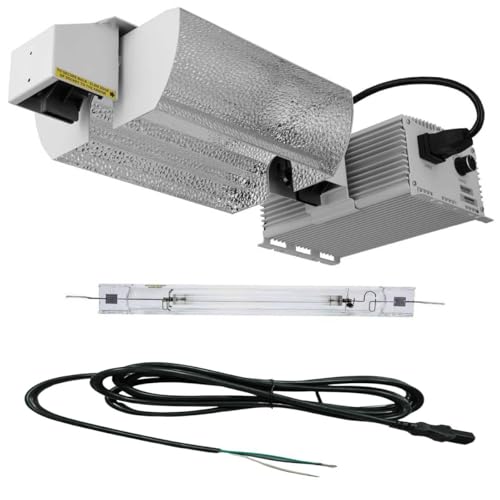
This system centers on a 1000W HID framework with a digital ballast that supports a 347V controller port for adjustable output across 600W, 750W, 1000W, and 1150W. The kit is designed to work with HPS and MH bulbs and supports multi-volt input (up to 347V), making it flexible for various electrical environments. Its cooling design uses a unique fin architecture for efficient heat dissipation and safety features guard against short circuits, surges, and overheating. Ideal for growers seeking a traditional HID experience with modern control capabilities.
Vegelumax 1000W HPS Bulb

The Vegelumax 1000W HPS bulb provides high PAR output with a 2100K color temperature and a robust red/orange spectrum, designed specifically for professional hydroponic cultivation. With an E39 base, this bulb aims to deliver intense illumination that can support vigorous flowering and fruiting. The design emphasizes lumen stability, maintaining a high percentage of initial light output after extended run times, which helps ensure consistent growth cycles in indoor gardens.
Beelux 1000W LED Grow Light

The Beelux LED unit is designed to replace a traditional 1000W HPS while consuming only about 110W. It targets a 4×4 ft grow area and emphasizes balance between light utilization and energy savings. The quality materials include an optical-grade PC cover and an aluminum back, supporting six-sided heat dissipation for a quiet operation. An enhanced red light component is incorporated to potentially improve yield, supporting a range of indoor crops from leafy greens to flowering ornamentals.
TATU 1000W LED Grow Light

The TATU 1000W LED Grow Light provides a full-spectrum solution with separate veg and bloom switches. It delivers an actual 100W draw to achieve a 1000W HPS equivalent performance, with a high-efficiency LED chip design to maintain light utilization around 90%. A robust heat-dissipation system uses an optical-grade PC cover and an aluminum back, and six-sided cooling helps keep noise levels low, making it suitable for quiet operation in grow tents and home setups. This option prioritizes spectrum control and energy efficiency for varying growth stages.
Buying Guide: Key Purchase Considerations
Selecting the right 1200W HPS equivalent or replacement for an indoor garden depends on several factors. Here are the primary considerations to help compare options objectively:
- Light Type and Spectrum: LED options deliver full-spectrum light that covers red, blue, white, and infrared bands, great for multiple growth stages. HPS systems excel at intense red output beneficial for flowering but can run hotter and require ballast compatibility.
- Power Efficiency and Heat: True power draw matters for electricity costs and heat management. LED units often draw less power while delivering comparable PAR, with cooling designs that minimize noise and extend lifespan.
- Coverage Area and Intensity: Match light output with your grow space. Check the recommended coverage area (feet or meters) and whether the fixture includes dimming, daisy chaining, or multi-light configurations for scalability.
- Reliability and Lifespan: Look for long-lasting components (sealed heatsinks, quality drivers, and robust diodes) to reduce maintenance and replacement frequency.
- Control Features: Dimming, ballast compatibility, and controller ports influence how precisely you can tailor light cycles to seedling, veg, and bloom phases.
- Installation and Noise: Quiet operation is important for home environments. Simple mounting options and efficient cooling reduce nuisance and simplify setup.
- Cost of Ownership: Consider upfront purchase price, energy usage, and expected bulb/LED replacement schedules. LED systems tend to offer lower ongoing costs despite higher initial prices.
- Compatibility: If you already own current fixtures or ballast, verify compatibility with the chosen light, including voltage requirements and connector types.
Across the selected products, a common pattern emerges: LEDs with full-spectrum output and energy-efficient design provide robust performance for seedling to bloom stages while reducing electricity consumption and heat load. HID/HPS options deliver traditional watt-per-watt intensity and familiar spectrum profiles but often require more cooling and more careful thermal management. When choosing, prioritize your space, climate, and growth goals to balance efficiency with yield potential.