The right solar generator can keep a refrigerator running during outages, camping trips, or off-grid living. This guide highlights five top options that balance capacity, safety, and reliability for fridge use. Each product is designed to deliver steady 120V power, handle cycling loads, and maintain battery health over time. Use this overview to compare runtimes, charging speeds, and expandability so your perishables stay cold when mains power isn’t available.
| Product | Brand | Capacity | Output |
|---|---|---|---|
| Jackery Solar Generator 1000 v2 | Jackery | 1070Wh | 1500W AC / 3000W surge |
| Jackery HomePower 3000 | Jackery | 3072Wh | 3600W / 7200W surge |
| EF ECOFLOW Delta 2 | EF ECOFLOW | 1024Wh | 1800W / 15 outlets |
| Jackery Explorer 2000 v2 | Jackery | 2042Wh | 2200W / 4800W surge |
| Hepway P1300 | Hepway | 1154Wh | 1300W+ / Refrigerator Mode |
Jackery Solar Generator 1000 v2 With 200W Panel

The Jackery Solar Generator 1000 v2 combines a 1,070Wh LiFePO4 battery with a strong 1,500W continuous AC output and a 3,000W surge, making it capable of running a household fridge during outages. Its light 23.8 lb frame and foldable handle enhance portability for RV trips and camping. A notable feature is its One Hour Fast Charging via the Jackery app, which prioritizes quick top-ups while preserving battery health through ChargeShield 2.0 technology. This model is designed for low-to-medium wattage appliances, including refrigerators, fans, and small freezers, with a long expected lifespan thanks to the durable LFP chemistry.
Key considerations for fridge use include managing compressor starting surges and ensuring stable 120V sine wave output. The 1,070Wh capacity supports typical fridge cycles, though larger or older models may require careful monitoring of runtime. The unit’s portability is a plus for mobile setups, and its safety features help prevent overheating or overcharging during extended outages. If you’re seeking a compact, reliable fridge backup with fast charging, this model offers a balanced mix of power, weight, and efficiency.
Jackery HomePower 3000 Portable Power Station

The Jackery HomePower 3000 provides robust home backup power with a 3,600W continuous output (7,200W surge) and a substantial 3,072Wh capacity. This configuration is well-suited for maintaining a refrigerator through longer outages, as well as powering essential devices like Wi-Fi routers, lights, and security systems. A highlighted feature is the ≤20ms UL-certified UPS, which automatically switches to backup power in microseconds, preserving critical appliances during sudden outages. The expandable potential and sturdy construction are attractive for homeowners seeking a dependable, ready-for-emergencies solution.
For fridge-focused use, the HomePower 3000’s larger capacity reduces the risk of running out of power during extended events. The UPS capability is particularly valuable for protecting a refrigerator’s compressor cycles and preventing temperature spikes. Consider this model if you want a high-wault backup that can also cover broader household loads, with convenient integration into a home battery system or solar setup over time.
Jackery Explorer 300 Solar Generator

The Explorer 300 offers a compact 293Wh lithium battery paired with two Pure Sine Wave AC outlets, delivering steady 300W power suitable for portable fridge needs during short trips or emergency scenarios. Weighing a mere 7.1 pounds, it’s a highly portable option for campers and RV travelers who need refrigerator support in transit. It supports multiple charging avenues, including a 60W PD USB-C input/output, fast-charge port, USB-A, and a DC car port, making it feasible to recharge from wall outlets, car ports, or solar panels like the SolarSaga 100W kit.
While its capacity is smaller than full-home backups, the Explorer 300’s quick recharging and light footprint win points for minimalist setups. Fridge users should be mindful of device wattage and compressor startup demands; for regular grocery storage or longer outages, pairing with larger units or combining with a solar array provides a more durable solution. It’s an ideal choice for lightweight, portable fridge protection on the go.
EF ECOFLOW Delta 2 Portable Power Station

The Delta 2 delivers a substantial 1,024Wh LiFePO4 battery and a powerful 1,800W continuous AC output, with a broad range of outlets and fast charging options. Its 15 built-in outlets provide versatility for powering multiple devices, including refrigerators, freezers, and other essential appliances during outages or outdoor deployments. The LiFePO4 chemistry ensures longer cycle life and stability, translating into reliable performance across frequent charge-discharge cycles. The Delta 2 is designed for home backup, camping, RV trips, or event power where robust, quiet, and safe power is needed.
For refrigerator use, Delta 2’s steady sine wave output and high surge capacity help manage compressor loads. If you anticipate longer outages or want to run more appliances in tandem, this model’s expandability and safety features make it a strong choice. It’s well-suited for users who require dependable power, quick recharging, and flexibility to add solar panels or batteries to scale capacity.
OUPES Mega 1 Portable Power Station
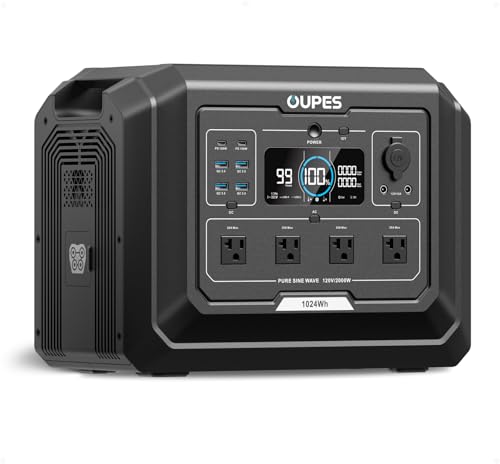
The OUPES Mega 1 is a high-capacity option featuring 1,024Wh LiFePO4 capacity, with 2,000W continuous AC output and a 4,500W peak. It is expandable to 5 kWh with additional batteries, making it suitable for long outages or full-home backup scenarios where a refrigerator needs persistent power. The device supports multiple charging paths, including solar and AC fast-charging, enabling rapid recharging for frequent use in outdoor or remote locations. This model is designed to deliver heavy-duty performance with a focus on safety and durability, ideal for users who want scalable energy storage for fridge protection and beyond.
When planning fridge backup, consider the need for sustained runtime and the possibility of expanding capacity as your cooling needs grow. The Mega 1’s UPS-like features, rugged build, and compatibility with solar expansion provide a forward-looking solution for households seeking resilience and long-term sustainability in power supply for refrigeration and other critical loads.
Buying Guide: Key Considerations For Fridge Backup
- Battery chemistry: LiFePO4 offers longer life, stable temperatures, and safer chemistry than many lithium-ion options, which is beneficial for repeated freezer/fridge cycling.
- Capacity vs. runtime: Calculate fridge wattage (including compressor startup) and estimate daily runtime to pick a unit with adequate watt-hours. Consider expandable systems if you anticipate longer outages.
- AC output and surge: Ensure continuous wattage exceeds fridge running watts plus startup surges. A higher surge rating helps handle compressor spikes without tripping.
- UPS and switching: A fast UPS helps protect delicate electronics and prevents temperature spikes when outages occur.
- Charging speed: Fast charging reduces downtime between outages. Consider units with multiple charging methods (AC, USB-C PD, solar).
- Portability vs. capacity: Portable units are easier for camping, but larger units provide longer fridge runtimes during extended outages.
- Solar compatibility: If you aim for green resilience, verify panel compatibility and expandability with the same ecosystem to maximize efficiency.
- Safety features: Look for overcurrent, short-circuit, and thermal protections, especially in environments with heat or humidity.
In summary, selecting a solar generator for a refrigerator involves balancing capacity, runtime, charging options, and expandability. The models showcased here cover compact portability for short trips, high-capacity home backups, and scalable systems suitable for longer outages or full off-grid living. Evaluate your fridge’s power needs, typical outage duration, and whether you want to add solar panels later to choose the best fit for your circumstances.