Choosing the right battery pairing for a 100W solar panel kit ensures reliable off-grid power, longer battery life, and safer charging. The following selections emphasize compatibility with 12V systems, smart charging features, and robust durability for RVs, cabins, boats, and camping gear. Each product highlights key specifications, charging efficiency, and safety considerations to help you compare options at a glance.
| Product | Main Benefit for 100W Systems | Best Use Case |
|---|---|---|
| Renogy 100W Starter Kit | Integrated controller with 10-year panel warranty | Off-grid RVs and campers |
| SOLPERK 100W Kit | High-efficiency MPPT controller with waterproof design | Marine, RVs, and outdoor sheds |
| Topsolar 100W Kit | All-in-one with tilt rack and intelligent controller | Backups and remote cabins |
| Renogy RNG-100D-SS | High conversion efficiency, compact design | Small spaces, vans, and mini-rigs |
| ECO-WORTHY 100W Kit | Durable frame, weather tolerance, included mounting | Boats and RVs |
Renogy 100W Starter Kit With Controller

The Renogy Starter Kit provides a complete entry into off-grid solar. The 100W monocrystalline panel delivers efficient output, while a 30A LCD PWM charger controller offers straightforward, reliable regulation for 12V battery banks. The kit includes an adaptor, tray cables, and Z brackets, making installation in RVs, campers, or small cabins practical. Efficiency claims include a 22.5% cell efficiency and UL/CSA/IEC certifications, suggesting solid safety and performance margins for daily use.
Key considerations for pairing with a battery: look for a battery type that tolerates PWM charging profiles and can handle daily cycling if you expect regular sun. For off-grid use, a deep-cycle lead-acid or a modern lithium option that matches the controller’s charging voltage (12V) is ideal. The kit’s service plans (10-year panel coverage, 2-year controller, 25-year power output warranty) indicate long-term reliability, which can translate into more predictable battery life when paired with appropriate storage and charging practices.
SOLPERK 100W Solar Battery Charger Kit

SOLPERK combines a 100W panel with a high-efficiency MPPT controller and a robust, waterproof design. The controller claims up to 30% more power versus standard PWM options, which can improve the charging profile for 12V batteries under varied sunlight. Its application range covers RVs, boats, sheds, and caravans, with protection against overcharge, deep discharge, surges, and overheating. A predrilled mounting approach and included hardware simplify installation.
Battery selection guidance: an MPPT-enabled system can optimize charging for lithium or sealed lead-acid chemistries. For frequent cycling, a lithium iron phosphate (LiFePO4) battery or a deep-cycle AGM battery can maximize usable capacity and lifespan. Ensure your battery’s maximum charging current aligns with the controller’s 10A charging rate to avoid thermal stress and premature wear. The waterproof ratings and overall build suggest suitability for outdoors where moisture and temperature swings occur.
Topsolar 100W Panel Kit With 30A Controller
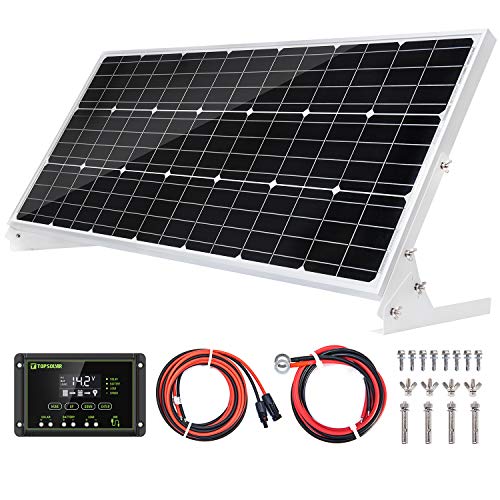
Topsolar bundles a 100W panel with a 30A solar charge controller, mounting hardware, and connector cables. The kit is designed for off-grid charging across vehicles, cabins, boats, and remote storage. It emphasizes a complete solution, including tilt racks and ready-to-connect cables, which can help reduce installation time. The package notes its suitability for 12V battery charging and back-up power scenarios, making it a practical option when you need predictable solar input for a modest storage bank.
Battery pairing notes: due to the higher controller rating, you can pair larger capacity lead-acid or Li-based batteries without stressing the charger. For longevity, choose a deep-cycle battery with a healthy depth of discharge (DoD) and a battery management system (BMS) suited to the chemistry. If space is limited, a compact LiFePO4 option may deliver more cycles and lighter weight, but confirm compatibility with the included controller’s voltage and charging profile.
Renogy Solar Panel RNG-100D-SS

Renogy’s RNG-100D-SS module emphasizes high efficiency with a 25% conversion claim, aided by 16BB N-Type technology. This design aims to reduce hot spots and extend panel life, which can be especially beneficial when paired with a battery that sees frequent charging in variable conditions. The panel is compact and lighter than older iterations, making it easier to install in smaller spaces like vans or rooftop setups on campers. It may pair well with both lead-acid and lithium 12V battery systems, provided a suitable charger is used.
Battery selection guidance: for use with high-efficiency modules, a battery with robust charge acceptance and good low-temperature performance is ideal. For lithium options, ensure the BMS can handle the system voltage and that the solar controller can support the charging current without triggering safety limits. Its compact size makes it attractive for tight installations while preserving usable capacity for daily loads.
ECO-WORTHY 100W Kit With Mounts

ECO-WORTHY’s bundle focuses on durability and ease of mounting, including 4 new mounting Z brackets and tray cables. The panel is described as 100W mono with a corrosion-resistant frame, able to withstand 2400Pa wind and 5400Pa snow loads. With an IP65-rated junction box, this kit is well-suited for exposed outdoor installations on RVs, boats, or sheds. The included PWM controller provides straightforward compatibility with typical 12V systems and a range of lead-acid or Li-based batteries.
Battery pairing guidance: a robust, weather-tolerant setup works well with sealed lead-acid, AGM, or LiFePO4 cells. If your climate experiences cold snaps, LiFePO4 remains efficient and has a longer cycle life, though it may require a dedicated BMS and proper charging thresholds. PWM controllers are generally forgiving with a variety of chemistries, but lithium systems benefit from proper bulk-absorption-taper charging profiles and temperature compensation to maximize longevity.
Buying Guide: Key Considerations For Battery Pairing With A 100W Panel
When selecting a battery to pair with a 100W solar panel, balance capacity, chemistry, weight, and installation flexibility. Here are multiple perspectives to help you decide:
- Battery chemistry matters: Lithium-based options (LiFePO4) offer longer life, higher DoD, and lighter weight, but require a proper BMS and compatible charging profiles. Lead-acid variants (AGM, flooded) are often cheaper upfront but have shorter cycles and heavier weight.
- Controller compatibility: If you plan to use an MPPT controller, you can maximize daily energy capture, especially in variable weather. PWM controllers are simpler and work well with many chemistries but may deliver less overall energy under same conditions.
- DoD and usable capacity: For small systems, aim for a battery with a DoD of 50-80% for lead-acid and 80-100% for LiFePO4 to extend life and avoid deep discharges that commit wear.
- Cycle life and temperature: Environments with heat, cold, or frequent cycling benefit from higher cycle life designs and temperature-compensated charging. Lithium batteries tend to perform better across a wider range of conditions.
- Physical fit and weight: If you’re mounting in a vehicle or cabin with limited space, compact high-efficiency panels and lighter batteries simplify installation.
- Safety features: Look for built-in protection against overcharge, deep discharge, short circuits, and proper venting for lead-acid options. A BMS is essential for Li-based chemistries.
- Maintenance needs: Lead-acid batteries require water top-ups and periodic equalization charges. Lithium systems demand less maintenance but need monitoring and proper handling to preserve the BMS and warranty.
Bottom line: for a 100W panel, pairing with a LiFePO4 battery set generally yields the best long-term value, especially for mobile setups like RVs or vans. Ensure the charger/controller is configured to support the chosen chemistry, and consider a modest battery bank that aligns with typical daily consumption to maximize usable energy from the solar array.