When you’re miles from the nearest outlet, reliable solar panels can keep your devices charged and your adventures uninterrupted. This guide highlights five highly capable, travel-friendly solar panel options ideal for hiking, camping, and backpacking. Each pick balances portability, weather resistance, and charging speed so you can stay connected off the grid without carrying heavy gear. Read on for product highlights, practical usage tips, and a concise Buying Guide to help you choose the right panel for your outdoor needs.
| Product | Wattage | Output Options | Key Benefit |
|---|---|---|---|
| FlexSolar 40W Foldable | 40W | USB-C, USB-A, 19V DC | Ultra-lightweight and fast dual charging |
| SOLUPUP 30W Foldable | 30W | USB-A, USB-C | High efficiency with IPX5 durability |
| Lumopal 40W Foldable | 40W | USB-C PD, USB-A QC, DC port | Balanced portability and performance |
| FlexSolar 100W Portable | 100W | PD3.0 USB-C, QC3.0 USB-A, DC | High power for power banks and small stations |
| EBL 100W Portable | 100W | USB-A, USB-C, DC, kickstand | Smart safety features with adaptable setup |
The following product snapshots summarize each option’s core strengths and what they’re best for in hiking and outdoor use. Consider how many devices you typically charge, the weight you’re willing to carry, and whether you need fast USB-C charging or a portable DC output for a small power station.
FlexSolar 40W Foldable Solar Panel Charger

The FlexSolar 40W foldable panel offers 40W total output with dual fast-charging ports: QC3.0 USB-A and PD2.0 USB-C, each up to 18W, plus a 19V DC port for small devices. Its smart IC optimizes charging based on connected devices, protecting against overcurrent, overheating, and short circuits. With a compact folded size of 8.0 x 11.1 x 1.8 inches and a weight of about 0.8 kg, it’s well suited for lightweight backpackers who still want reliable on-demand power. The device is designed for direct charging (no onboard storage), which keeps the setup simple and robust for outdoor use.
Solar Power Bank 49800mAh by JSKEI
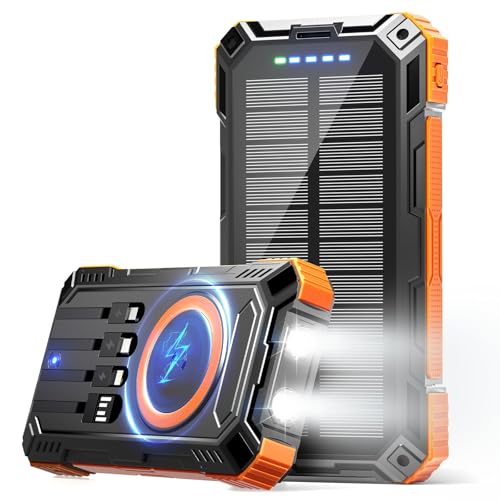
Although not a panel itself, this 49,800mAh solar power bank pairs well with larger outdoor charging setups. It includes built-in cables and two USB ports plus wireless charging, making it easy to power multiple devices without carrying separate adapters. The device is built for durability, with impact-resistant materials and a 15W USB-C fast charge option that can bring a phone to partial charge quickly in bright sun. It’s ideal for longer trips where you need to ride out variable sun exposure while keeping essential devices ready to go.
SOLUPUP 30W Portable Foldable Solar Panel

SOLUPUP’s 30W foldable panel emphasizes efficiency with a monocrystalline cell setup and a quoted energy conversion rate around the 23% mark. It outputs via USB-A and USB-C (5V/3A, 15W max) and boasts IPX5 waterproofing for rain and dust protection. Its built-in smart chip optimizes charging automatically and can reconnect after interruptions when sunlight returns, reducing manual intervention during outdoor sessions. A compact fold and rugged build make it a practical companion for day hikes and weekend camping where lightweight performance matters most.
FlexSolar 100W Portable Solar Panels

This higher-output option targets hikers who rely on small power stations or multiple devices. It delivers 100W with PD3.0 USB-C, QC3.0 USB-A, and DC outputs, along with a 4-in-1 charging cable. The foldable panel weighs about 4.1 pounds and folds to a compact size, while the unfold size provides substantial surface area for rapid sun capture. The construction focuses on portability and weather resistance, making it a versatile choice for longer expeditions that require steady power with fewer recharges.
EBL 100W Portable Solar Panel

The EBL 100W panel emphasizes a smart IC system that delivers 23% efficiency with overcharging, overheating, and short-circuit protections. It features a portable kickstand allowing a 45-degree angle to optimize sun exposure, which can boost energy capture by approximately 20% compared to flat placement. The magnetic handle assists with folding and storage, and its IP65 rating ensures weather resistance. This panel is well-suited for hikers seeking a robust, versatile energy source with straightforward setup for campgrounds or remote trails.
Buying Guide: Key Considerations For Hiking
- Power needs: Estimate daily device requirements (phones, GPS, headlamps, small power banks). Choose wattage that accommodates peak usage without adding excessive weight.
- Portability: Prioritize foldable designs, lightweight frames, and compact folded dimensions. Consider the total weight, not just the panel’s wattage.
- Output flexibility: USB-C PD and USB-A ports enable charging across devices. For solo power stations, ensure DC outputs are compatible with your gear.
- Durability and weather resistance: Look for waterproofing, dustproofing (IP ratings), and rugged laminations (ETFE is common). This extends lifespan in harsh environments.
- Smart charging features: Built-in chips that optimize output and protect devices help ensure safe, efficient charging in unpredictable conditions.
- Setup and orientation: Panels with adjustable kickstands or easy-to-position mounting options improve solar exposure and charging speed.
- Storage and transport: A compact, well-padded case or carry bag makes packing easier and reduces the risk of damage during transit.
- Compatibility with power banks or small stations: If you carry a portable power station, verify that the panel’s DC or USB-C outputs align with its input requirements.
Usage Scenarios And Perspectives
For ultralight hikers, a compact 30–40W foldable panel with USB-C and USB-A outputs can meet essential device needs without adding significant weight. Campers who rely on a small power station may prefer a higher-watt panel (80–100W) to recharge batteries more quickly, especially on days with variable cloud cover. Those who carry multiple devices benefit from panels with multiple outputs and smart ICs to prevent accidental device damage. Durability, ease of setup, and weather resistance are equally important when selecting a panel for rugged trail conditions. Consider pairing a foldable panel with a portable power bank to guarantee a steady energy supply during longer trips.
Each panel presented here offers a distinct balance of weight, output, and convenience. Your choice should reflect how you hike, the number of devices you bring, and the typical sun exposure you expect on the trail. By assessing these factors, you can choose a solar panel that reliably supports your outdoor adventures without overburdening your pack.