Find the right black plastic irrigation hose for reliable, low-maintenance watering across gardens, landscapes, and hydroponic setups. This guide highlights five versatile options that balance durability, flexibility, and ease of use for different watering needs. Best for: DIY landscapers, small farm plots, hydroponics enthusiasts, and anyone seeking simple, long-lasting irrigation tubing. A quick summary table below helps compare key traits at a glance.
| Product | Size / Length | Best For | Limitation |
|---|---|---|---|
| DBR Tech 1/4″ Drip Tubing (50 ft) | 1/4″ ID, 50 ft | Dense plantings, window boxes, raised beds | Blank distribution tubing; needs compatible emitters |
| ZY-hosetube Black Vinyl Tubing 1/2″ (25 ft) | 1/2″ ID, 5/8″ OD, 25 ft | General low-pressure runs, easy shaping | Limited length per spool |
| Raindrip 1/4″ Drip Tubing 100 ft | 1/4″ ID, 100 ft | Main supply and emitter feeds for larger areas | Longer runs require careful layout |
| ZY-hosetube 1/2″ Vinyl Tubing 100 ft | 1/2″ ID, 5/8″ OD, 100 ft | Flexible, long runs with minimal kink | Heavier spool to manage |
| Raindrip 1/4″ Soaker Hose 50 ft | 1/4″ OD, 50 ft | Border plantings, vegetable beds, planters | Soaker tubes are slower to water larger zones |
DBR Tech 1/4″ Drip Tubing — 50 Ft

The DBR Tech 1/4 inch drip tubing is designed for flexible, professional-grade watering in gardens, hydroponics, and DIY landscapes. The tubing uses a high-density PVC plastic that supports precise placement and distribution across controlled micro-watering zones. It is especially suitable for gardeners who need to route lines around beds, planters, and trellised crops with consistent moisture delivery.
- Best for: DIY landscapers and hydroponic hobbyists seeking adaptable tubing for custom layouts.
- Why selected: Flexible, cut-to-length design allows multiple lines without excess material.
Limitations: It is a blank distribution tube, so you’ll pair it with emitters or spray/mist systems to complete a irrigation setup. Ensure emitter compatibility with your layout for even coverage.
ZY-hosetube Black Vinyl Tubing 1/2” 25 Ft

This 1/2″ black vinyl tubing provides strong flexibility with minimal kinking and a smooth interior for easy flow. It is rated for low-pressure applications and is compatible with basic drip irrigation components. The 25-foot length makes it convenient for short runs or as a secondary line in a larger setup.
- Best for: Small installations where easy bending and compatibility with 1/2″ fittings matter.
- Why selected: Thick walls help resist kinks, while the compact length simplifies storage.
Limitation: It is a shorter length, which may require splicing or additional connectors for larger gardens.
Raindrip 1/4″ Drip Tubing, 100 ft

Raindrip’s 1/4-inch irrigation tubing is designed for feeder lines and low-flow drip systems, suitable for trees, shrubs, flower beds, and planters. It connects to main supply lines and emitters to deliver steady moisture where roots need it most. The coil is shrink-wrapped for convenient handling and storage.
- Best for: Home gardens needing reliable feeder tubing for drip emitters and small trees.
- Why selected: Widely compatible with typical drip irrigation parts, easy to cut and install.
Limitation: Long runs should be planned to avoid pressure drop and uneven distribution across distant areas.
ZY-hosetube Pond Hose 3/4” × 25 ft

This pond hose features corrugated, reinforced PVC with an integral helix for strength and flexibility. It is designed to move water in ponds, fountains, and garden waterfalls while remaining safe for fish and wildlife. The black color blends naturally with outdoor surroundings, making it suitable for landscape water features.
- Best for: Outdoor water features where a durable, kink-resistant hose is needed.
- Why selected: Reinforced construction reduces crimping and collapse under movement or pressure shifts.
Caution: While robust, this hose is intended for water features and may be overkill for simple plant irrigation needs.
Raindrip 1/4″ Soaker Hose, 50 ft
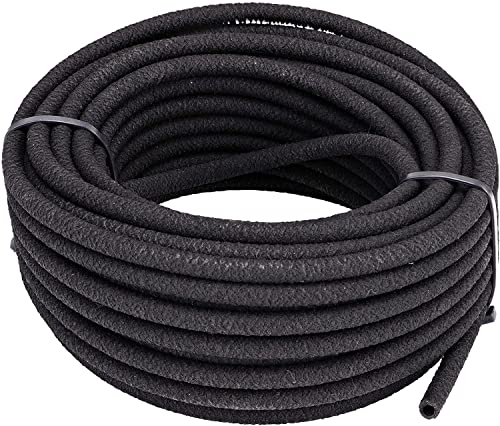
Raindrip’s 1/4-inch soaker hose delivers moisture slowly along its length, ideal for borders, vegetable rows, or planter beds. It works well for short, flat runs and connects to a main supply line via 1/4-inch micro fittings. Soaker systems keep soil consistently moist around the root zone.
- Best for: Border plantings and vegetable beds that need slow, even watering.
- Why selected: Slow release helps reduce water waste and evaporation compared to sprinklers.
Limitation: Soaker hoses can take longer to saturate large areas; plan layouts to minimize dry pockets.
Buying Guide: Key Considerations For Black Plastic Irrigation Hose
- What is the irrigation goal? If you need uniform root-zone moisture, choose soaker or drip tubing. For landscape features, a flexible vinyl hose with good kink resistance may be better.
- What length and layout will you use? Short runs are easier to manage; larger installations may require tubing with higher pressure tolerance or reinforced construction.
- What fittings and emitters will you pair with the tubing? Ensure compatibility with micro fittings, barbed connectors, and emitters you already own.
- Is there a need for durability in harsh conditions? UV resistance, heat tolerance, and chemical resistance help tubing last longer in outdoor environments.
- Do you need transparency or color? Black hoses minimize algae growth in shaded areas and blend with landscapes, but some setups may benefit from clear lines to monitor flow.
- What maintenance is acceptable? Flexible PVC tubing is easy to cut and replace, while reinforced or thicker-walled hoses resist kinking but may be heavier to handle.
Practical Tips For Selecting And Using Black Irrigation Tubing
- Choose tubing with the correct inner diameter (ID) for your flow requirements and available emitters.
- Plan for expansion: consider spare tubing length and connectors for future garden changes.
- Store coils neatly to prevent kinks; use spools or clips to keep lines organized.
- Test your system with a gentle water supply before full deployment to ensure even coverage.
Common Buyer Questions
- What is the difference between drip tubing and soaker hose? Drip tubing delivers water to emitters point-by-point, while soaker hoses seep water along their length for broader saturation.
- Can black plastic tubing be used for hydroponics? Yes, many black PVC and vinyl tubes support hydroponic setups when compatible with emitters and fittings.
- Is thicker tubing always better? Not necessarily. Thicker walls resist punctures and kinking but cost more and may limit flexibility; choose based on your layout needs.
- How do I prevent kinking? Opt for tubing with reinforced walls or higher flexibility, and avoid sharp bends; use longer straights with gentle curves.
- What size should I buy for main lines vs. emitters? Use 1/4″ or 1/2″ main lines for most drip and emitter systems, reserving smaller IDs for feeders and emitters.
- Do I need a pressure regulator? In many drip systems, a regulator helps maintain consistent flow and protects emitters from excess pressure.
Frequently Asked Questions
- What is the typical use for 1/4-inch tubing? It is commonly used as a feeder line or emitter supply in drip irrigation systems and hydroponics.
- Can I connect these hoses directly to a garden hose? Most setups use adapters or barbed connectors to integrate with a main supply line safely.
- Are these hoses safe for edible plants? Yes, the listed materials are designed for irrigation in garden settings, including edible crops, when used as directed.
- How should I store irrigation tubing when not in use? Coil it neatly or use a spool; keep it away from direct sunlight to extend the tubing’s life.
- What maintenance helps extend tubing life? Regular checks for leaks, cleaning with mild solutions, and replacing worn sections prevent failures during the growing season.
- What should I consider when choosing between 25 ft and 100 ft lengths? Longer lengths reduce the need for joints but are heavier and may be harder to manage; choose based on distance and layout.