Answering the question of which liquid fertilizer works best for deer food plots, these products are designed to boost clover, legumes, and other forage. The selections below are chosen for spray-ready application, fast leaf uptake, and soil-boosting benefits. They’re best for hunters and land managers seeking faster green-up, thicker plots, and improved grazing frequency. The buyer’s guide below highlights what to look for in nutrient balance, application ease, and plot type.
Summary table of selected products
| Product | Best For | Key Benefit | Approx. Coverage |
|---|---|---|---|
| CloverMAXX Liquid Clover Fertilizer | Clovers and legumes | Rapid green-up and regrowth | Up to 1 acre per jug |
| Gone Wild Mega Lime 10X | Soil preparation and pH balance | Soil pH improvement and nutrient uptake | Treats 1 acre |
| Clover Fuel Food Plot Enhancer | Legume-based plots | Faster growth and thicker stands | 1 acre+ potential per use |
| Jolt Liquid Fertilizer | Maximum forage production | Spray-on foliar feeding | Per-plot application |
| Crank’d Liquid Fertilizer | Whitetail forage and protein | High-efficiency ortho-phosphate blend | 2.5 gallon bottle |
Note: The table provides a quick snapshot. Detailed product notes follow to help you compare suitability for your plot size, plant species, and application method.
CloverMAXX Liquid Clover Fertilizer
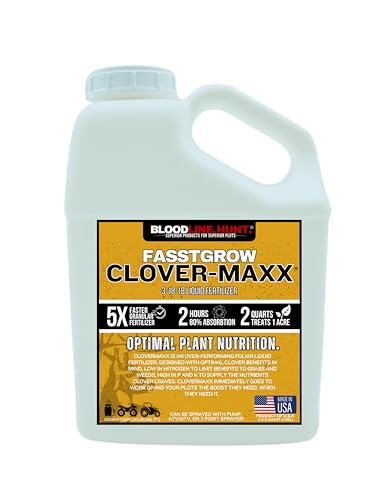
Best for: Clover-dominant plots, especially white, red, or ladino varieties. This product focuses on rapid green-up and vigorous regrowth for clover-heavy food plots. It is designed for liquid foliar application and mixes easily with water, making it suitable for backpack or ATV sprayers. This choice helps attract deer with more forage in a shorter time frame. Caution: Avoid oversaturation; follow label rates to prevent leaf burn in extremely hot conditions.
Gone Wild Mega Lime 10X

Best for: Soil conditioning and pH adjustment before or during the growing season. This liquid soil conditioner helps improve nutrient uptake and overall plant health, which can translate to better forage production. It treats up to an acre per application, making it convenient for mid-to-large plots. Caution: Results depend on existing soil conditions; testing your soil first can guide how aggressively to apply.
Clover Fuel Food Plot Enhancer

Best for: Legume-based plots like clover, soybeans, alfalfa, and peas. Clover Fuel is designed to help clover plots grow faster, thicker, and longer-lasting, with a focus on legume-specific nutrition. It is a liquid fertilizer that avoids the risk of burning when used as directed. Caution: Ensure compatibility with your current plot seed mix and avoid applying during extreme heat or drought without interim watering.
Antler King Jolt Liquid Fertilizer
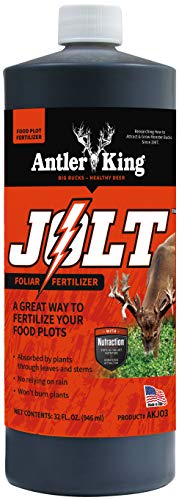
Best for: An economical option that delivers a quick, spray-on feeding for plants, stems, and leaves. Jolt emphasizes making fertilizer readily available to plants through foliar uptake, enhancing forage production efficiently. Caution: This type of product is best used as part of a broader plot management plan; over-reliance on foliar feeding alone may not address soil-based deficiencies.
Domain Outdoors Crank’d Liquid Fertilizer

Best for: Quick-acting nutrition for clover, chicory, and bean forage. The 3-18-18 formula with ortho-phosphate provides faster nutrient availability, with leaves absorbing nutrients within 24 hours for an immediate boost. This makes Crank’d a strong choice when you need a fast response in established plots. Caution: High nitrogen content may cause leaf scorch if applied during heat stress; follow label directions precisely.
Domain Outdoor Clutch Clover Seed Mix

Best for: Quick-establishing clover varieties with a focus on rotation-friendly plots. This product combines clover seeds with a simple application approach, making it suitable for smaller plots or for adding diversity to an existing mix. Caution: Seed-based products require moisture for germination; ensure adequate watering after application and monitor emergence.
Buying Guide: Key Considerations for Liquid Fertilizers in Deer Plots
- Plot type and target species: Match the fertilizer to clover, alfalfa, soybeans, or chicory to maximize uptake and grazing appeal.
- Mode of application: Foliar sprays offer quick leaf absorption, while soil-conditioning products affect root growth and long-term vigor.
- Nutrient balance: Look for formulas with balanced N-P-K ratios (such as mid-level nitrogen for leafy growth and phosphorus for root/flower development) and consider micronutrients if your soil test indicates a deficiency.
- Soil compatibility: Some products boost soil pH or chelate nutrients; test soil pH to determine whether lime or acidifying amendments are necessary before application.
- Environmental conditions: Apply during favorable weather windows to prevent wash-off and ensure leaf uptake; avoid extreme heat or drought without supplemental irrigation.
- Coverage and mixing: Confirm the product’s coverage claim (per acre) and verify compatibility with your sprayer equipment and water volumes.
- Safety and handling: Follow label instructions for safe handling, mixing, and storage to protect yourself, wildlife, and the environment.
Frequently Asked Questions
- What is the main purpose of liquid fertilizer in deer plots? It accelerates growth, boosts forage quality, and improves grazing attraction by delivering nutrients directly to plant leaves and roots.
- Can I use multiple liquid fertilizers on the same plot? Yes, but stagger applications and follow label directions to avoid nutrient overload or root burn.
- How do I choose between foliar and soil-based liquid fertilizers? Foliar products offer rapid leaf uptake, while soil-based options support longer-term root growth and soil health.
- Do I need soil testing before applying these products? Soil testing helps tailor nutrient choices and pH adjustments to your plot’s needs and can prevent inefficient use of products.
- Are there safety concerns for deer with liquid fertilizers? When used as directed, these products are designed for plant uptake without leaving harmful residues; always follow label safety guidelines.
- What is a quick way to gauge effectiveness after application? Look for visible leaf color improvement, new growth within a week, and increased forage availability at the next grazing period.