Direct answer: A spaghetti-tube drip irrigation setup works best when you use thin 1/4-inch tubing to create a feeder line and distribute water efficiently to plant rows, containers, or garden beds. The following products are selected for compatibility with 1/4-inch tubing, ease of connection, and clear suitability for DIY garden projects. This guide helps choose among feeder lines, distribution tubing, and complete kits designed for small to medium gardens.
Who should read this: Home gardeners, small-property owners, and DIY enthusiasts looking to install or upgrade a low-water, drip-watering system. Whether you’re watering raised beds, flower borders, vegetables, or container plants, these selections provide reliable 1/4-inch tubing options and kit components. The top picks emphasize ease of setup, durability, and practical guidance for scalable irrigation.
| Product | Best For | What It Includes |
|---|---|---|
| Raindrip 016010T 1/4-Inch Tubing | Feeder lines for small systems | 100 ft black 1/4″ tubing; fittings compatible with drip parts |
| Rain Bird T22-100S Distribution Tubing | Main line or branch-off in small systems | 100 ft 1/4″ distribution tubing |
| Raindrip R257BRVT 1/4″ Tubing | Multiple zones and varied plantings | 50 ft 1/4″ tubing |
| Inntop 240FT Drip Irrigation System Kits | All-in-one kit with quick-connects | 40 ft 1/2″ main, 200 ft 1/4″ distribution, 30 emitters & accessories |
| Raindrip 016005P 1/4-Inch Tubing | Additional feeder lines and ports | 50 ft 1/4″ tubing; compatibility with Raindrip parts |
Raindrip 016010T 1/4-Inch Tubing

Best for creating a feeder line that supplies water to low-flow devices. Use as a main line in a small drip system for trees, shrubs, beds, or planters. The tubing is compatible with standard drip irrigation parts, and the coil ships shrink-wrapped for accessibility. Choose this when you need a simple, flexible line to reach multiple emitters.
Best use case: Small garden plots or container setups where a single feeder line spans several plants. Limitation: It requires compatible fittings and emitters to complete the system.
Rain Bird T22-100S Drip Tubing 100′
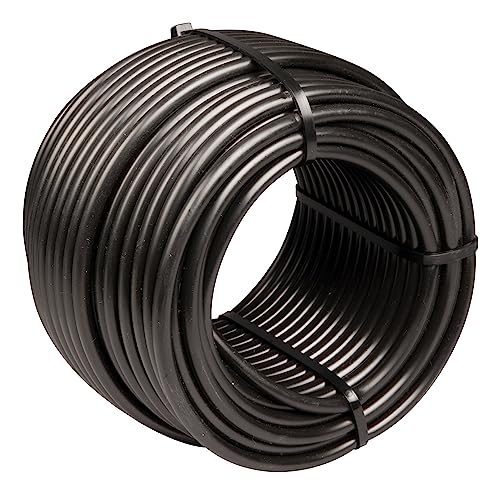
Best for durable, flexible main or branch tubing with a textured finish that speeds connections. Suitable for the main line of a small irrigation system or to branch from larger tubing to micro-watering devices. Unrolling and staking is straightforward, making it a good choice for gardens with mixed plantings.
Best use case: Garden beds and borders needing reliable, easy-to-handle tubing. Limitation: Not a complete kit; requires compatible emitters and fittings to complete the system.
Raindrip R257BRVT 1/4-Inch Tubing

Best for branching off the main supply line to create feeder lines for low-flow devices. It supports watering a variety of areas, from small pots to larger plantings, with durable vinyl tubing that handles regular use. This tubing integrates with Raindrip components and other compatible systems.
Best use case: Diverse planting layouts where several zones need controlled watering. Limitation: Requires additional fittings to complete a full system with emitters or drippers.
Inntop 240FT Drip Irrigation System Kits

Best for an all-in-one setup with quick-connects. This kit includes both 1/2″ main tubing and 1/4″ distribution tubing, plus a large set of emitters and fittings. It’s ideal for gardeners who want a fast, plug-and-play installation across raised beds or greenhouses.
Best use case: Large or multi-zone projects where speed of setup matters. Limitation: Heavier initial investment and more components to manage than a single-tipe feeder tube setup.
Raindrip 016005P 1/4-Inch Tubing

Best for creating feeder lines and connecting to drip irrigation parts. It’s compatible with Raindrip systems and other 1/4″ tubing setups. The shrink-wrapped coil makes storage easy and accessible when expanding a system across beds or containers.
Best use case: Expanding an existing drip layout or building a new feeder line. Limitation: Requires compatible fittings and emitters to deliver water effectively to each plant.
Buying Guide: Spaghetti Tube Drip Irrigation System Essentials
- What size tubing fits my system? Most spaghetti-tube projects use 1/4-inch tubing for emitters and feeder lines. Some kits provide a 1/2-inch main line with 1/4-inch distribution to create scalable layouts.
- What kit elements matter? Look for main line tubing, distribution tubing, emitters or drippers, quick-connects, and fittings. Quick-connects save time and reduce leak risk during setup.
- How many zones do I need? Plan zones by plant type, sunlight exposure, and watering needs. Multi-zone kits help tailor flow to different areas without overwatering.
- Is durability important? Vinyl or polyethylene tubing with UV resistance lasts longer in outdoor gardens. Textured or reinforced finishes can improve handling and connections.
- Should I choose a complete kit or individual parts? Beginners may prefer all-in-one kits for faster setup, while experienced gardeners may mix and match parts to fit irregular beds.
FAQ
- What is spaghetti tube drip irrigation? A compact approach using thin tubing to deliver water directly to plant roots or near the base, reducing waste and evaporation.
- Can I connect 1/4″ tubing to a main line? Yes, most 1/4″ feeder tubing connects to larger lines or distribution tubing via barbed fittings or adapters.
- Do I need emitters for every plant? Not always. A centralized feeder line with adjustable emitters can water multiple plants, though individual emitters provide precise control.
- Are quick-connects necessary? They speed up installation and reduce leakage at joints, making maintenance easier.
- Can these systems be used in raised beds or containers? Yes, the 1/4″ tubing is well-suited for low-flow watering in beds, pots, and planters.
- Do these kits require batteries or electricity? No; drip systems operate passively using gravity and pressure from your water source.