Answering the need for efficient orchard watering, these drip irrigation supplies are engineered to deliver water directly to tree roots with minimal waste. This guide focuses on five dependable products that suit orchard setups, from home orchards to small commercial plantings. Each entry explains who it’s best for, why it’s selected, and practical usage tips.
| Product | Ideal For | Why It Stands Out |
|---|---|---|
| Unoutur 300 Pcs Barbed Connectors Kit | Small to mid-size gardens and orchards | Comprehensive 300-piece set with various barbs, tees, elbows, and end plugs for flexible piping layouts |
| Dripworks Premium Orchard Irrigation Kit | Medium to larger orchards | Agricultural-grade components designed to water up to 20 trees with a mainline and emitter network |
| Rain Bird SW20-30PS Drip Emitter Pack | Targeted tree irrigation | Pressure-compensating emitters for uniform flow across tubing runs |
| Rain Bird SW10-30PS Drip Emitter Pack | Smaller trees or starter orchards | Lower-flow, pressure-compensating emitters for precise irrigation |
| CESTAME 280 Pcs Barbed Connectors Kit | Budget-conscious setups | Numerous fittings in a boxed set, designed for quick and simple connections |
Unoutur 300 Pcs Barbed Connectors Kit

The Unoutur kit includes 300 pieces designed for 1/4″ drip lines, including elbows, tees, barbed end plugs, and 4-way couplings. It’s best for growers who want a single, comprehensive parts set to customize irrigation layouts across flower beds, vegetable plots, or greenhouse runs. Use guidance recommends soaking fittings in 70–80 °C water for about 10 seconds before assembly to improve fit and prevent leaks. Best for gardeners who value a large assortment of fittings in one box and prefer DIY customization.
- Best for diverse layout possibilities with many barbed fittings.
- Better for setups needing multiple tee and elbow configurations.
- Avoid if you require specialized emitters or tubing beyond 1/4″ drip line without adapters.
Best use cases include flower gardens, vegetable beds, greenhouses, and lawn edge installations where a flexible layout is needed. The kit excels in adapting to irregular garden shapes but does not include emitters or mainline tubing itself, so plan to pair with appropriate emitters and mainline components.
Dripworks Premium Orchard Irrigation Kit

This kit provides a robust orchard watering solution with 3/4″ mainline tubing and 1/2″ secondary tubing plus a quality filter and pressure regulator. It’s designed for up to 20 trees, making it a practical choice for medium orchards seeking reliable, field-proven components. The mainline-to-emitter architecture helps deliver consistent water to each tree, supporting even root-zone moisture distribution. The kit’s emphasis on durable filtration and pressure control helps maintain emitters’ performance over time.
- Best for medium orchards needing dependable mainline and emitter network.
- Better for growers who want integrated filtration and pressure regulation.
- Avoid if you require a compact kit for very small plots.
Rain Bird SW20-30PS Drip Emitter Pack

The SW20-30PS 2 GPH emitters deliver a consistent 2 gallons per hour, with pressure compensation ensuring uniform flow along tubing runs. Their self-piercing design makes installation straightforward for 1/4″ tubing, and they work with 1/2″ or larger driplines as needed. This is a strong pick for orchard rows where soil and root zones vary slightly along the row, requiring steady moisture delivery. A caveat is that uniform performance depends on maintaining consistent supply pressure across the entire system.
- Best for uniform moisture along longer tree rows.
- Better for setups with 1/4″ tubing needing reliable, predictable flow.
- Avoid if very low-pressure sources are used without regulator, which can affect flow accuracy.
Rain Bird SW10-30PS Drip Emitter Pack

The SW10-30PS package features 1 GPH emitters that are ideal for smaller trees orStarter orchard blocks, delivering steady moisture with a lower throughput. Like the SW20-30PS, they are pressure-compensating, which helps maintain even watering despite minor elevation changes along a line. This option is well-suited for compressing costs in a smaller planting while preserving accurate drip rates. Note that lower flow may require longer irrigation durations to satisfy larger root zones.
- Best for starter orchards or rows with smaller trees.
- Better for precise, modest water needs per tree.
- Avoid if you need high-flow coverage on very large trees without extending run times.
CESTAME 280 Pcs Barbed Connectors Kit
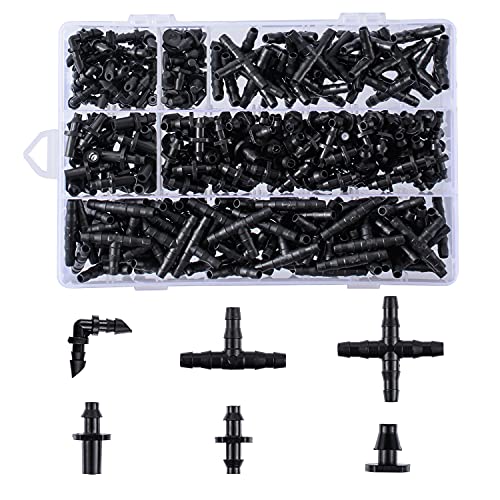
The CESTAME set emphasizes quantity and value, offering 280 pieces with a boxed design that makes storage straightforward and reduces leak risk during storage. It includes straight and oblique barbed fittings, tees, elbows, and end plugs intended for 1/4″ tubing usage. It’s best for budget-minded users who want a broad assortment for quick repairs or custom lateral layouts. A limitation is that it lacks integrated emitters or tubing, so you’ll pair it with compatible drip tubing and emitters.
- Best for budget-focused projects needing many fittings.
- Better for do-it-yourselfers who frequently modify layouts.
- Avoid if you need a complete plug-and-play kit with emitters included.
Buying Guide: Orchard Drip Irrigation Essentials
What size tubing should I use for an orchard?
Most home and small commercial orchards use 1/4″ drip tubing for emitters along tree rows, with larger mainlines (3/4″ or similar) feeding remote sections. Plan for a mainline that minimizes pressure loss and supports the total emitter count.
Do I need a filter and pressure regulator?
Yes. A filter keeps debris from clogging emitters, and a pressure regulator helps maintain consistent flow. Drip systems operate best at a steady low pressure, typically around 10–30 psi depending on emitter types and tubing layout.
What emission rate should I choose for orchard trees?
Rate selection depends on tree size, soil type, and climate. Moderate trees in loamy soil often respond to 1–2 GPH emitters per tree, but adjust based on soil moisture monitoring and tree water demand throughout the season.
How do I prevent clogging and ensure even coverage?
Use filtering before emitters, flush lines during setup, and stagger emitter placement to avoid zones of over- or under-watering. Pressure-compensating emitters help maintain uniform flow along longer runs.
What’s a practical layout for a small orchard?
Run a mainline along the tree rows with emitters placed at the root zones. Use tees and elbows from a barbed fittings kit to create branch lines to each tree. Keep emitter spacing consistent and protect tubing from sun exposure and physical damage with edging or mulch.
How should I plan for maintenance and expansions?
Choose modular components that can be easily added or replaced. Keep spare fittings and a few extra emitters on hand, and loop a seasonal check into your maintenance routine to replace clogged or degraded parts before the next growing cycle.
FAQ
- What is the best starter kit for a small orchard? A kit combining mainline tubing, emitters, and a basic filter/regulator pair works well, such as a premium orchard kit or a bundled barbed fittings set for customization.
- Can I mix different emitter brands in the same system? Yes, as long as the tubing size and emitter flow rates are compatible, but consistency helps with uniform watering.
- How often should I check for leaks? Inspect after initial installation, after major weather events, and at the start of each growing season.
- Do these kits work with existing irrigation timers? Most drip systems are compatible with standard irrigation controllers; you may need a simple solenoid valve or a pressure-regulated feed.
- Is higher flow always better for trees? Not necessarily. Overwatering can cause root oxygen deprivation and nutrient leaching. Match flow to tree size, soil type, and irrigation duration.