Looking for reliable ways to extend your growing season, protect delicate seedlings, and nurture plants from start to finish? This guide highlights five top greenhouses and cold frames that suit a range of spaces and budgets. Each option targets specific buyers—from casual hobbyists to serious gardeners—so you can choose the best scaffold for your crops. Below is a quick summary table to compare who each product is best for.
| Product | Best For | Key Benefit |
|---|---|---|
| Gardzen Mini Greenhouse | Seed starters and small-space growing | Generous internal height and roll-up door for easy access |
| Kelived Portable Cold Frame | All-season protection in moderate climates | Large growing area with clear cover for warmth and humidity |
| Outsunny Raised Garden Bed with Polycarbonate Greenhouse | Integrated bed and cover for raised-bed gardening | Dual-use design with weather protection and ventilation |
| Backyard Discovery Aggie Cedar Frame | Natural wood aesthetic and year-round protection | Temperature-activated lid and solid insulation |
| Giantex Wood Cold Frame Greenhouse | Adjustable airflow and compact indoor/outdoor use | Openable roof and sturdy fir construction |
Gardzen Mini Greenhouse, Portable Cold Frame

The Gardzen Mini Greenhouse is designed for seed starting and protection of small to mid-size plants in indoor and outdoor settings. Its generous dimensions—71.7 inches long, 36.2 inches wide, and 42.5 inches high—provide ample space for multiple seed trays or potted specimens, making it a strong choice for hobby gardeners who want a portable, easy-to-move structure. The clear cover creates a classic greenhouse effect, effectively raising ambient temperatures and humidity to support germination and early growth. A roll-up zipper door enables simple access, ventilation, and watering without constant disassembly.
Best for: Gardeners with a dedicated seed-starting phase and limited space who need a lightweight, portable greenhouse with straightforward access. It’s well-suited for balcony or patio setups and for gardeners who want quick assembly and easy roll-up ventilation. Choose this if you prioritize a larger internal volume in a portable frame and easy climate control.
Limitation: While the overall space is generous, it may require a flat, stable surface for best stability in high winds. Proper anchoring is recommended in exposed locations.
BKSFOAA Wooden Cold Frame Greenhouse
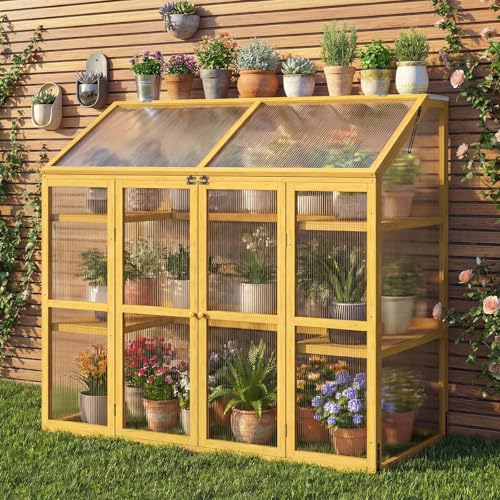
The BKSFOAA Wooden Cold Frame combines natural wood construction with practical interior organization. It features six built-in partitions for plant grouping and a large interior to accommodate both tall and short pots. The structure is reinforced with metal supports and windproof ground nails to improve stability. The middle partition can magnetically detach from the back plate, offering flexible layout options as your garden evolves. Overall dimensions are 53.15″ x 27.76″ x 53.94″.
Best for: Gardeners who value a sturdy wooden build, organized plant space, and a compact footprint. It’s a good fit for patios, decks, or between garden beds where natural aesthetics matter. Opt for this if you want a robust wooden cabinet with flexible interior partitions.
Caution: Wood requires regular maintenance to prevent weathering in damp climates; ensure proper sealing and periodic checks of the metal supports for long-term durability.
Giantex Wood Cold Frame Greenhouse

The Giantex Cold Frame Greenhouse offers a compact, portable wooden design with a transparent roof and adjustable roof angles. It uses premium natural fir for a sturdy frame and reliable performance. The clear panels diffuse light gently to reduce the risk of scorching while maintaining heat to support seedlings and small plants. An adjustable roof allows fine-tuning of airflow and light exposure, which is useful for different growth stages or weather conditions.
Best for: Those seeking a small, aesthetically pleasing wooden structure that can be placed on a balcony, patio, or garden edge. It’s particularly suitable for gardeners who want to regulate ventilation by adjusting the roof angle and who appreciate solid wood craftsmanship.
Limitation: The size is modest, so the total plant capacity is best for seedlings, small potted plants, or herb beds rather than large mature specimens.
Kelived Portable Cold Frame Greenhouse

The Kelived model features a 72.8-inch long by 37.4-inch wide footprint with a tall 47.2-inch height, translating to a substantial growing area and clear cover for effective warmth and humidity retention. It uses a durable steel frame and a polyethylene cover designed to shield plants from frost, wind, and rain while still allowing light penetration for healthy growth. The design includes roll-up zippered doors for easy access, ventilation, watering, and plant maintenance.
Best for: Gardeners who want a larger, all-season cold frame with a robust frame and reliable protection from harsh weather. It’s a practical choice for outdoor setups where a stable, winter-ready environment is needed. Choose this if you need a balance of space, durability, and climate control without building from scratch.
Backyard Discovery Aggie Cedar Wood Cold Frame

The Aggie cedar cold frame blends traditional looks with practical features. It uses a temperature-activated polycarbonate lid that opens automatically when temperatures rise above 70℉, closing as it cools. This eliminates the need for electricity or manual adjustments during temperature fluctuations. The unit includes a double-wall polycarbonate lid that enhances insulation while still providing natural light. A five-year warranty offers added peace of mind for durable outdoor use.
Best for: Gardeners who prefer a natural cedar aesthetic and a lid that automatically manages temperature changes. It’s especially useful in regions with variable spring and fall temperatures where manual venting is impractical.
Buying Guide
What size fits your space? Measure your outdoor or indoor location carefully. If you have a balcony, a compact model with 2–4 feet of width may be ideal; for patios or yards, look for widths around 4–6 feet with interior height that accommodates your tallest seedlings.
How will you manage ventilation and heat? Consider whether you need a roll-up door, adjustable roof, or a temperature-activated lid. Models with clear polycarbonate or greenhouse-style panels keep light available while reducing heat loss. If climate stability is a concern, a larger model with better insulation may be worth the extra space and cost.
What construction suits your climate? Wood frames (fir or cedar) offer aesthetics and natural insulation but require maintenance in damp locales. Metal frames provide strength and longevity but can heat up in direct sun. Polycarbonate or PE covers balance light transmission with protection from wind and frost.
What is your desired level of maintenance? Wooden greenhouses require periodic sealing and inspection of joints. Metal frames typically need less routine care but may get hot in sun. For low-effort options, choose pre-assembled units with simpler assembly and fewer parts to maintain.
How will you arrange plants? Look for models with internal shelving or partition options if you plan to organize by plant type, height, or start times. Some units offer adjustable shelves or removable panels to adapt to different crops and seasons.
FAQ
- What is a cold frame and how does it differ from a greenhouse?
A cold frame is a simple structure with a transparent cover designed to trap heat and extend the growing season for a small area. A greenhouse typically provides a larger, more controlled environment with higher temperatures and humidity for longer periods.
- Which material lasts longer outdoors, wood or metal frames?
Metal frames tend to be more durable with less maintenance in many climates, while wood offers natural insulation and aesthetics but requires sealing and protection from moisture.
- Do cold frames require electricity?
Most do not. Some models feature temperature-activated lids or venting systems that operate without electricity, while others may rely on manual ventilation.
- How much space do I need for a greenhouse to start seeds?
For starting seeds, aim for at least 2–4 feet of width and 3–6 feet of length if you plan to run multiple seed trays and have space for transplanting.
- What features should I prioritize for winter protection?
Insulation panels, a sealed lid, and a sturdy frame are key. Temperature control mechanisms, such as auto-opening lids or vented roofs, help prevent overheating on sunny days.
- Can these structures be used indoors?
Yes, several models are suitable for indoor use on a sunlit sill, balcony, or garage space to start seeds or house tender plants during colder periods.