Answering the top buyer question: which salt spreader offers reliable, consistent coverage for winter safety? This guide covers practical, easy-to-use options for homeowners, small businesses, and professionals who need steady salt or ice-melt application. Each pick is selected for clear performance in snow and ice management, with notes on suitable yard sizes, material handling, and maintenance needs.
The following table summarizes five well-rounded salt spreaders, highlighting capacity, best-use scenario, and why each stands out. Use this quick reference to compare major factors at a glance.
| Product | Best For | Capacity | Why It Stands Out |
|---|---|---|---|
| SaltDogg WB400 | Medium to large driveways and commercial paths | 200 lb | Precise, jam-resistant flow and wide 44″ path |
| Chapin 88300B SaltPro | Contractor-grade reliability for cold weather | 80 lb | Adjustable baffles, weather-resistant, rugged auger |
| Chapin 88000A SaltPro | Residential use with heavy salt loads | 80 lb | Weather-ready, fixed front and adjustable side baffles |
| At Home 75 lb Drop Spreader | Smaller properties and simple setups | 75 lb | Maintenance-free flow control, low-maintenance wheels |
| Yard Commander 60 lb | Yards with mixed seed and salt needs | 60 lb | Composite hopper, compact design, even coverage |
SaltDogg WB400 Walk-Behind Drop Spreader
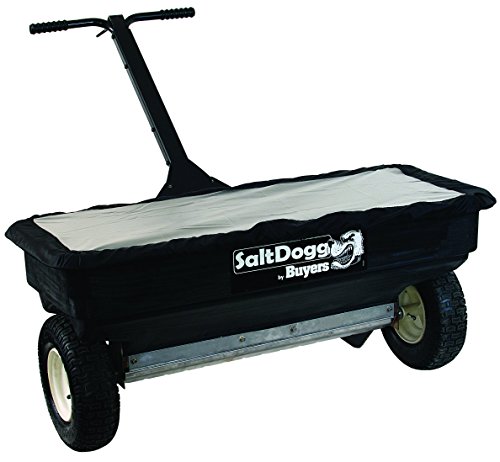
The SaltDogg WB400 is a robust option designed for reliable salt or ice-melt distribution with a 2.5 cubic-foot (200 lb) hopper. Its stainless steel frame and agitator contribute to long-term durability in winter conditions. The 44-inch spread profile allows one-pass coverage of wider driveways and pathways, improving efficiency during storms.
Best for: larger residential driveways, commercial walkways, and professionals who prioritize wide coverage and consistent material movement. This model suits buyers who want a sturdy, low-maintenance spreader with strong flow control. Caution: heavier models require more storage space and may be harder to maneuver on uneven terrain.
Chapin 88300B Spreader, Salt, Ice Melt
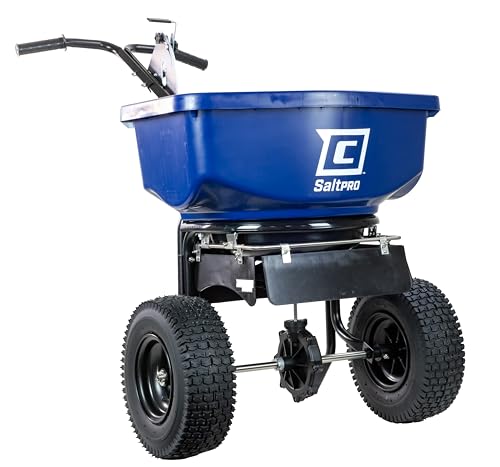
The Chapin 88300B is a contractor-grade salt spreader with an 80-pound capacity and a rugged, spiked auger. It features adjustable front and side baffles to fine-tune the spread pattern, making it a strong choice for uneven surfaces or denser salt deposits. Its weather-resistant construction helps protect the hopper during snowy conditions.
Best for: professional or heavy-use scenarios where precise pattern control matters, such as long driveways or commercial entrances. Choose this if you regularly spread larger quantities and need dependable clogs resistance. Limitation: heavier use may require more physical effort or a powered assist on very large properties.
Chapin 88000A Spreader, SaltPro, Residential
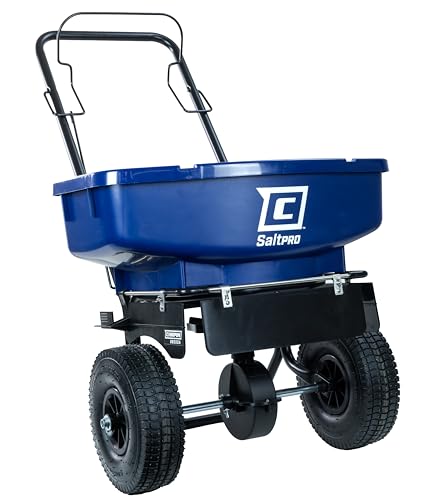
The Chapin 88000A is designed for residential use with an 80-pound capacity and weather-resistant features. It uses a plastic spiked auger to reduce clumping and has fixed front and adjustable side baffles for spread-pattern control. The rain and snow cover help protect the hopper while you work, making it a practical winter tool for homeowners.
Best for: homeowners who want reliable, straightforward operation with good resistance to winter elements. Avoid this if you require extremely large capacity or ultra-wide coverage for frequent heavy-duty use.
At Home 75 lb Drop Spreader

The At Home 75 lb Drop Spreader provides a maintenance-free steel flow control system and 10″ never-flat tires. It holds up to 10,000 square feet of material, offering solid performance for standard residential driveways and sidewalks. The steel mechanism supports long-term reliability under winter use.
Best for: buyers wanting a simple, durable spreader with low upkeep and adequate capacity for typical home properties. Consider lighter weight if storage space is extremely limited. Caution: steel components may require rust protection in damp garages or near coastal areas.
Yard Commander – 60 LB Walk-Behind Spreader

The Yard Commander spreader features a durable composite hopper, a 60-pound capacity, and a 22-inch spread pattern. It is designed for even coverage across areas up to 15,000 square feet, making it suitable for mid-sized lawns and properties with mixed needs (salt, seed, or fertilizer in different seasons). Its compact design supports easy storage and transport.
Best for: moderate-size landscapes requiring reliable, uniform distribution without heavy equipment. Better for those who want a lighter, easier-to-maneuver unit. Limitation: capacity is on the smaller side for very large areas or frequent heavy-salt usage.
Buying Guide: Salt Spreader Essentials
- Material compatibility: Confirm the spreader’s hopper material and agitator design suits salt, ice melt, or other de-icers you use. Some plastics resist corrosion, while metal components may require extra care.
- Capacity and coverage: Match hopper capacity to your typical area. Larger driveways benefit from higher capacities like SaltDogg WB400, while smaller properties may use 60–80 lb models.
- Spread pattern control: Look for adjustable front and side baffles and a tunable gate to customize the distribution for different granule sizes and weather conditions.
- Durability and maintenance: Weather-resistant hoppers, rust-resistant frames, and jam-resistant flow are key for winter environments. Consider models with simple, low-maintenance designs.
- Wheels and maneuverability: Pneumatic tires and weight distribution affect handling on uneven surfaces. Never-flat tires reduce downtime during storms.
- Storage and portability: Tow-behind options can be advantageous for larger properties, while compact units suit tight spaces or multi-use setups.
- Price vs. value: Higher-capacity or contractor-grade spreaders offer durability and speed but may be overkill for small homes. Evaluate total cost of ownership including spare parts and replacement augers or screens.
Frequently Asked Questions
- What size salt spreader should I choose for a typical residential driveway?
– For most single-family homes, 80 lb to 100 lb capacity spreaders provide a balance of coverage and manageability. If you have a very small area, an 60 lb model may suffice. - Do I need a weather-resistant spreader for winter use?
– Yes. Weather-resistant housings and engines help protect against moisture, salt corrosion, and freezing temperatures, extending the tool’s life. - Is a walk-behind spreader better than a tow-behind for driveways?
– Walk-behind spreaders are easier for small to medium areas and offer precise control, while tow-behind models reduce labor for large properties but require a compatible tractor or vehicle. - Can spreaders handle fertilizer or seeds during other seasons?
– Many models are designed to handle different materials, but check hopper compatibility and recommended uses in the product specs. Some hoppers are optimized for salt and ice melt, not fertilizer. - What maintenance is needed after winter use?
– Clean the hopper, dry any moisture, lubricate moving parts as recommended, and inspect the gate and auger for wear. Store in a dry place to prevent rust. - How important is precise spread control?
– Highly important. Proper calibration prevents over-application that can damage plants or under-application that reduces traction. Use models with adjustable baffles and gates to tailor output to your material and weather.