Direct answer: If you want quick, reliable pool water readings, choose 5-in-1 or 7-in-1 test strips that cover the core parameters you monitor—chlorine, pH, alkalinity, and stabilizers. This guide highlights top options suited for DIYers, spa owners, and pool pros, with clear guidance on who benefits most from each product.
| Product | Key Benefit | Best For |
|---|---|---|
| Industrial Test Systems 481339 5 in 1 Pool Check | Comprehensive five-parameter strip | Homeowners who want a broad snapshot |
| Industrial Test Systems 481348 Copper 3 in 1 Pool Check | Includes copper reading; color-match chart | Those needing copper tracking alongside pH and alkalinity |
| EASYTEST 7-Way Pool Test Strips | 7 parameters in one strip | Families with frequent testing needs |
| Pool Check Borate Test Strips | Specialized borate measurement | Pools with borate buffering |
| Bliss Pool 7 in 1 Pool Test Strips | 7-parameter coverage with large pads | Budget-friendly, easy-read strips |
Industrial Test Systems 481339 5 in 1 Pool Check

This 5-in-1 strip measures Free Chlorine/Bromine, Total Chlorine/Total Bromine, and Total Alkalinity. Readings appear across a standardized color scale for fast interpretation. Best for users who want a broad, single-strip overview of water chemistry. Consider if you primarily test for sanitization and basic buffering in residential pools.
Best for: homeowners who want a straightforward, all-in-one test without juggling multiple products. Limitation: does not separately report copper or cyanuric acid; for those needs, pair with another strip type.
Industrial Test Systems 481348 Copper 3 in 1 Pool Check

Designed to detect Copper, pH, and Total Alkalinity with an optimized color chart. It uses a single-dip method and is described as faster and easier than liquid tests, with accuracy comparable to liquid kits. Best for pools where copper levels matter or when swimmers have metal sensitivity concerns.
Best for: users needing copper and basic alkalinity/pH insight in one strip. Caution: Copper readings may be influenced by certain water treatments, so monitor trends rather than single results alone.
EASYTEST 7-Way Pool Test Strips
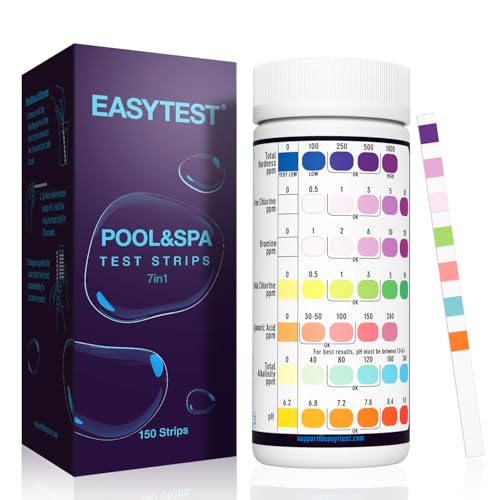
This kit offers seven-in-one testing, including Bromine, Total Alkalinity, pH, Free Chlorine, Total Chlorine, Total Hardness, and Cyanuric Acid. It emphasizes affordability and a fast, color-chart-driven read. Suitable for frequent testing in households, hot tubs, and spas.
Best for: busy pool owners who want a broad parameter set at a low cost. Limitation: may require careful alignment with color charts under bright light for precise readings.
Pool Check Borate Test Strips

Specifically designed to detect borate levels in pool water, with a five-level detection range. The kit includes 50 strips and a color chart. Best for pools buffered with borates or for technicians who frequently verify borate concentrations.
Best for: professionals and DIYers who rely on borate balance for corrosion control and algae prevention. Caution: borate readings should be interpreted in context with other parameters to avoid misinterpretation.
Bliss Pool 7 in 1 Pool Test Strips

The Bliss Pool 7-in-1 strips cover Total Alkalinity, pH, Free Chlorine, Total Chlorine, Bromine, Total Hardness, and Cyanuric Acid with large pads and a color chart. Marketed as accurate, the strips emphasize easy use for regular pool maintenance and quick checks.
Best for: budget-conscious swimmers who want clear readings across multiple common parameters. Limitation: color interpretation can vary with lighting; ensure testing is done in consistent light for best accuracy.
Buying Guide: How To Choose Pool Check Test Strips
- What parameters matter most to you? If you need broad coverage, 7-in-1 strips (pH, chlorine, bromine, alkalinity, hardness, cyanuric acid) are convenient. For borate-rich pools, Borate-specific strips help track that chemical balance.
- Do you require copper readings? If metal content is a concern (green water, staining, or copper-based algaecides), copper-inclusive strips like the 3-in-1 Copper Pool Check are useful.
- How often will you test? For households testing weekly, a large quantity at a low price per strip (e.g., 150-strip packs) can be cost-effective. For occasional checks, smaller kits may suffice.
- Is ease of use a priority? Strips with single-dip procedures and color charts are ideal for non-technical users. Fast results help maintain consistent chemical levels.
- Lighting and color accuracy: Some strips rely on color matching that can be influenced by ambient light. Always compare results in natural or neutral lighting.
- Water type considerations: Pools with heavy chlorine use, bromine systems, or spa water can affect readings differently. Choose a kit that covers the parameters you monitor most in your system.
Glossary of Key Terms
- Total Alkalinity: The water’s buffering capacity, helping prevent pH swings.
- Free Chlorine vs Total Chlorine: Free chlorine is the active sanitizing agent; total includes combined forms.
- Cyanuric Acid: A stabilizer that protects chlorine from sunlight.
- Copper: An element monitored for metal balance, which can affect staining and swimmer comfort.
- Borate: Used as a buffer to improve clarity and prevent corrosion in some pools.
FAQ
- Q: Which pool test strips are best for beginners?
A: 7-in-1 strips with a clear color chart are generally easiest for beginners to read and use regularly. - Q: How often should I test my pool water?
A: Most pool owners test at least twice a week during pool season, and more often if there are balancing issues or heavy usage. - Q: Can I rely on one strip for all pool types?
A: For basic residential pools, a well-rounded 7-in-1 strip is suitable. If you have special treatments (borates or metals), choose strips that cover those needs specifically. - Q: Do strips need any special storage?
A: Store in a cool, dry place away from sunlight to prevent color chart fading and strip degradation. - Q: Are copper readings important for saltwater pools?
A: Yes, copper levels can indicate a risk of staining or corrosion in some saltwater or metal-containing systems. - Q: How should I interpret a borderline reading?
A: Compare the strip with the color chart on the bottle, and consider retesting after a few hours or days to confirm a trend before adjusting chemicals.