Answering the question, this guide highlights the best outdoor station clock thermometers for easy, at-a-glance weather monitoring. These devices blend indoor/outdoor temperature, humidity, barometric pressure, and atomic clock features into one display. They’re ideal for homeowners, renters, and outdoorsy setups who want a reliable view of conditions across multiple locations. The top five options below are chosen for clarity, wireless sensor support, and long-term readability in American homes. A quick buyer’s table is included to compare key specs side by side.
| Product | Best For | Core Feature |
|---|---|---|
| Newentor Weather Station | All‑around monitoring for multiple locations | 3 channels, large 7.5″ color LCD |
| DreamSky Weather Station | Easy readability with USB power | Large display, dimmable, auto DST |
| Wittime Weather Station | Detailed barometer data | Dew point, mold indicators, dual alarms |
| U UNNI Weather Station | Bright, always-on display | Dew point, heat index, barometer |
| Geevon Weather Station | Touchscreen with adjustable backlight | 3 sensors, dew point, heat index |
Newentor Weather Station Wireless Indoor Outdoor Thermometer

The Newentor unit uses a 7.5″ LCD color display to show inside and outside temperature and humidity, including high/low values, time and date, alarm, and a multi-day weather forecast. It supports up to three remote sensors, letting you monitor multiple indoor and outdoor spots. An auto-calibrated forecast for the next 12–24 hours helps plan daily activities. The included remote sensor expands coverage beyond a single location. Best for households needing clear, multi-location monitoring with a robust forecast view. A limitation is the single included remote sensor, which may require additional sensors for many zones.
DreamSky Weather Station Indoor Outdoor Thermometer

The DreamSky model features a large, easy-to-read color display with an atomic clock that auto-updates via WWVB, plus a USB-powered plug-in option. It supports indoor/outdoor temperature and humidity monitoring across up to three sensors, with a dimmer-friendly interface for easy viewing from afar. Best for viewers who want a bright, easy-to-read screen and automatic timekeeping. Note that only one sensor is included, so add-ons are needed for more locations.
Wittime Weather Station Indoor Outdoor Thermometer

The Wittime unit provides an atomic clock, 180° viewing angle, and a host of data including dew point, heat index, mold indicator, and barometric pressure with a historical table. It supports up to three channels and has adjustable brightness for readability in different lighting. Best for users who want rich meteorological data and a broad viewing angle. The device uses battery power and can be wall-mounted or placed on a table. A limitation is the need for 7–10 day calibration for accurate forecasts.
Weather Station Indoor Outdoor Thermometer Wireless, U UNNI
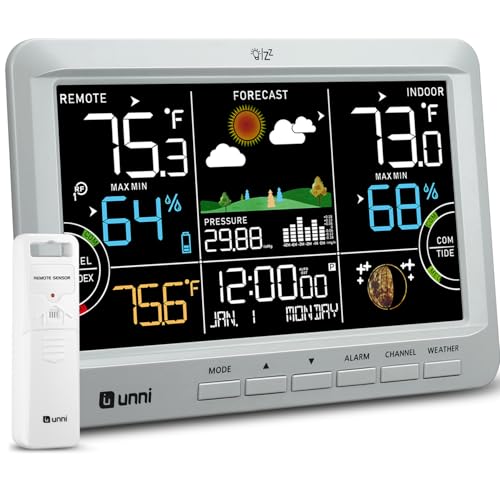
The U UNNI model emphasizes an always-on, full-view display with bright numerals and a wide range; it tracks indoor/outdoor temperature, humidity, dew point, barometer, and comfort indicators across multiple sensor locations. It uses patented wireless tech for steady data transmission up to 330 feet, and supports auto-DST with WWVB-synced time. Best for households that want a bright, constant read with dependable wireless connectivity. A potential limitation is the need for proper time zone configuration to ensure accurate WWVB syncing.
BALDR Indoor Outdoor Thermometer Wireless with Clock

The BALDR model offers indoor/outdoor temperature with a calendar and alarm clock, plus wireless sensors for multiple locations and battery-powered operation. It is a practical choice for those who want a simple, portable setup without wires. Best for small spaces or temporary placements where charging options are limited. A caveat is that additional sensors must be purchased separately for more than one outdoor location.
Grilza Weather Station Wireless Indoor Outdoor

The Grilza unit features a 7.5″ HD display with a comprehensive weather interface, including an atomic clock with DST support and an area-wide forecast based on barometric pressure trends. It provides a clear, high-contrast interface to view temperature, humidity, forecast, time, and date. Best for users who want an optimized, large-display experience and a robust forecast. Note that accurate forecasts require calibration over 7–10 days.
Buying Guide: What To Consider When Buying An Outdoor Station Clock Thermometer
- Display readability: Choose a model with a large, high-contrast screen or a touchscreen if you prefer quick taps to view data.
- Timekeeping: Atomic clock features ensure accurate time; confirm WWVB compatibility for your time zone.
- Sensor coverage: Decide how many outdoor sensors you need. Some models include one sensor; others support up to three.
- Power options: Look for plug-in models with USB or battery-powered units for flexibility in placement.
- Data depth: If you want dew point, heat index, and barometric trends, verify these capabilities in the spec sheet.
- Forecast reliability: Most devices calibrate forecasts over 7–10 days; consider whether you want frequent recalibration.
- Connectivity range: Wireless transmission ranges vary (often up to 200–330 feet in open space). Consider your property layout.
- Additional features: Moon phase, tide data, alarm clocks, memory for highs/lows, and backlight levels can influence daily usability.
Frequently Asked Questions
- What is an outdoor station clock thermometer?
It combines indoor/outdoor temperature, humidity, barometric pressure, and a clock in a single display for quick weather checks. - Do these devices require a power outlet?
Many models offer both plug-in power and battery options; check your preferred model for power requirements before setup. - Can I connect multiple outdoor sensors?
Some units support up to three wireless sensors; others include one and require extra sensors for more locations. - Is atomic timekeeping necessary?
Atomic clocks ensure highly accurate time; if you live in an area with weak WWVB signals, manual or manual-dst options may be needed. - How long does calibration take for forecasts?
Forecasts typically calibrate over 7–10 days to provide location-based predictions. - Which display is best for a bright room?
A large 7.5″ color LCD with adjustable backlight tends to offer the best readability in varied lighting.