Answering the question: these fertilizer injectors are designed to automatically mix liquid or granular nutrients into your irrigation system, helping you feed lawns efficiently without manual mixing. They’re best for homeowners with small to medium lawns, professional landscapers managing drip systems, and gardeners who want consistent nutrient delivery in seasonal cycles. Below is a quick buying guide and five top options with clear strengths and limitations.
Summary of chosen products:
| Product | Best For | Tank / Dosing Capacity | Key Benefit |
|---|---|---|---|
| Chapin 4701 HydroFeed 24-Ounce | Small lawns, easy setup | 24-Ounce tank | Compact auto-mix injector with simple monitoring |
| Chapin 4702 HydroFeed 32-Ounce | Medium lawns, greater dosing flexibility | 32-Ounce tank | Higher capacity, broad compatibility |
| UPLYKKE Venturi Fertilizer Injector | Electric-free, larger irrigation lines | Integrated kit, flow-based | Reliable venturi mixing for consistent nutrition |
| EZ-FLO 2.5-Gallon Fertilizer Injector | Large areas, long runs | 2.5-Gallon reservoir | High coverage with versatile use beyond fertilizer |
| NEWTRY Fertilizer Injector, 0.4%-4% | Flexible dosing, varied systems | 0.4%-4% adjustable dosing | Water-powered with adjustable concentration |
Chapin 4701 HydroFeed 24-Ounce In-Line Injector

- Tank: 24-ounce clear reservoir with funnel-shaped head for easy filling and monitoring usage.
- Compatibility: Suitable for liquid or granular concentrates and/or fish emulsion applications.
- Mounting: Built-in bracket for secure mounting to walls or posts.
Best for: Small lawns or planter beds where a compact, straightforward injector is preferred. Choose this if you want a simple install with visible fill level and compact footprint. Limitation: smaller tank means more frequent refilling on larger areas.
Chapin 4702 HydroFeed 32-Ounce In-Line Injector

- Tank: 32-ounce clear reservoir with funnel-shaped head for easy filling and monitoring usage.
- Usage: Ideal for liquid or granular concentrates and/or fish emulsion applications.
- Mounting: Includes a built-in bracket for secure mounting to walls or posts.
Best for: Medium-sized lawns or drip setups where more nutrient volume per fill reduces refills. Better for larger pots or garden beds. Caution: still a gravity-fed system—ensure flow compatibility with your irrigation schedule.
Chapin 4700 HydroFeed 16-Ounce Injector

- Tank: 16-ounce clear reservoir with funnel-shaped head for easy filling and monitoring usage.
- Flexibility: Adjustable connection elbow lets the tank mount to any hose spigot.
- Applicability: Works with liquid or granular concentrates and/or fish emulsion.
Best for: Smaller irrigation networks or portable setups where you need flexible mounting. Limitation: lower capacity requires more frequent refilling during peak feeding periods.
UPLYKKE Venturi Fertilizer Injector Kit

- Design: Water-powered injector with a built-in flow control valve for precise fertilizer mixing.
- Capability: Handles water flow rates of 1.82-6.34 m3/h with working pressure up to 950 kPa for consistent crop nutrition.
- Kit contents: Includes injector unit, water tube, control valve, and filter—ready to start fertilizing immediately.
Best for: Drip systems on larger yards or farm plots where electricity-free operation is essential. Caution: installation requires compatible 1-inch drip line fittings and adequate water pressure.
Fertilizer Injector Bottle by Sinbana
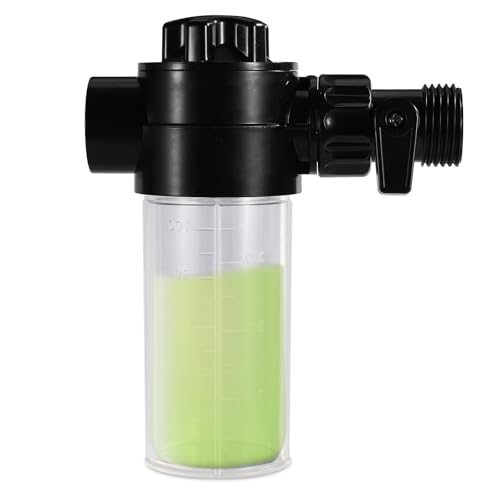
- Contents: Includes 1 injector bottle, a valve, and hose adapter for inline use.
- Material: Made of durable plastic; designed to seal well and resist leaks.
- Ideal use: Suitable for gardens, lawns, and potted plants.
Best for: Quick-add injectors for small beds or containers. Better for: those who want a simple, disposable bottle style flow with basic inline compatibility. Limitation: not a complete system; may require additional fittings for full integration.
EZ-FLO 2.5-Gallon Fertilizer Injector

- Capacity: 2.5-gallon reservoir that treats up to 20,000 sq ft per fill.
- Scope: Universal compatibility with liquid, water-soluble, or dissolved dry products; can handle insect repellents and iron supplements.
- Usage: On/off pressure operation; suited for larger turf and garden areas.
Best for: Large lawns or properties needing fewer refills and broader product compatibility. Limitation: larger unit may require more space and secure mounting.
NEWTRY Fertilizer Injector for Drip Irrigation (0.4%-4%)

- Dosing: Adjustable from 0.4% to 4% for precise nutrient delivery.
- Connection: Fully compatible 3/4″ NPT connections with water-powered operation.
- Flow Range: 0.05-13 GPM; supports various greenhouse, garden, and hydroponic setups.
Best for: Gardeners and small farms needing precise, adjustable nutrient delivery without electricity. Better for: diverse irrigation systems where flow varies. Caution: higher pressure or flow may require more frequent calibration to maintain consistent dosing.
Buying Guide: How to Choose the Right Fertilizer Injector
How do you choose between a compact 16- or 24-ounce unit and a larger 2.5-gallon reservoir? Consider your lawn size, irrigation flow, and how often you’re willing to refill.
- System compatibility: Ensure the injector’s connection type (NPT, hose bib, inline) matches your irrigation setup. Some units require 1-inch or 3/4-inch fittings.
- Tank capacity and refill frequency: Smaller lawns benefit from 16–24 ounce tanks; larger areas benefit from 32 ounces or more, or a reservoir with higher capacity.
- Dosing control: Fixed vs. adjustable dosing matters. If you need precise nutrient levels, choose models with adjustable or programmable dosing.
- Power source: Water-powered injectors require sufficient water pressure and flow. Electric-free options are ideal for off-grid or simple systems but may have limited control accuracy under variable flow.
- Versatility: Some units accommodate a wide range of products, including insecticides and iron supplements; assess whether you need multi-use compatibility.
- Ease of installation: Look for built-in mounting brackets and clear fill indicators to minimize setup time.
- Maintenance: Check for leak-proof construction and ease of cleaning or replacing components like filters and hoses.
Practical installation considerations
- Place the injector after the main water shutoff but before drip emitters to ensure nutrient distribution reaches all zones.
- Avoid using incompatible concentrates; follow manufacturer guidelines for dilution with water.
- Inspect periodically for leaks, especially at connections and seals, and replace worn gaskets as needed.
Usage scenarios
- Residential lawn care: A compact 16–24 ounce injector is typically sufficient for up to several thousand square feet.
- Farm or large garden beds: A 2.5-gallon EZ-FLO style injector provides fewer refills and broader coverage.
- Seasonal nutrition programs: Injectors with adjustable dosing help tailor feeding to growth stages and weather.
FAQ
- What is the main purpose of a fertilizer injector in irrigation systems?
- Can I use any fertilizer with an injector?
- Do I need electricity to operate these injectors?
- How do I determine the right dosing percentage?
- Is a larger reservoir always better?
- Are there maintenance tasks I should perform regularly?
Direct answers: Fertilizer injectors automatically mix nutrients into irrigation water, improving uniformity and reducing manual mixing. Not all fertilizers are compatible; follow product guidelines. Most injectors are water-powered or gravity-fed and do not require electricity. Dosing percentage depends on plant needs and fertilizer instructions. A larger reservoir reduces refilling but may be unnecessary for small lawns. Regular inspection and cleaning prevent clogs and leaks.