Readers seeking a 600W double-ended grow light kit will find a range of options that balance efficiency, coverage, and durability. This guide highlights five relevant products, explains who each is best for, and notes practical considerations. The selections cover true 600W double-ended systems, plus compatible higher-wattage double-ended kits for comparison. Ideal buyers include home growers upgrading veg cycles, commercial tent setups, and hobbyists seeking even canopy coverage with easy ballast control.
| Product | Watt / Type | Best For | Key Benefit |
|---|---|---|---|
| Raylux Grow Light System Kits (1000W DE) | 1000W Double Ended HID | Growers needing broad coverage in larger tents | High reflectivity hood and adjustable ballast |
| Platinum Horticulture 1000W DE Kit | 1000W Double Ended HID | Commercial-style setups seeking uniform canopy | Open reflector with premium European aluminum |
| Grower’s Choice 600W DE MH | 600W Double Ended MH | Vegetative growth and early flowering in small-to-medium tents | 4K spectrum with UV output for resin production |
| iPower 630W CMH Kit | 630W CMH (double-lamp fixture) | Indoor gardens needing cooler operation and broad spectrum | Low heat; large coverage for vegetative and bloom phases |
| SunStream 600W SE HPS | 600W Single-Ended HPS | Budget-minded setups prioritizing strong flowering output | Economical; higher energy efficiency over traditional SE lamps |
Raylux Grow Light System Kits With Controller Port

Best for: Larger grow spaces where uniform canopy is a priority. The Raylux kit uses a 1000W double-ended design with an open-style VEGA reflector and a 120V-220V input ballast, enabling flexible deployment across different regions. This kit is ideal for growers who want wide light distribution and easy multi-deployment via the controller port. Limitation: bulb not included, so users must purchase compatible DE bulbs separately.
Platinum Horticulture 1000W DE Kit
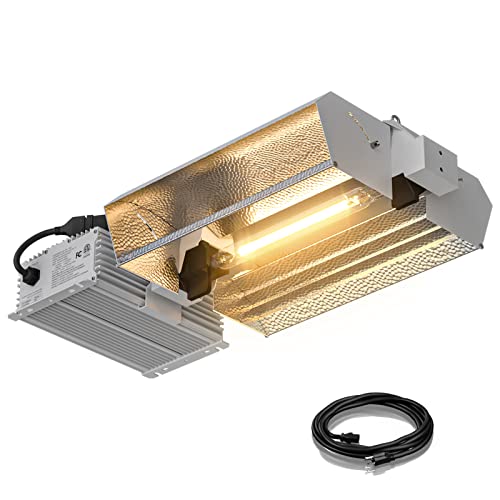
Best for: Growers seeking a premium, high-coverage 1000W DE system for large grow tents or rooms. The open reflector design and 208-277V ballast support broad, uniform light penetration. Caution: bulb not included; ensure you select compatible double-ended bulbs and ballast settings for your region.
Grower’s Choice DE MH 600W

Best for: Vegetative growth and early flowering in compact spaces. This 600W double-ended MH kit targets rapid vegetative development with UV output that can improve resin production. Limitation: data emphasizes UV output but lacks detailed warranty or certification information in the listing.
iPower 600W HPS Grow Light Bulb Kit

Best for: Growers focusing on flowering stages with emphasis on red-orange spectrum. This is a cost-effective option with high PAR output and a 2-pack setup to extend coverage. Caution: unit uses single-ended design; not a true double-ended kit, so coverage and uniformity may differ from DE systems.
SunStream 600W SE HPS Bulb Kit

Best for: Budget-conscious growers who want solid flowering performance. The 600W SE HPS bulb delivers strong red spectrum for blooms. Limitation: single-ended design and higher energy per lumen compared to DE systems; consider DE options for larger canopy coverage.
Buying Guide: Key Considerations For 600W Double Ended Grow Lights
What wattage and configuration do you need? Double-ended (DE) systems deliver more uniform canopy penetration and often higher canopy PAR at broader coverage. If you operate in a smaller tent (4×4 feet or less) a true 600W DE kit paired with a suitable ballast can be ideal. For larger rooms, DE kits in the 1000W range offer greater light spread but require larger reflectors and more robust cooling.
Which ballast and voltage matter? Look for adjustable or multi-voltage ballasts to handle 120V and 240V operations, plus safety features like short-circuit protection and overheat protection. A ballast with multiple power levels helps dial in vegetative and flowering stages without changing bulbs.
What about bulbs and compatibility? Some listings show bulbs as “not included.” Confirm that your chosen kit supports double-ended bulbs compatible with your ballast and reflector. For CMH (Ceramic Metal Halide) or HPS options, ensure you understand the spectrum and PAR output relevant to vegetative growth or flowering.
Reflector design and light distribution. Open reflectors often deliver wider light spread, reducing dead zones. A high-reflectivity interior (e.g., 95%+ aluminum) improves efficiency. Consider the form factor: longer fixtures fit broader tents; compact designs suit small grow areas.
Cooling and reliability. DE systems can run hotter, so review cooling features like graduated fin cooling and safety protections. Some models emphasize cooler operation and safer ignition, which is important for continuous operation in grow environments.
Frequently Asked Questions
- What is a double-ended grow light kit? A DE kit uses bulbs connected at both ends, often delivering higher PAR and more uniform canopy coverage than single-ended systems.
- Is a 600W DE kit enough for a 4×4 grow tent? It can be, particularly when paired with a high-reflectivity hood and proper ventilation. Larger tents may benefit from higher wattage DE systems for even coverage.
- Do DE kits require special ballasts? Yes. DE bulbs typically require a compatible high-frequency or digital ballast designed for DE operation to ensure proper ignition and stable power levels.
- Are bulbs included with these kits? Some listings do not include bulbs. Verify bulb compatibility and purchase bulbs that match the ballast and reflector specifications.
- What spectra are best for vegetative vs. flowering? Blue-dominant spectra (around 6500K) support vegetative growth; red-dominant or full-spectrum options support flowering. Some CMH and DE MH/HPS combos aim to cover both stages with a single fixture.
- Is DE more energy-efficient than SE? DE systems can deliver more uniform coverage and higher PAR per watt in many setups, but efficiency depends on fixture design, ballast, and cooling efficiency.