Answering the common question: which rope works best with shade sails and outdoor setups? This guide highlights five top options suited to different needs—durability, length, and ease of use. Ideal buyers include DIY homeowners installing shade sails, campers organizing outdoor spaces, and hobbyists securing lightweight outdoor gear. The table below helps compare key specs at a glance.
| Product | Brand | Length | Diameter | Best For |
|---|---|---|---|---|
| Sun Shade Sail Rope, Outdoor 50 Feet Diamond Solid Straps | DIIG | 50 ft | 1/4 in | Durable shade-sail setups; general outdoor use |
| SMART&CASUAL 100 ft 1/4″ Polyester Rope | SMART&CASUAL | 100 ft | 1/4 in | Long runs for banners, lines, or shade sails |
| White Rope 1/4″ 50ft Polyester Braided Rope | COCONUT | 50 ft | 1/4 in | Flag poles, light shade sail setups |
| PERKHOMY 90 ft 1/4 inch Polyester Rope | PERKHOMY | 90 ft | 1/4 in | Outdoor utility, camping, general line use |
| TECEUM Paracord Type III 550 Black – 100 ft | TECEUM | 100 ft | 4 mm | Survival, camping, general utility |
DIIG Sun Shade Sail Rope Review

Best for: Homeowners installing shade sails who want a strong, weather-resistant line. This 50-foot, 1/4-inch polyester rope is described as premium quality, with three-strand braid for extra strength. It’s noted for tear and abrasion resistance, colorfastness, and good braking function. The 600-pound working load limit supports typical shade sail needs. Caution: shorter length may require joins or additional rope if your installation spans a larger area.
SMART&CASUAL 100 Ft Polyester Rope

Best for: Long outdoor runs where a lightweight yet strong rope is needed. The rope uses a polyester core and outer skin with diamond-braided construction for even stress distribution and higher weight capacity. It’s praised for easy knot tying and portability. Limitation: may be less UV-resistant than premium outdoor-rated options over extended seasons.
COCONUT White Polyester Braided Rope
Best for: Lighter shade sail setups or flag-pole arrangements where ease of handling matters. This 50-foot, 1/4-inch polyester braided rope provides good abrasion resistance and a 600-pound breaking strength. It is flexible for knots and easy to manage. Caution: color and texture may vary between batches; ensure length suffices for your project.
PERKHOMY 90 Ft Polyester Rope
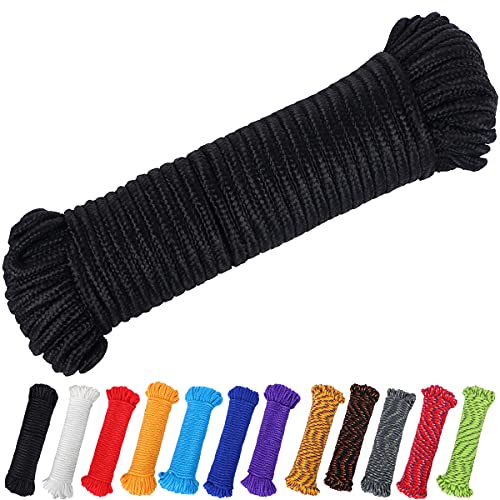
Best for: Outdoor utility tasks, including shade sail tensioning and general line work, thanks to a long 90-foot length and 1/4-inch diameter. The rope is described as diamond braided, offering good handling and knot security. Limitation: being a general utility rope, it may not offer specialized UV resistance beyond standard outdoor use.
TECEUM 100 Ft Paracord Type III 550

Best for: Survival-minded projects or camping scenarios needing a robust 550-pound-rated paracord. This Mil-Spec Type III cord uses a 32-strand sheath with a 5/32-inch diameter and is UV-resistant. Caution: paracord is flexible and thin; ensure knot strength and anchor points match the load requirements for shade sail supports.
Buying Guide: Key Considerations When Choosing Shade Sail Rope
- Material and weather resistance: Polyester and braided options resist fading, moisture, and UV exposure better than many alternatives. Look for rustproof hardware compatibility if you plan metal connectors.
- Strength and load rating: For shade sails, select ropes with higher working load limits, typically 600 pounds or more for standard installations. Paracord options may be lighter but suitable for auxiliary roles or smaller sails.
- Length and diameter: Measure the span and tension needs. Longer runs require thicker diameters or multiple segments with secure knots. A 1/4-inch diameter is common for shade sails, while 4mm paracord suits lighter tasks.
- Knot-ability and handling: Diamond braid and three-strand braids offer different knot security and ease of tying. Consider how easy it is to adjust tension after installation.
- Durability vs. ease of use: Heavier-duty ropes last longer in sun and rain but can be stiffer to handle. Lighter options may be easier to work with but may need replacement sooner in harsh environments.
- Length variety: If your project requires multiple anchor points, modular rope options or longer lengths provide flexibility without excessive joins.
What to avoid and why
- Avoid using thin, low-strength ropes for large shade sails or high-tension setups; they can snap or stretch over time.
- Avoid blends that are not proven outdoor or UV-stable for long-term use; color fade and material degradation reduce performance.
- Avoid non-mil-spec paracord for structural shade sail anchors unless the design explicitly tolerates light loads.
Installation tips for better performance
- Use proper knots and secure hardware rated for outdoor use to minimize slip and wear.
- Pre-stretch or tension the rope gradually during installation to reduce sag over time.
- Inspect connections regularly, especially after strong winds or rain events.
- Match rope diameter to the hardware and eyelets to avoid fraying and wear.
FAQ
- Q: What rope diameter is best for a standard shade sail? A: A 1/4-inch diameter is common for many shade sails, offering good strength with manageable flexibility.
- Q: Is paracord suitable for shade sails? A: Paracord Type III can be used for lightweight tasks or auxiliary lines, but for primary sail supports, higher-strength polyester braids are preferred.
- Q: How long should shade sail rope last outdoors? A: With UV-stable polyester and proper maintenance, rope can last multiple seasons, though exposure, salt, and wind can shorten life.
- Q: Should I pre-stretch the rope before mounting a shade sail? A: Yes, pre-stretching helps suppress sag and maintains tension after installation.
- Q: Can I mix rope brands on a single shade sail installation? A: Mixing brands is possible if load ratings and diameters match and hardware compatibility is ensured; otherwise, consistency reduces risk of failure.
- Q: What maintenance is recommended? A: Inspect for fraying and wear, clean off dirt, and re-tension periodically to compensate for slackening with weather changes.