Answering the demand for reliable field monitoring, the best game spy trail cameras deliver cellular connectivity, high-resolution photos, and crisp videos without constant manual card checks. This guide highlights five top options, explains who each is best for, and includes practical buying considerations to help you choose confidently. Ideal buyers range from hunters seeking seamless remote scouting to wildlife enthusiasts who want real-time updates from remote properties.
Overview table of chosen products:
| Product | Best For | Key Benefit |
|---|---|---|
| SPYPOINT Flex-M Twin Pack Cellular Trail Cameras (2) | Value-oriented cellular scouting | Free photo transmission plan with cross-carrier reliability |
| SPYPOINT Flex-M Twin Pack Cellular Trail Cameras (2) SD Cards Included | Hunting setups needing SD cards | Includes SD cards for immediate operation |
| SPYPOINT Flex-M 2-Pack and SD Card 2-Pack with LIT-22 | Extended power and memory | Includes rechargeable battery pack and SD cards |
| SPYPOINT Flex G-36 Twin Pack | High-resolution scouting | 36MP photos and 1080p video with sound |
| SPYPOINT Flex-Dark Twin Pack | No-glow night surveillance | No-glow LEDs with 40MP photos |
SPYPOINT Flex-M Twin Pack Cellular Trail Cameras

The Flex-M twin-pack is designed for hunters and property managers who want dependable cellular access with minimal setup. It uses cross-carrier monitoring to stay connected regardless of local network changes, making it best for remote sites where service can be unpredictable. The plan options include a free photo transmission plan and affordable paid tiers, enabling flexible scouting intensity. The cameras are described as easy to configure with mobile activation and on-device formatting, which helps reduce field time.
Who it’s best for: hunters who value value and low maintenance, or property owners who need reliable remote monitoring without carrier fiddling. Why selected: this model emphasizes cross-carrier stability and a no-hassles setup, plus a unique free photo transmission plan that can reduce ongoing costs.
Caution: Relying on the free plan means monthly limits exist; consider upgrading if you expect heavy scouting or multiple cameras in use at the same time. The data plan is per camera, so manage devices accordingly.
SPYPOINT Flex-M Twin Pack Cellular Trail Cameras — 2 SD Cards Included

This bundle targets shooters who want immediate use out of the box, thanks to included SD cards. The Flex-M cameras provide the same free transmission plan and cross-carrier reliability, with the SD cards ensuring you don’t wait for card formatting or compatibility steps in the field. The configuration is straightforward, and the cameras support extended autonomy when paired with solar solutions sold separately.
Who it’s best for: hunters who prefer a ready-to-run package with memory ready, or scouts who need to deploy quickly across several zones. Why selected: the SD card inclusion eliminates a common setup delay and keeps operation simple in rugged environments.
Caution: Included SD cards may vary by batch; verify card compatibility for your micrSD size and format before use to avoid formatting delays in the field.
SPYPOINT Flex-M 2-Pack With SD Card 2-Pack And LIT-22
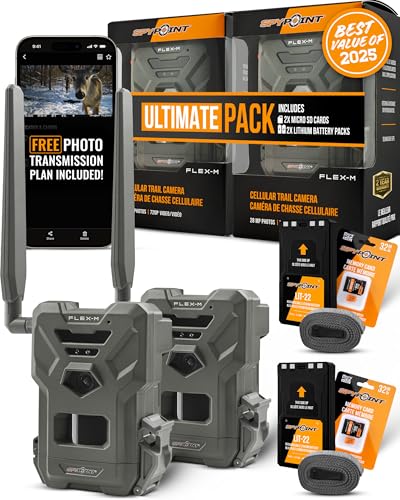
This multiple-pack option targets serious scouting operations. In addition to the core camera features, it bundles an SD card and LIT-22 rechargeable battery pack, which helps extend field life and reduces disposal waste from AA batteries. The no-wifi design keeps things simple and relies on cellular transmission for updates. The free photo transmission plan remains a key feature for ongoing scouting clarity.
Who it’s best for: multi-camera setups on larger properties or seasonal monitoring where battery life and memory are critical. Why selected: the added battery pack and SD cards deliver extended field autonomy and smoother deployment.
Caution: Rechargeable packs add upfront cost and require proper charging management in cold weather to avoid reduced performance.
SPYPOINT Flex G-36 Twin Pack

The Flex G-36 focuses on high-detail scouting with 36MP photos and 1080p video with sound. It uses cellular connectivity to push updates directly to your devices, which is advantageous for those who want to monitor activity without visiting the site frequently. The camera’s speed and sensitivity are designed to capture fast-moving wildlife and to provide clear evidence for season planning.
Who it’s best for: hunters and wildlife researchers who require ultra-crisp images and reliable sound-enabled video. Why selected: the 36MP resolution and live video features offer a level of detail that supports precise decision-making in the field.
Caution: Higher resolution can consume more data; ensure your service plan can accommodate higher transfer volumes if you operate multiple cameras in one area.
SPYPOINT Flex-Dark Twin Pack

The Flex-Dark model emphasizes no-glow night vision, which helps keep nighttime scouting discreet. It captures 40MP photos and 1080p videos with sound, and it supports multi-shot, Time-Lapse+, scheduling, and in-app mapping features. This makes it well-suited for nighttime surveillance and covert observations where game presence matters after dark.
Who it’s best for: nighttime monitoring aficionados who need stealth and high-resolution daytime and nighttime media. Why selected: the no-glow capability reduces the chance of spooking wildlife and gives precise night footage for proof and planning.
Caution: No-wifi operation relies on cellular transmission; check coverage in remote sites to ensure consistent updates.
Buying guide: key considerations for choosing a game spy trail camera
- Connectivity: Do you want cellular access in the field, or is SD-card-only data retrieval acceptable? Cellular models deliver real-time updates, while non-cell cameras require physical visits or card retrieval.
- Resolution and video quality: Higher megapixel photos (e.g., 36MP or 40MP) provide crisper images for identifying details, while 1080p videos with sound capture more context of animal behavior.
- Night vision capability: No-glow or low-glow options help minimize disturbance at dawn, dusk, or night. Consider your need for stealth versus range and image clarity.
- Power and endurance: Battery type (AA vs rechargeable packs) and solar compatibility affect field longevity. Rechargeable packs can reduce waste and maintenance but may add upfront cost.
- Memory and data plans: Look at included SD cards, as well as transmission plans. Free or low-cost monthly plans can be a strong value for light use; higher activity may require scalable options.
- Field deployment and durability: IP ratings (e.g., IP65, IP66) indicate weather resistance. Consider placement height, brush, and temperature range when planning installation.
- Ease of use: On-camera setup and mobile pairing speed up configuration. Cameras that support simple activation reduce field time and errors.
- Budget and bundle value: Bundles that include SD cards, batteries, or solar panels can save money over buying items separately, especially for multi-camera deployments.
Frequently asked questions
- What is the benefit of a no-glow night vision camera? No-glow night vision minimizes detection risk by emitting no visible light, making it suitable for discreet nocturnal surveillance.
- How does a free photo transmission plan work? A free plan lets you receive a limited number of photos per month automatically. If you need more, affordable paid tiers are available, and plans are usually per camera.
- Do these cameras require Wi-Fi? Most SPYPOINT models in this guide operate without home Wi-Fi; they use cellular networks for remote updates. Some models rely on SD cards for storage and manual data transfer.
- Is higher megapixel always better? Higher megapixels provide more detail but can increase data usage and storage needs. Consider your goal: identification versus quick scouting overview.
- What should I consider when deploying multiple cameras? Plan for battery life, memory capacity, and data plans per camera. Spread units across zones to avoid data bottlenecks and ensure coverage continuity.
- What is cross-carrier coverage? Cross-carrier coverage means the camera automatically uses the best available network, reducing the need to select a specific carrier during setup.